Get Full Government Meeting Transcripts, Videos, & Alerts Forever!
Get email alerts on the Restaurant Industry Hearing topic
No spam. Unsubscribe anytime.
San Francisco supervisors hold hearing as restaurant owners warn of closures; departments point to permitting gains but owners press for fee relief
Summary
City departments described faster online permitting, consolidation and pilot programs at a Sept. 16 hearing, but restaurateurs told supervisors that fee burdens, long conditional-use timelines and safety and housing problems are forcing closures and worsening vacancies.
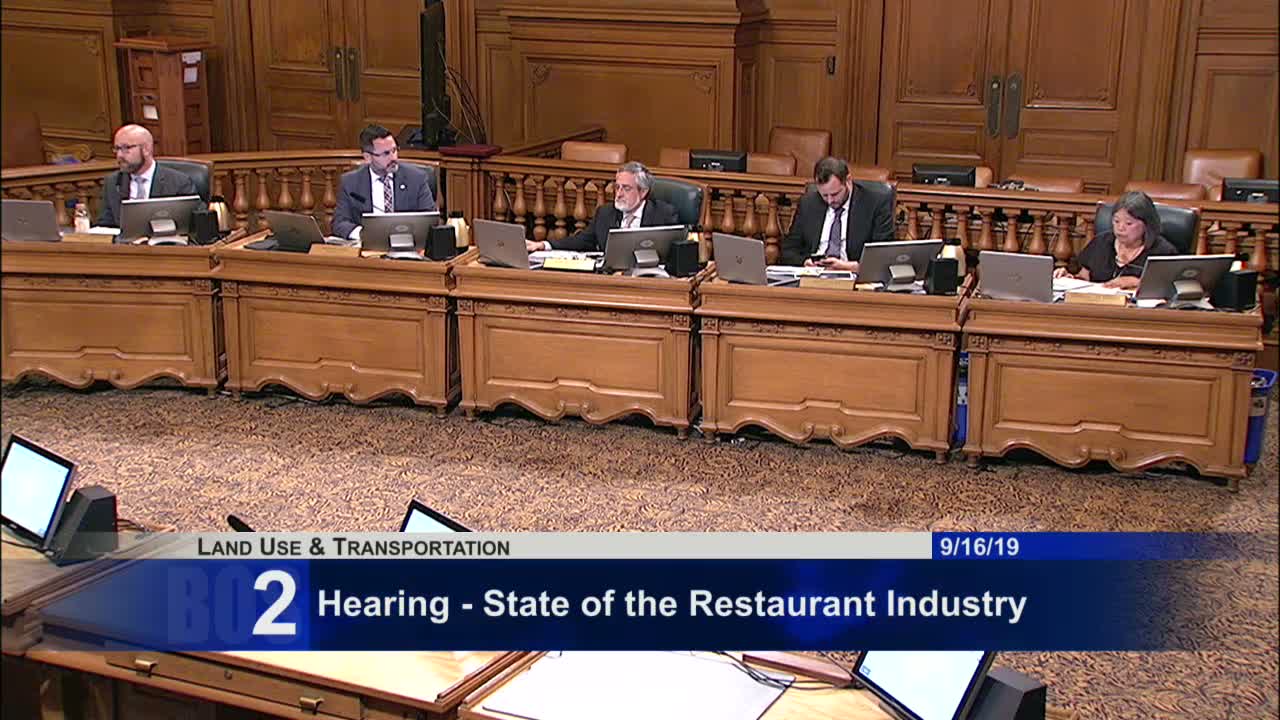
San Francisco supervisors heard roughly four hours of testimony on Sept. 16 on the precarious financial and regulatory climate facing the city’s restaurants, as department officials described recent permitting reforms while owners urged quick action on fees, access to housing for employees and street safety.
The Land Use and Transportation Committee convened for a hearing sponsored by Supervisor Sandra Lee Feuer to assess “whether departments are individually improving systems to be more user friendly and how departments collectively can provide clarity in the overall process,” Feuer said.
Laurie Thomas, policy chair of the Golden Gate Restaurant Association, told the committee the industry supports thousands of jobs but is losing ground. “Up until about two years ago, the number of restaurants opening and closing was approximately equal,” Thomas said. “But based on some numbers for Yelp, we’ve seen in the past two years, the closings outnumber the openings by about 9%.” She blamed rising rents, permitting delays, homelessness and regulatory costs, and urged the city to explore targeted tax or voucher support and changes to the Health Care Security Ordinance (HCSO).
City departments presented changes intended to shorten permitting timelines. Katie Sherping of the Office of Economic and Workforce Development described Open in SF, a single point-of-contact program that connects restaurant operators with a case manager. “Since the launch of the program at the end of 2016, 269 businesses have received assistance,” Sherping said, and the program has surfaced recurring process bottlenecks for improvement.
The Treasurer’s office and Department of Public Health described digitization efforts. Tejal Shah, chief assistant treasurer, said the consolidated online food-permit application and licensing system has reduced back-and-forth inquiries; Shah reported that more than 1,200 applications have been entered and that 647 applications were approved in less than a month after the launch of the online system.
Public Health’s Director of Environmental Health, Stephanie Cushing, said a value‑stream mapping exercise reduced the food‑permit process “from 79 steps” to “8 steps,” and the department is moving inspections to a more risk‑based model.
Department staff stressed caveats in the data: Steven Kwok of the Department of Building Inspection said the agency’s sample of roughly 900 restaurant permit applications produced an average processing time of about 44 days, but acknowledged that many operators experience long outliers that create financial strain when rent accrues during long build‑outs.
Public Works described the cafe tables-and-chairs permit program and the fee structure used for sidewalk seating: an initial base application fee of $144 plus $8 per square foot, and a lower renewal fee of $71 plus $7 per square foot; staff offered to follow up with the committee on revenue and cost-recovery figures.
Despite the departments’ reforms, owners described long, costly experiences in opening and maintaining businesses. Several public commenters reported conditional-use (CU) reviews that took more than a year; one owner said a first CU took 13 months and a second took 16 months. Others listed compounding pressures: wages, healthcare mandates, monopoly utility rates, delivery-platform commissions, and lost foot traffic tied to homelessness and safety concerns.
Supervisors voiced agreement that restaurants are vital to neighborhood vitality and that there is a need for both near-term actions and longer-term reforms. Multiple supervisors identified fee relief as a potential near-term measure—Peskin noted 22 different fees can apply to a start-up restaurant—and asked departments to return with data on fees, cost recovery and program outcomes. The committee voted to continue the hearing to the call of the chair so departments and industry stakeholders could provide follow‑up information.
Next steps: the committee asked departments to provide data on fee revenues and recovery, program evaluations for Open in SF and the online permitting system, and recommendations for targeted fee relief or administrative changes to reduce time and cost for operators.