Get Full Government Meeting Transcripts, Videos, & Alerts Forever!
Get email alerts on the Residential Care Zoning topic
No spam. Unsubscribe anytime.
Committee forwards 18‑month interim zoning controls to slow conversions of residential care facilities
Summary
The committee unanimously forwarded an 18‑month interim zoning resolution requiring conditional use authorization for conversions of residential care facilities to give the city time to prevent closures and assess capacity; sponsors cited a 26% decline in facilities since 2012 and proposed two nonsubstantive amendments.
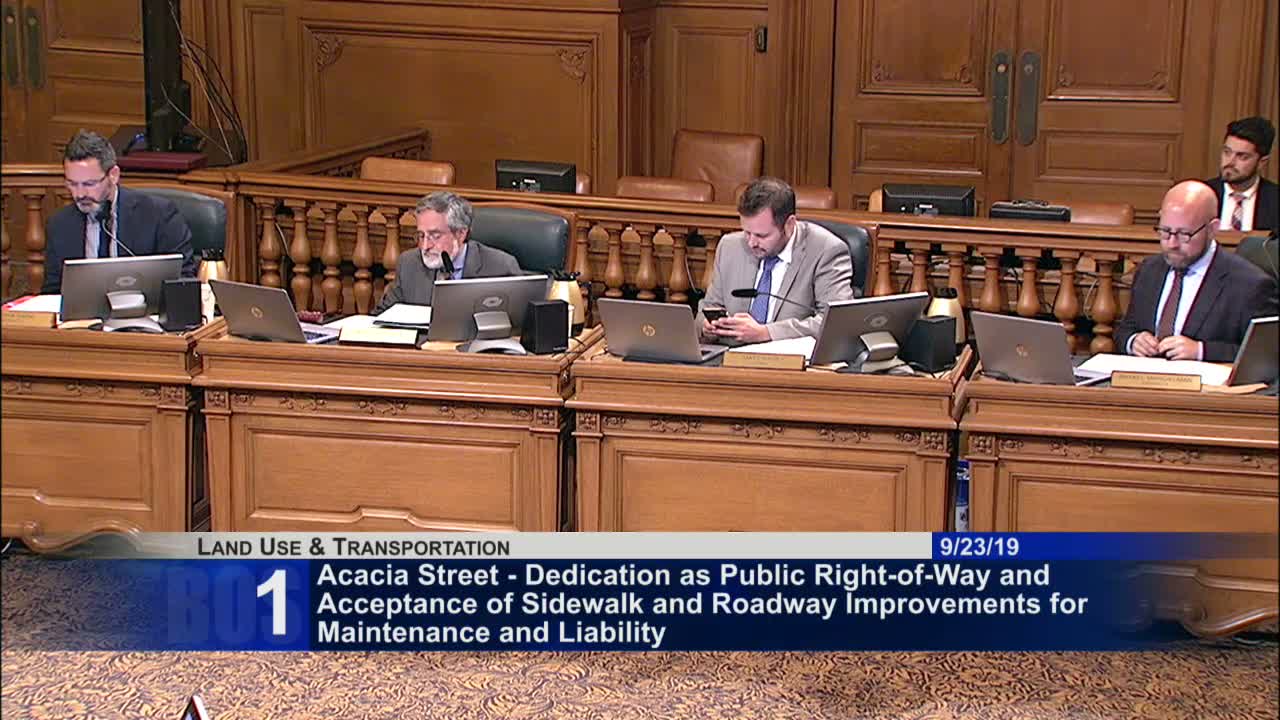
The Land Use and Transportation Committee on Sept. 23 voted to forward to the full Board of Supervisors a resolution imposing 18‑month interim zoning controls that would require conditional use authorization before a residential care facility can be converted to another use. The committee adopted two nonsubstantive drafting amendments and added co-sponsors "without objection."
Supervisor Mandelman, who introduced the resolution, said the measure is intended as "an urgently needed stop gap measure to preserve a crucial component of our city's housing stock for vulnerable disabled and elderly residents." He said the resolution responds to documented losses: "San Francisco has 21 fewer residential care facilities than we did in 2012, a 26% decline, which has resulted in a loss of 112 critically needed beds over that time." He also told the committee the Department of Public Health had learned of the imminent planned closure of three additional facilities.
The resolution would require the Planning Commission, when evaluating a proposed change of use, to consider findings by the Department of Public Health, the Human Services Agency, the Department of Aging and Adult Services, and the San Francisco Long Term Coordinating Council on the capacity of existing residential care uses, the populations served and the nature and quality of services; the impact on the neighborhood; whether sufficient licensed beds exist within a one‑mile radius; and whether the use will be relocated or replaced.
Supervisor Mandelman offered two amendments he described as nonsubstantive: one to clarify that the controls apply to residential care facilities established with or without permits, and a second to correct a drafting error in how a Planning Code section was cited. Claire Lindsey, senior health planner at the Department of Public Health, testified that DPH supports the interim controls and that the department "is supportive of this legislation as it aids to preserve the current stock and control the conversion of San Francisco's residential care facilities."
Vice Chair Asha Safaie and Supervisor Matt Haney both voiced support, with Safaie urging the Department of Public Health to ensure reimbursements are sufficient to keep small, privately run operators financially viable and asking staff for an inventory of how many residential care facilities remain and where they are located. Haney asked to be added as a co-sponsor. The committee adopted the amendments and forwarded the resolution to the full Board as amended with a positive recommendation; no roll-call vote was recorded in the transcript.
If approved by the Board, the interim controls would pause discretionary conversions for 18 months to give the city time to consider long-term strategies including potential acquisition of small sites and funding support for operators.