Get Full Government Meeting Transcripts, Videos, & Alerts Forever!
Get email alerts on the Renewable Electricity topic
No spam. Unsubscribe anytime.
Supervisor committee advances ordinance requiring large nonresidential buildings to source 100% renewable electricity
Summary
The Land Use and Transportation Committee forwarded an ordinance that would require nonresidential buildings of 50,000 sq ft and larger to meet on-site electricity demand with 100% greenhouse-gas-free or renewable sources, phased in by size through 2030; the item moves to the full Board with recommended amendments.
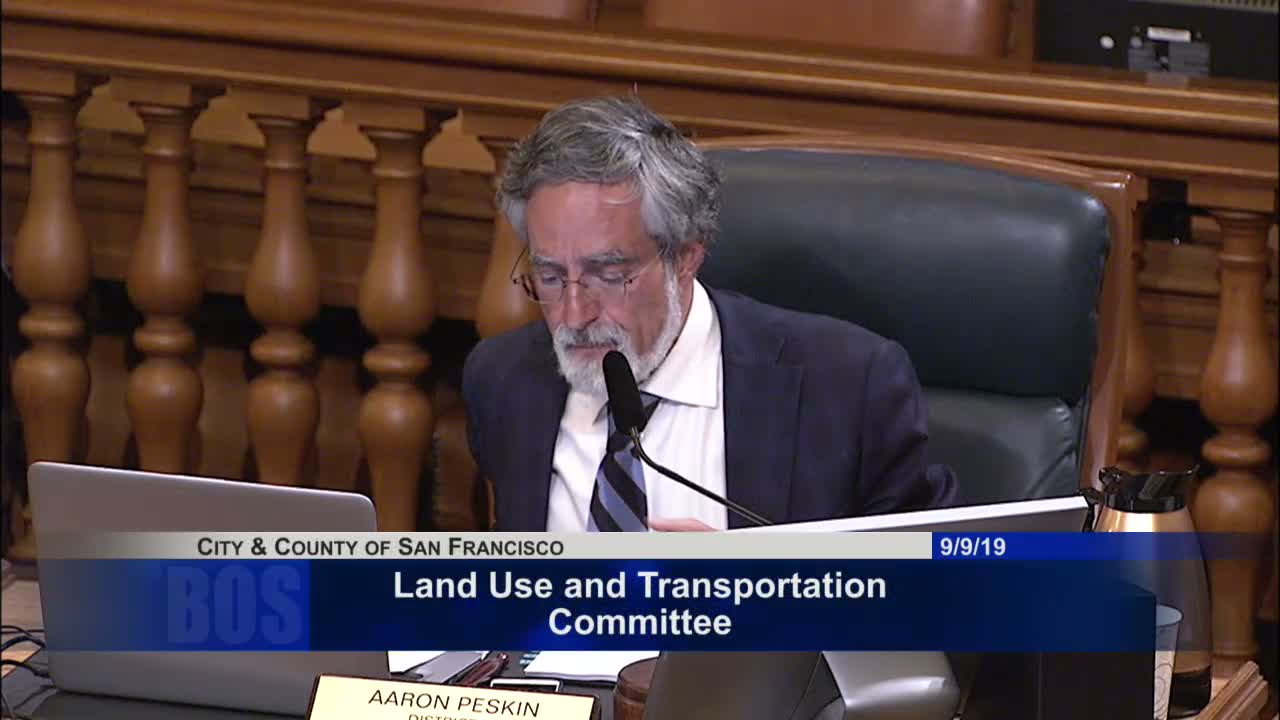
The Land Use and Transportation Committee on Thursday advanced an ordinance that would require large nonresidential buildings in San Francisco to meet on-site electricity demand with 100% greenhouse-gas-free or renewable resources. Committee members adopted clerks' clarifying amendments without objection and forwarded the measure to the full Board of Supervisors with a positive recommendation.
Department of the Environment staff described the ordinance as a targeted, phased approach aimed at large commercial buildings that, while a small share of the building stock, account for a disproportionate share of commercial-sector electricity use. "The proposal is very simple. It's to require that they purchase a 100% renewable electricity," said Barry Hooper, senior green building coordinator for the Department of the Environment.
Hooper said the proposal would initially apply to buildings 500,000 square feet and larger in 2022, expand to buildings 250,000 square feet and larger in 2024, and include buildings 50,000 square feet and larger by 2030. He told the committee that the affected buildings represent roughly 9% of commercial buildings but consume about 73% of the sector's electricity. Hooper said the shift could reduce roughly 150,000 tons of CO2 emissions per year attributed to electricity for those buildings.
City staff emphasized the ordinance is intended to be implementable without major technical retrofits for many buildings: owners could comply by purchasing qualifying renewable electricity products or by installing on-site generation. Hooper said market options have become more affordable since CleanPowerSF introduced a higher-tier product, noting the incremental cost over default service has fallen substantially from earlier estimates — historically cited at about 2¢ per kilowatt-hour — and that CleanPowerSF and PG&E products often show incremental costs in the low single digits (frequently around 1%).
Charles Sheehan of the Department of the Environment briefed the committee on clerks' amendments that align the ordinance's definitions with state law. "We're tightening language and bringing us more in alignment with the state's definition of renewable energy," Sheehan said, adding that the revised language makes clear that Hetch Hetchy power may qualify under state rules and count toward the requirement.
Michael Himes of CleanPowerSF told the committee his agency supported the alignment with state law. After public comment — a single speaker urged on-site solar and storage rather than purchasing utility products — Supervisor Matt Haney moved to adopt the non-substantive amendments; the motion passed without objection. The committee listed Supervisor Safaie, Chair Erin Peskin and Supervisor Haney as cosponsors and forwarded the item to the full Board with a positive recommendation.
Next steps: the ordinance will be considered by the full Board of Supervisors; the committee record indicated the item will appear on the Board agenda on Sept. 17.