Get Full Government Meeting Transcripts, Videos, & Alerts Forever!
Get email alerts on the Urban Forestry topic
No spam. Unsubscribe anytime.
Board committee hears stark warnings on tree canopy shortfall and seeks funding and data to reverse losses
Summary
Departments and community groups told the committee that San Francisco’s urban canopy is shrinking despite new maintenance funding; presenters called for dedicated planting funds, a better tree‑management database, and an equity‑focused planting strategy.
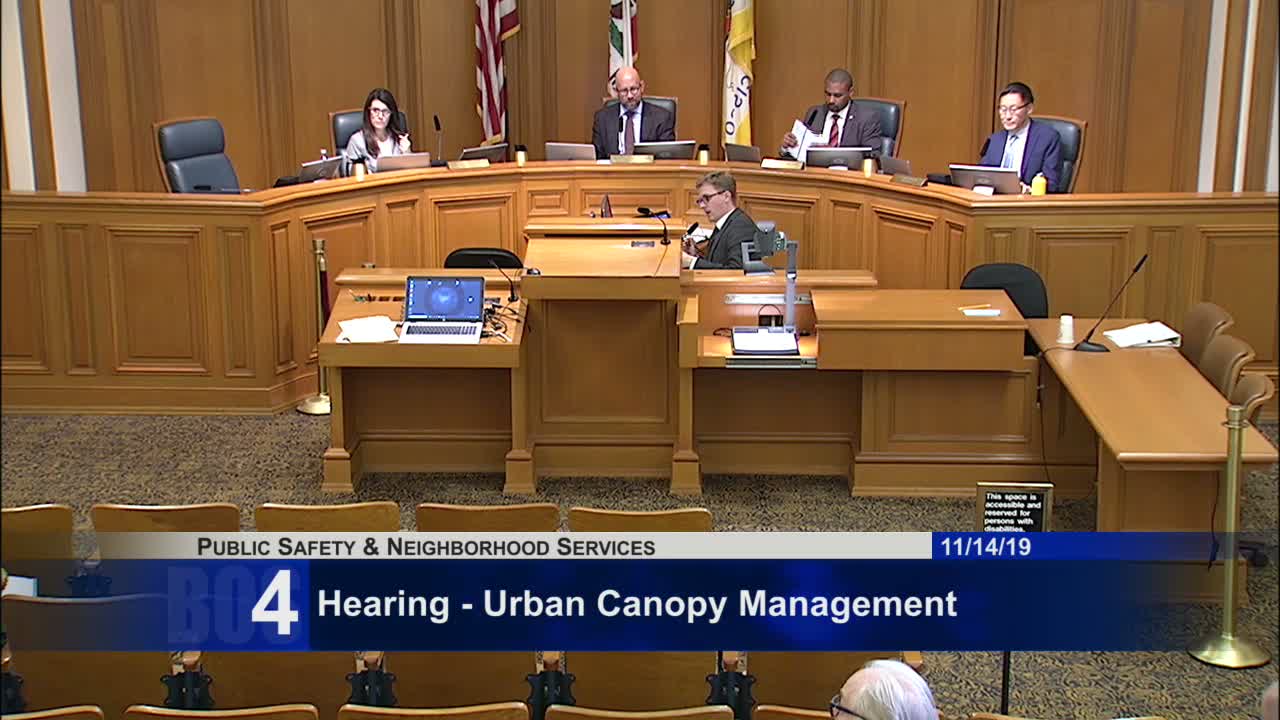
The committee on Nov. 14 held a wide‑ranging hearing on the city’s urban canopy and the planting, removal and maintenance of trees on public property, hearing presentations from the Department of the Environment, Urban Forestry Council, Bureau of Urban Forestry/Public Works (Street Tree SF), Rec & Park, and the Public Utilities Commission, and extensive public comment urging urgent action.
Dan Flanagan, chair of the Urban Forest Council, said San Francisco has roughly 124,000 street trees and estimated opportunity sites of 35,000–40,000 more, but noted the city removed nearly twice as many trees last year as it planted and identified a backlog of trees in need of removal or remediation from deferred maintenance. Flanagan and other presenters credited the 2016 Prop E measure with establishing a dedicated funding source for maintenance but said planting funds remain inadequate; Friends of the Urban Forest and the Bureau of Urban Forestry estimated it costs about $2,000 to plant and establish a street tree over three years.
Public Works staff explained Street Tree SF made the city responsible for maintaining trees historically managed by property owners, which has the near‑term effect of more removals as unsafe trees are corrected, and outlined a canopy growth strategy that prioritizes neighborhoods with low canopy (Southeast, South of Market, Outer Sunset) and replacement plantings as removals occur. Rec & Park described its parkland reforestation goal of planting two trees for every one removed (parkwide, not necessarily at the same site) and noted constraints from park uses and native-vegetation protection. PUC said some reservoir lands require tree removal for dam safety per the state Division of Safety of Dams (DSOD) and that PUC is restoring native watershed vegetation on some sites in lieu of replanting trees.
Speakers and public commenters urged stronger funding (estimates ranged to $8 million per year to substantially expand plantings), improved data and an urban-forestry management database, equity in where new trees are planted, and better communication with neighborhoods when removals are proposed. The committee filed the hearing record for follow up.