Get Full Government Meeting Transcripts, Videos, & Alerts Forever!
Get email alerts on the Small Business Amnesty Active Space topic
No spam. Unsubscribe anytime.
Supervisor Ronan’s amnesty bill clears committee after extensive tenant testimony
Summary
The committee forwarded legislation to legalize current uses at 3150 Eighteenth Street for a limited period, offering a 10‑year amnesty for non‑office uses and a 3‑year allowance for office uses while requiring permits and landlord notice provisions.
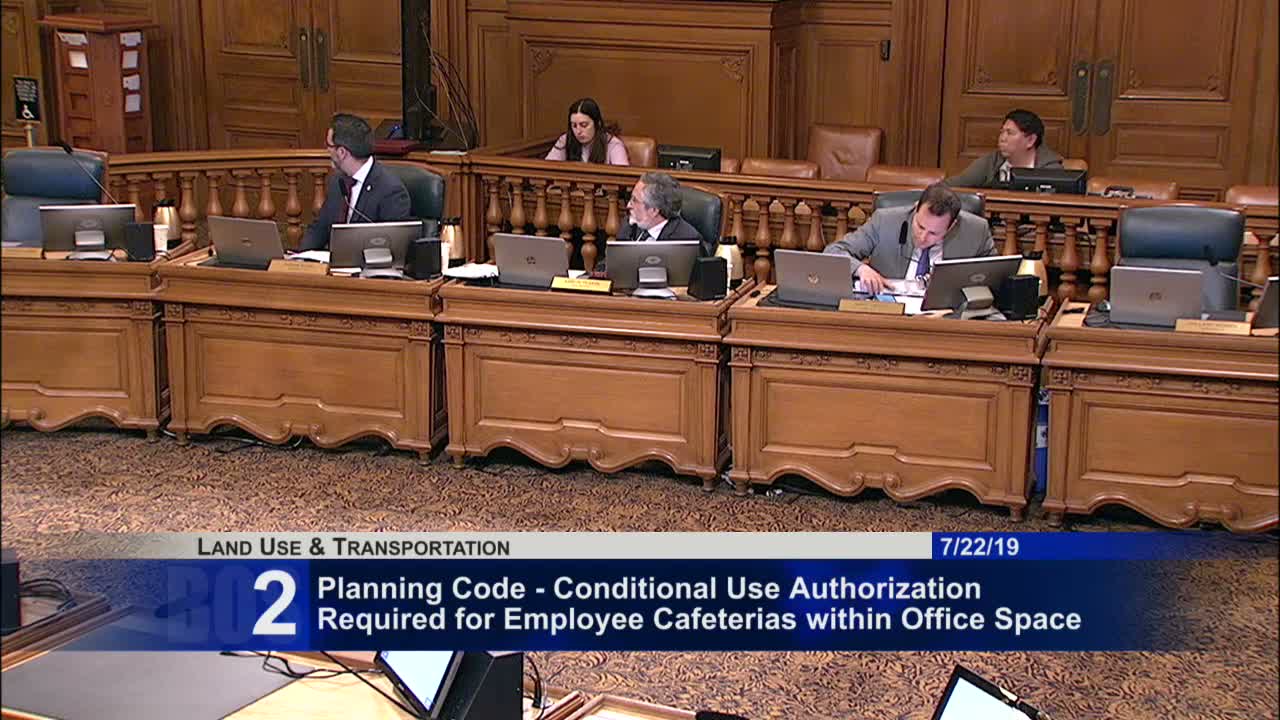
The Land Use and Transportation Committee on July 22 advanced an ordinance sponsored by Supervisor Hillary Ronan to create a legitimization (amnesty) program for tenants at Active Space, 3150 Eighteenth Street in the Mission District.
Ronan told the committee that more than 150 businesses faced closure or fines earlier in the year after zoning restrictions were enforced. The proposed ordinance would allow existing nonconforming personal‑service and similar uses at the building to remain as legal nonconforming uses for up to 10 years, provided tenants file appropriate permit applications. The planning commission had recommended a shorter period for office uses; Ronan introduced an amendment to allow office uses a 3‑year legitimization term and asked the Office of Small Business to assist tenants in navigating the permitting process.
Dominica (transcript also shows "Diminetta") Donovan of the Office of Small Business told the committee the Small Business Commission supported the legislation and estimated the program would prevent displacement or closure of approximately 200 small and independently owned enterprises at the site. Planning staff said most units in the building lacked establishment‑of‑use permits and that administrative or building permit fees could vary by unit depending on prior unpermitted alterations.
Dozens of tenants — massage therapists, therapists, tattoo artists, hairstylists, and other small proprietors — provided public comment describing how Active Space made it possible for small, minority‑ and women‑owned businesses and providers serving vulnerable clients to operate in San Francisco. Speakers requested that the committee maximize tenure protections (some asked for perpetual grandfathering) and minimize fees; Ronan and committee members discussed options such as grouping similar uses to apply together to reduce per‑business fees and a clause to require landlords to notify prospective tenants in writing about allowed uses.
Deputy City Attorney John Givner said the city attorney’s office was working on enforcement with respect to the property owner and would follow up with the sponsor’s office. Chair Aaron Peskin and other supervisors characterized the landlord’s conduct as misleading tenants and emphasized the need both to protect PDR (production, distribution, repair) zoning and to mitigate mass displacement.
The committee accepted Ronan’s amendments and agreed to forward the item as a committee report with a positive recommendation for the Board of Supervisors hearing the following day.
Next steps: the ordinance will be considered by the full Board of Supervisors on the first reading schedule; committee minutes indicate additional follow‑through with the City Attorney’s Office about enforcement against the landlord.