Get Full Government Meeting Transcripts, Videos, & Alerts Forever!
Get email alerts on the Conservatorship topic
No spam. Unsubscribe anytime.
Supervisors review conservatorship data and gaps in beds and placements
Summary
Committee heard a BLA report finding prior state data undercounted San Francisco conservatorships, discussed declines in referrals after 2012, and pressed city agencies on shortages of locked subacute beds and the need for formal data-sharing and outcome measures.
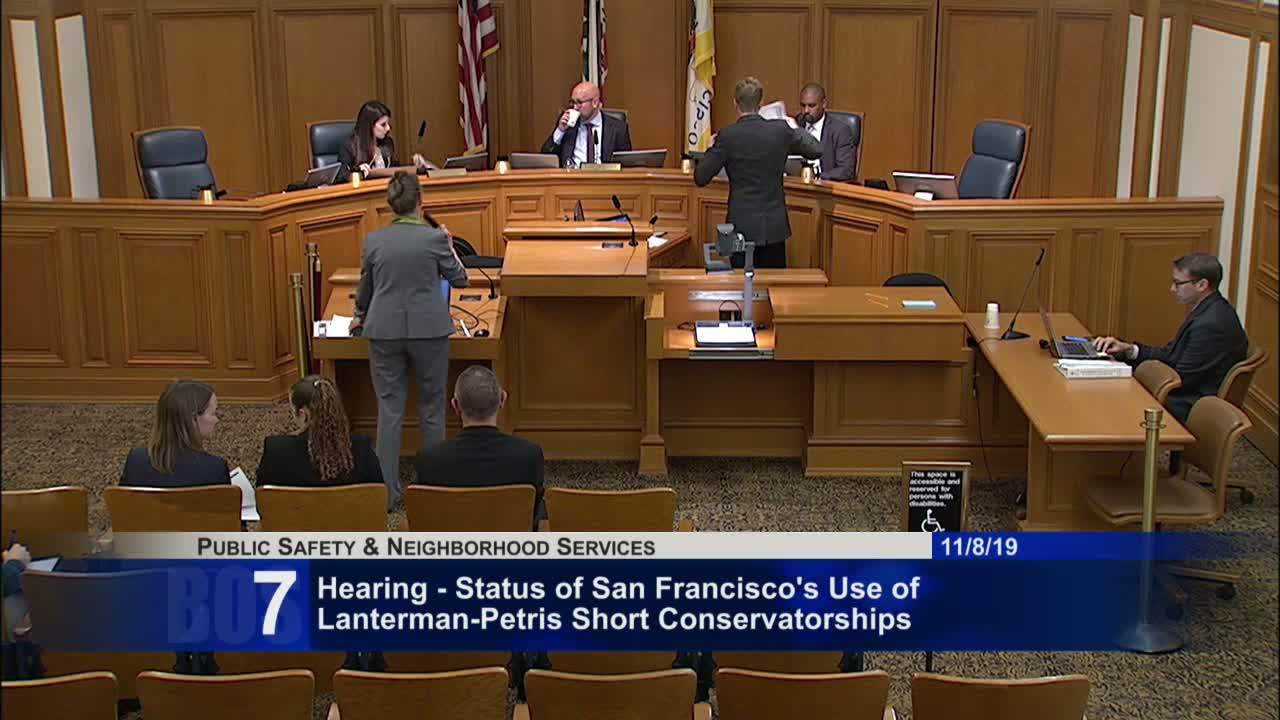
The Public Safety Committee on Nov. 8 held a hearing on the Budget and Legislative Analyst—s report examining Lanterman-Petris-Short (LPS) conservatorships in San Francisco, where analysts, public-health officials and hospital psychiatrists detailed reporting errors, shifts in referrals and a shortage of post-acute beds.
Severin Campbell of the Budget and Legislative Analyst—s office told supervisors that state-published figures understated San Francisco—s conservatorship caseload because the county had been reporting only new referrals rather than new and reestablished conservatorships; after consulting the Superior Court and a survey of other counties, the BLA concluded San Francisco—s actual conservatorship rate is higher than previously reported.
Campbell and other presenters documented a 13% decline in unduplicated conservatorship clients between 2012 and the report period driven by fewer new referrals earlier in the period, while noting a recent uptick in referrals. The report pointed to several possible drivers: the 2015 Welfare and Institutions Code change allowing longer holds outside the conservatorship process (W&I Sec. 5270), budget constraints and policy shifts favoring community-based, less-restrictive care. The BLA recommended data-sharing agreements, a formal MOU between DPH and the Office of Public Conservator to establish clinical assessment standards, improved outcome metrics and evaluation of community-based conservatorship models.
Department of Public Health and Office of Public Conservator staff provided corrected data and described innovations including community-based conservatorship pilots and the new housing conservatorship pilot. DPH said the city had about 617 individuals under temporary or permanent conservatorship at the July 2019 point-in-time count and that the department is working to correct state reporting to the Department of Health Care Services.
Psychiatric leaders described capacity gaps. Dr. Mark Leary, interim chief of psychiatry at Zuckerberg San Francisco General, said the hospital often has about 20 patients in locked acute units awaiting locked subacute placement and that wait times average roughly 51 days, creating a "choke point" in system flow. Leary said lack of locked subacute capacity and placement options constrains the ability to move patients through the system and can affect decisions about when to pursue conservatorship.
Supervisors pressed agencies about racial disparities (DPH said African Americans represented close to 20% of the conservatorship caseload in certain analyses), bed counts and the need for consistent reporting. The committee accepted the hearing—s record as "heard and filed." The BLA agreed to update the report—s comparative numbers after incorporating corrections from county and court sources.