Get Full Government Meeting Transcripts, Videos, & Alerts Forever!
Get email alerts on the Emergency Firefighting Water System topic
No spam. Unsubscribe anytime.
Supervisors back urgent plan to expand emergency firefighting water system across San Francisco
Summary
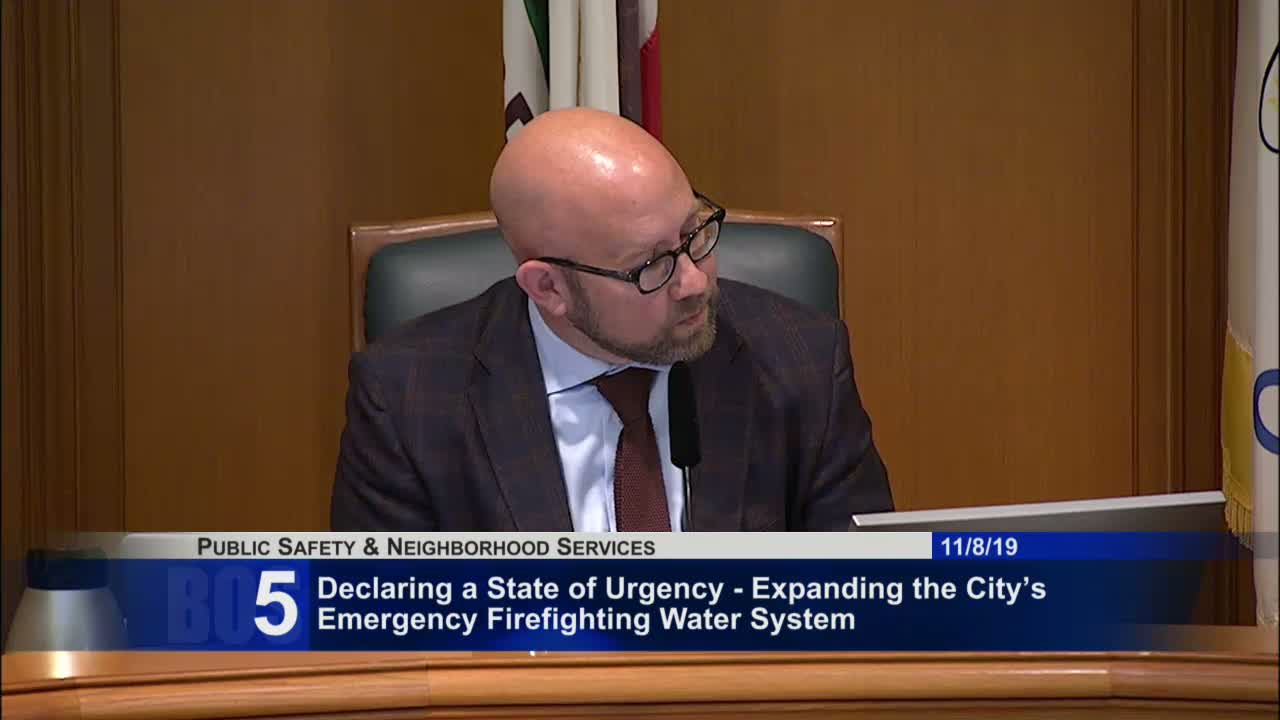
The Public Safety Committee unanimously forwarded a resolution urging a citywide plan to expand San Francisco—s Emergency Firefighting Water System, directing studies on seawater pump stations, neighborhood needs analysis, and interim portable apparatus as officials warned one-third of the city lacks EFWS protection.
San Francisco—s Public Safety and Neighborhood Services Committee on Nov. 8 advanced a resolution seeking urgent action to extend the city—s Emergency Firefighting Water System (EFWS) to neighborhoods currently unprotected by high-pressure pipelines.
Supervisor Matt (Marr) introduced the resolution, saying the EFWS "includes 135 miles of high pressure pipelines and 2 saltwater pumping stations" and that "one third of the city is not protected by the EFWS," leaving many western and southern neighborhoods vulnerable in a major earthquake and resulting fires.
The resolution directs the San Francisco Public Utilities Commission (SFPUC) and department partners to complete several deliverables: by June 30, 2021, complete a feasibility study for a West-Side saltwater pump station and a neighborhood-level analysis of EFWS needs; by Dec. 31, 2021, develop a comprehensive EFWS action plan, including funding strategies; and to aim for citywide EFWS delivery by June 30, 2034. John Scarpulla of the SFPUC said the PUC will use updated hydraulic and ignition modeling and provide quarterly updates to the PUC citizens advisory committee and the Board.
Officials emphasized stabilizing existing infrastructure before expansion, noting prior bond investments to upgrade reservoirs and pump stations. The Fire Department described the role of "host tenders," portable apparatus that can transport large volumes of water above ground; the department said five such units are funded and spec—ied for procurement now and that roughly 15 additional units would be needed to address immediate gaps.
Community speakers urged faster, larger-scale action. Nancy Werfel told the committee the resolution is "a good start...but it does not go far enough or fast enough," and urged commitments on additional pump stations, backup power planning for PG&E shutoffs, and potable-water contingencies. Eileen Bogan and other community members asked the city to add parks such as Stern Grove to risk modeling and pursue short-term measures beyond host tenders.
Supervisors discussed funding trade-offs and noted a proposed $154 million bond in spring 2020 as a first step. The committee voted to forward the resolution to the full Board of Supervisors with a positive recommendation without objection. The full board will consider any technical amendments and timing of bond proposals and procurement.