Get Full Government Meeting Transcripts, Videos, & Alerts Forever!
Get email alerts on the Treatment On Demand topic
No spam. Unsubscribe anytime.
Supervisors press DPH, providers on gaps in 'treatment on demand' under Proposition T
Summary
At a Sept. 27 committee hearing, San Francisco supervisors heard DPH and providers say treatment capacity has expanded but faces intake, eligibility and outreach barriers; advocates and people with lived experience disputed reports that demand is met and called for an independent audit and a Treatment on Demand task force.
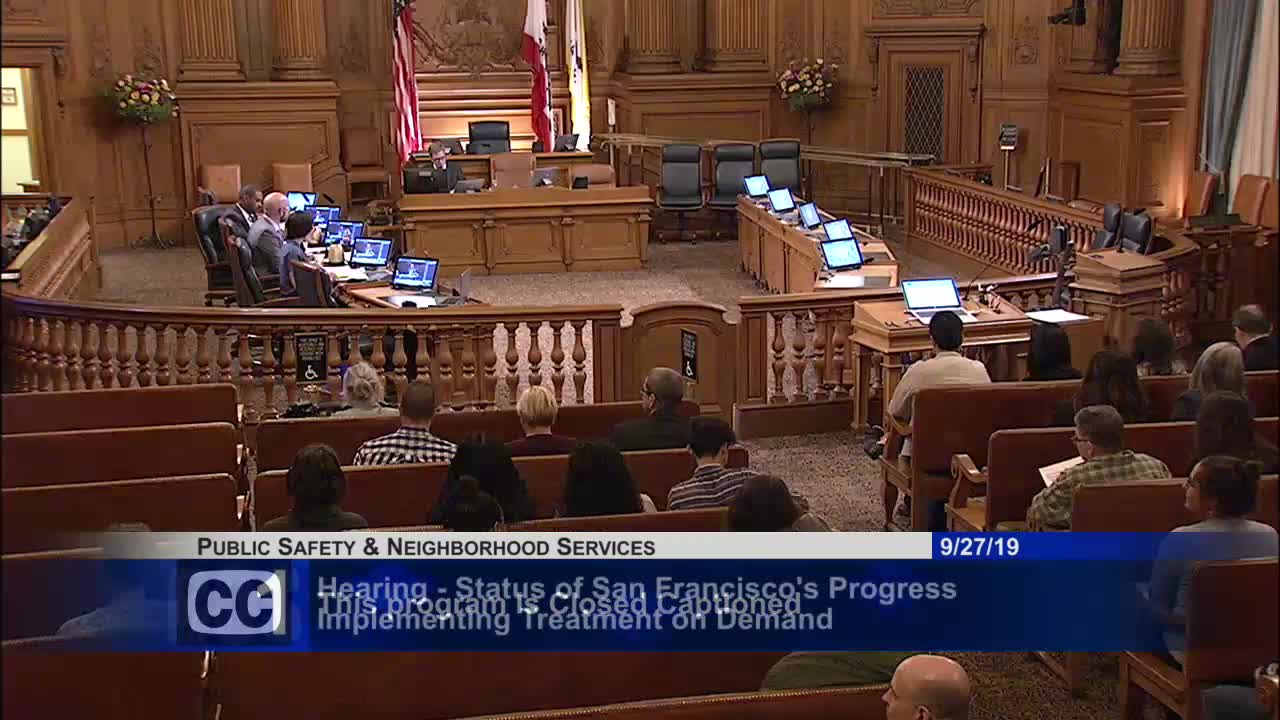
SAN FRANCISCO — The Public Safety and Neighborhood Services Committee held a special Sept. 27 hearing to examine how the city is meeting Proposition T (2008) commitments to provide free and low-cost substance use treatment "commensurate with demand." Committee Chair Supervisor Rafael Mandelmann opened the hearing by recounting the measure's history and asking for a clear accounting of progress and remaining gaps.
Dr. Judith Martin of the Department of Public Health told supervisors that the city served 6,005 clients in 2018—, nearly all adults and 56 percent experiencing homelessness, and described the Drug Medi-Cal Organized Delivery System (DMC-ODS) implementation, external quality review, and a projection of 212 new behavioral-health beds through 2020. ‘‘We have proven access for opioid use disorder treatment," Martin said, while also noting a rise in methamphetamine-related overdoses in 2017— and 2018.
Supervisors pushed Martin on whether the city's measures actually capture unmet need. "A walk on the streets of San Francisco would suggest not that well," Mandelmann said in framing the hearing; Supervisor Haney asked whether DPH's conclusion that demand is met reflects how the city counts only people who show up and complete intake rather than those who drop out, are unsheltered or lack phone access. Martin acknowledged limits in measurement methods and said some people may drop out during intake; she pointed to residential-treatment medians of about four days and argued the system is faster than in the past.
Providers described operational obstacles that they say prevent existing capacity from serving people who are unsheltered or justice-involved. Vitka Eisen, CEO of HealthRight 360, outlined an intake workflow where eligibility checks, transfers of Medi-Cal enrollment and county review (TAP) can create multiple "drop-off" points. "We can place people in the same day for detox, but when we have to send someone over to Harrison Street for Medi-Cal enrollment, we lose people," Eisen said, explaining why some residential beds sit vacant even while people on the street remain untreated.
Scott Arai of Positive Resource Center and representatives from the Stonewall Project and UCSF Citywide Case Management emphasized that many clients have co-occurring mental illness and need step-down housing and case management after residential treatment. Dr. Fumi Mitsueishi of Citywide urged more "pretreatment" outreach—engagement and low-threshold services that are not reimbursed by Medi-Cal—to reach people who "can't knock on the door."
Advocates and people with lived experience filled the public-comment portion with sharp critiques of DPH reporting and urgent calls for change. Javier Vermaan of the Treatment on Demand coalition said the city has not provided the required independent reports and called for an externally overseen task force. "We need an independent look at what is really happening and why people are not getting services," Vermaan said. Several public speakers — including case workers and people who have been homeless or in recovery — said the July report claiming little or no wait for residential beds contradicts everyday experience: workers escorting clients to TAP and hospitals reported month-long waits for justice-involved clients and frequent loss of clients during multi-step intake.
The committee did not adopt a new funding measure at the hearing, but Chair Mandelmann moved that the hearing be "heard and filed," a motion taken without objection. Supervisors signaled interest in further oversight: several called for a task force or independent audit, clearer wait-list tracking, and budget proposals that prioritize staffing, site-based eligibility workers and low-threshold outreach.
What happens next: supervisors said they will continue related policy work and that proposals including Mental Health SF and other budget items will intersect with treatment-on-demand planning. Advocates pressed the board to require an independent evaluation of how DPH measures demand and to add explicit budget line items for pretreatment, intake navigation and step-down housing.
Sources: presentations and Q&A by Dr. Judith Martin (Department of Public Health), Vitka Eisen (HealthRight 360), Dr. Scott Arai (PRC/Baker Places), Mike Disipolo (Stonewall Project), Dr. Fumi Mitsueishi (UCSF Citywide), testimony from the Treatment on Demand coalition and two dozen public-commenters.