Get Full Government Meeting Transcripts, Videos, & Alerts Forever!
Get email alerts on the Homelessness topic
No spam. Unsubscribe anytime.
Supervisors hear gaps in San Francisco’s system for people released from psychiatric holds; departments outline pilots and bed expansions
Summary
The Public Safety and Neighborhood Services Committee probed how city departments coordinate care for people with mental‑health and substance‑use challenges exiting hospitals, with officials noting program expansions (Hummingbird Place, Healing Center), new data tracking and pilots but persistent gaps in low‑barrier psych respite and locked subacute beds. The committee continued the item for follow‑up data.
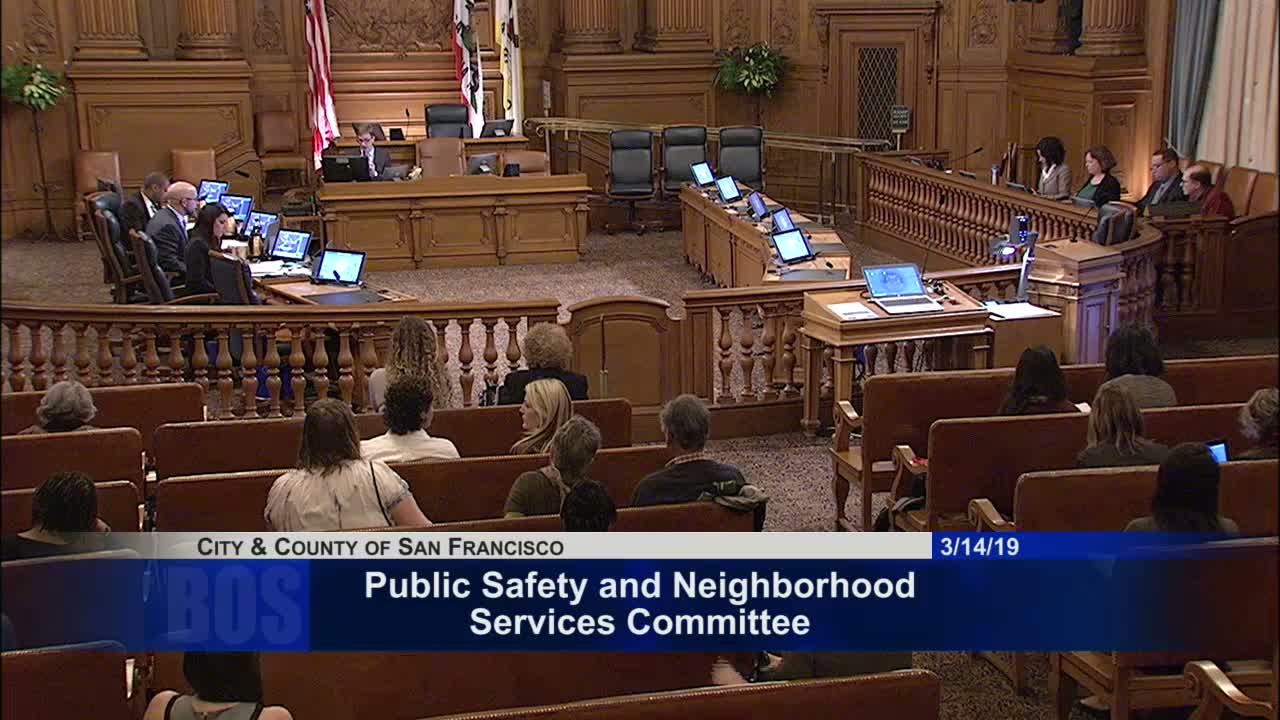
Supervisor 'Catherine Stephanie' opened the March 14 Public Safety and Neighborhood Services Committee hearing saying a repeated street encounter with a distressed person prompted her to examine how city departments handle coordinated exit from hospitals, including the 5150 process under the Welfare and Institutions Code.
"We talk a lot about coordinated entry but not coordinated exit," she said, adding the goal of reducing the hospital-to-street revolving door and identifying what additional services or beds are needed.
Department officials and hospital clinicians described a multiagency system that has improved interagency coordination but lacks capacity at several lower levels of care. Dr. Barry Zevin, medical director of Street Medicine at the Department of Public Health, opened with a case study of a patient identified as "John T.," a 34‑year‑old man who engaged with street medicine, a low‑barrier buprenorphine pilot and medical respite and is now in the permanent‑supportive‑housing pipeline. Zevin used the case to illustrate how repeated outreach and multiagency supports can stabilize high‑risk individuals.
Roland Pickens, director of the San Francisco Health Network, described the Healthy Streets Operation Center (HSOC) as an "air traffic control" that routes nonemergency calls to the most appropriate first responder (HOT outreach teams, street medicine, EMS or police). Pickens said co‑location of the Treatment Access Program (TAP) and the Behavioral Health Access Center (BHAC) at 1380 Howard allows clinicians to decide whether a person’s primary need is substance‑use or mental‑health treatment.
Officials walked supervisors through the system map: street outreach, TAP/BHAC assessments, navigation centers, residential treatment placements (including HealthRight 360 and Progress Foundation programs) and the housing ladder into permanent supportive housing. Hummingbird Place — a low‑barrier psych respite that opened with 15 beds — has been expanded and was reported during the hearing at 29 beds, and the Healing Center (a collaboration with UCSF and Dignity Health) was reported to have expanded from 40 beds to 54. HSH also said it expects 72 new transitional housing beds for clients receiving substance‑use services to open in July.
Despite these additions, departments identified key shortfalls. DPH and HSH officials said the system needs more psych respite and locked subacute (LSAT) beds and more community‑based residential care options that can serve people with dual diagnoses (severe mental illness plus substance use). Dr. Mark Leary, who operates Psychiatric Emergency Services (PES) at San Francisco General, addressed a disputed audit figure about PES referrals: the 38 percent 'no referral' figure in a draft audit was attributed in part to a drop‑down coding artifact in clinical records, and Leary said PES gives a referral to outpatient services to people discharged who are not admitted to inpatient units. He added that social‑work staffing at PES is being increased and that psychiatric nurses play a primary role arranging follow‑up, though data gaps remain about how many people complete those referrals in practice.
Human Services Agency Deputy Director Susie Smith outlined benefits‑linkage pilots that outstation eligibility workers at navigation centers and shelters, reporting high approval rates in early pilot data and a $2.4 million Housing and Disability Advocacy Program (HDAP) grant that has so far housed 13 people and advanced several SSI applications. HSH Deputy Director Carrie Abbott described coordinated entry as a system with just over 6,000 people assessed (roughly 4,700 adults and 1,500 family members), and said prioritization tools are being refined to surface people most in need of permanent supportive housing.
Supervisors pressed for more precise metrics: average wait times for residential treatment beds (mental‑health residential waits were estimated in some exchanges at weeks to months), the number of PES discharges who are homeless, and estimates of how many low‑barrier beds would be required to substantially reduce returns to the street. DPH staff said follow‑up tracking is being improved and committed to providing more precise numbers on bed counts, waits and costs of alternatives to inpatient care.
Public commenters — including clinicians, people with lived experience and advocacy organizations — urged expanding voluntary, community‑based supports, more intensive case management that meets people where they are, and additional deeply affordable housing rather than expanding involuntary conservatorship authority. Several speakers warned against relying on expanded conservatorship (referred to in the hearing as SB 10 45 in the transcript) without adding treatment capacity.
The committee did not take a final action on policy at the hearing. Chair Mandelmann moved, and members agreed without objection, to continue the item to the call of the chair and to request follow‑up data from DPH, HSH and HSA on bed inventories, average wait times, PES follow‑up rates and the estimated resources required to expand low‑barrier psych respite and locked subacute capacity.