Get Full Government Meeting Transcripts, Videos, & Alerts Forever!
Get email alerts on the Education Funding topic
No spam. Unsubscribe anytime.
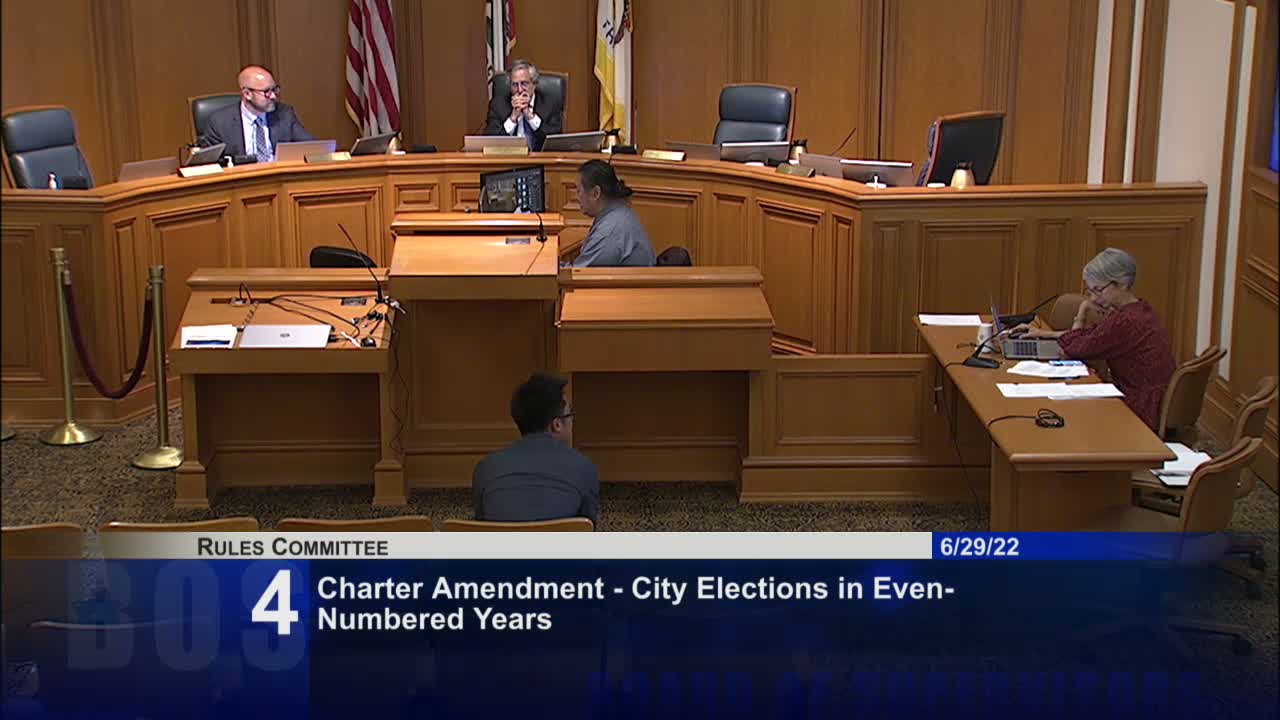
Rules Committee adopts amendments and continues Student Success Fund charter measure after overwhelming public support and labor negotiations
Summary
Supervisors Ronan and Melgar introduced a Student Success Fund to provide up to $60 million a year for evidence‑based academic and social‑emotional interventions in SFUSD schools. The measure drew broad support from educators, parents, community organizations and many labor leaders; authors adopted multiple amendments on administration, outcomes, and recessionary protections and continued the item to July 6 to finalize language with unions.
Supervisor Hillary Ronan presented a charter amendment to create a Student Success Fund administered by the Department of Children, Youth and Their Families (DCYF) to provide multi‑year grants (up to $1,000,000 per school) for programs that raise academic achievement or social‑emotional wellness for pre‑K–12 schools. Ronan and co‑sponsors said the fund would be prioritized for the district’s lowest‑performing schools and include robust outcome measures, data sharing, and joint governance between DCYF and SFUSD.
Maria Hsu (DCYF Director) described DCYF’s role as grant administrator and emphasized partnerships with schools, parents, after‑school providers and community‑based organizations. Incoming Superintendent Matt Wayne (appearing remotely) and multiple school board members said the fund would help the district deliver evidence‑based interventions and sustain successful pilots that expired when prior grant funding ended.
The proposed funding plan ramps up to $60,000,000 per year over several years and includes a reserve and a recessionary trigger: authors added a mechanism allowing the Board to reduce allocations to a floor amount if the City projects a large discretionary shortfall (e.g., $200,000,000) so that essential city services are protected. The package also included caps on administration (not to exceed 3.5% for DCYF and SFUSD each), clarified that the fund will not pay for core district obligations, and established reporting and evaluation requirements.
Public comment was substantial and overwhelmingly supportive, with parents, educators, community organizations, school board commissioners and many union representatives urging adoption. Labor representatives and unions expressed general support for the program’s goals but sought stronger protections to ensure the fund does not force layoffs if the ERAF (Educational Revenue Augmentation Fund) is reduced or eliminated; labor submitted a set of proposed funding amendments that would prioritize ERAF as the near‑term source and add reserves and ramp schedules to reduce general fund risk.
Ronan said she and co‑sponsors had offered multiple compromises (floor levels, ramp adjustments, CPI caps, reserve language and a built‑in trigger if ERAF disappears) but could not reach full agreement ahead of the committee meeting. The committee adopted the authors’ technical and programmatic amendments and continued the item to July 6 for finalization after additional labor consultations.
If adopted by voters, the Student Success Fund would create a multi‑year, city‑funded grant program intended to institutionalize community‑schools models and sustain interventions that have demonstrably improved reading and math outcomes at pilot sites.