Get Full Government Meeting Transcripts, Videos, & Alerts Forever!
Get email alerts on the Local Budget Revenue topic
No spam. Unsubscribe anytime.
Supervisors advance payroll and property transfer tax proposals, set amendments for ballot discussion
Summary
The committee created two versions of a payroll-tax initiative, advanced a property transfer-tax proposal with a higher threshold and solar/seismic credits, and moved the telephone-user tax modernization and related items toward the November ballot with continuances and technical amendments.
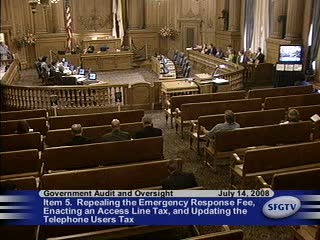
The Government Audit and Oversight Committee on July 14 advanced several potential November ballot measures designed to raise local revenue and modernize existing taxes.
Supervisor Aaron Peskin presented an initiative to close a payroll partnership loophole that the Controller's Office estimates could raise roughly $19 million annually before exemptions. Peskin said he would incorporate a mayoral request to raise the small-business exemption from $167,000 to $250,000 (with CPI adjustments) and proposed splitting the proposal into two initiative files: one using an 80% safe-harbor for partnership draws and a second using a 200% of the top-quartile compensation calculation. The committee created those two files and continued the matters for further public comment and technical review.
On real-property transfer taxes, Peskin proposed a progressive increase (including a credit of up to one-third of the transfer value for solar installations or seismic retrofits after Jan. 1, 2009) and offered to raise the high-rate threshold from $2 million to $5 million by amendment to preserve passage prospects. Supervisor Jake McGoldrick presented an alternative progressive scale with lower thresholds; the Controller's Office estimated Peskin's original draft would have averaged about $40 million annually and McGoldrick's version about $61 million annually, but both are subject to large year-to-year volatility.
Clerks read items 4 and 5, which would repeal the emergency response fee and replace it with an equivalent access-line tax and modernize the telephone-user tax; city staff from the Office of Economic and Workforce Development said the measure is intended to be revenue neutral and to preserve roughly $43-$45 million annually for 9-1-1 and emergency services.
Public comment on the revenue items showed a split: human-services and affordable-housing groups endorsed placing revenue measures on the ballot to avoid midyear cuts, while representatives of the real-estate and business community warned that raising taxes during an economic downturn could harm owners and transactions. The Chamber and business groups said they would work with supervisors on exemptions and offsets.
Procedurally, the committee continued items 2, 4, 5, 6, 7 and 8 for one week to allow technical amendments and additional public comment, created two payroll-tax files as described above, and amended item 8 to treat leasehold instruments of 35 years (rather than 50) as subject to the transfer tax and to raise the top-threshold to $5 million. The items were continued to the committee's July 21 hearing with the intention of forwarding recommendations to the full Board on July 22 where appropriate.
The Controller's Office and the City's Office of Economic Analysis will provide revised modeling and implementation cost estimates at the next hearing; the committee signaled it will refine thresholds, exemptions, and implementation language ahead of the ballot timetable.
The committee adjourned after agreeing to continue and refine the ballot language and technical amendments.