Get Full Government Meeting Transcripts, Videos, & Alerts Forever!
Get email alerts on the Audit Priorities topic
No spam. Unsubscribe anytime.
Supervisors press budget analysts and controller on audit priorities as budget cuts loom
Summary
A hearing on a budget analyst list of possible 2009 management audits explored options to prioritize audits that could yield general-fund savings; staff estimated available hours and discussed timing and scope with the committee.
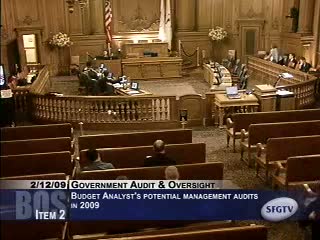
The Government Audit and Oversight Committee held a hearing to review the Budget Analyst Office’s list of potential management audits for 2009 and to solicit the Controller’s input on timing and risk-based priorities.
Severn Campbell of the Budget Analyst Office said her office had prepared a memo and a roster of potential audits drawn from the controller’s risk assessment, prior audits and board suggestions. Campbell said the office could allocate about 5,000 staff hours to audit work under the current contract but cautioned that a proposed reduction in the budget analyst contract could reduce available hours.
"We have about 5000 hours that we can allocate," Campbell said when describing the office’s capacity and scheduling estimates. Deborah Newman (Budget Analyst Office) added that recent Budget and Finance Committee recommendations would reduce the office contract by about $423,842 across the current and next fiscal year if approved, decreasing available audit resources.
Peg Stevenson of the Controller’s Office explained the City Services Auditor charter (Appendix F) and the chartered set-aside of 0.2% of the city budget to fund audit work. Stevenson said the 0.2% calculation has yielded between $10 million and $12 million in recent years and that roughly half of the controller’s staff are auditors. She described a risk-assessment table that separates departments that have not had a management audit in the last eight years from those recently audited.
Committee members discussed potential audit topics that could generate general fund savings, including consolidation savings from the General Services Agency, the 311 call center consolidation, Department of Public Health community health contracts and jail health services, fleet management and revenue-maximization opportunities. Stevenson and Campbell both stressed that management audits are deeper than routine budget line-item reviews and often require site visits and longer engagements. Stevenson's office said a typical performance audit takes at least 1,000 staff hours.
Public comment urged robust attention to Department of Public Health work. Douglas Shep, a San Francisco General Hospital employee, recommended auditing DPH or targeted units at SF General (x-ray and outpatient registration), alleging chronic underperformance.
The committee agreed to continue the discussion and aim to return with an ordered list of audit priorities at the next meeting (target date: February 26) so that staff could begin new audit work in March if appropriate.