Get Full Government Meeting Transcripts, Videos, & Alerts Forever!
Get email alerts on the Utilities Smart Grid topic
No spam. Unsubscribe anytime.
San Francisco committee orders cost-and-climate review of PG&E smart-meter plan after critical testimony
Summary
The Government Audit and Oversight Committee heard experts and residents who questioned PG&E's smart-meter proposal'c citing cost, technology obsolescence and limited climate benefits; the committee directed city agencies to participate in CPUC proceedings and to conduct a cost-and-climate review.
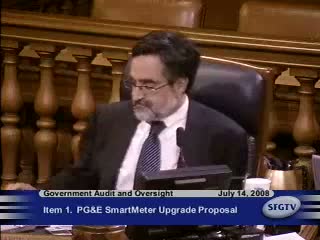
The Government Audit and Oversight Committee of the San Francisco Board of Supervisors on July 14 heard sharp criticism of Pacific Gas and Electric's planned smart-meter deployment and directed City departments to take part in the pending California Public Utilities Commission review and to perform a city-led cost-and-climate analysis.
Chair Supervisor Aaron Peskin opened the hearing by saying the ordinance before the committee would require the Department of the Environment and local PUC to review PG&E's upgrade proposal and that, after such a review, "if indeed the upgrade proposal was not cost effective, that it would be the city's policy to oppose Pacific Gas and Electric's proposal." Peskin noted CPUC approval already covers roughly $1.7 billion in installations and said PG&E is seeking additional funding.
Expert witnesses and consumer advocates urged scrutiny. Mark Toney, executive director of the Utility Reform Network, urged passage of the ordinance and said smart meters represent "an outrageous waste of ratepayer money" that primarily increases shareholder returns by enlarging PG&E's capital base. Toney cited the originally approved $1.7 billion price tag (about $340 per customer) and said PG&E had applied for additional upgrades that would raise costs further.
Former California Public Utilities Commissioner Loretta Lynch told the committee she finds the PG&E pilot "obsolete, unnecessary, and wasteful," and recommended independent, fact-based analysis before San Francisco endorses installations. Lynch said the meters do not, in her view, reliably reduce greenhouse-gas emissions or fix glaring distribution reliability problems and warned that the program could "lard" ratepayer bills with costs that ultimately boost shareholder profits.
City staff said the City will participate in the CPUC proceeding. Sandra Rovetti, regulatory and legislative affairs manager for the SFPUC's Power Enterprise, told the committee the SFPUC will coordinate with the Department of the Environment and file testimony that shares concerns raised by the Division of Ratepayer Advocates and TURN. Rovetti said testimony filing was scheduled and the City is exploring use of an AMI (automated metering infrastructure) consultant to support the cost-and-climate review.
City advocates and staff also described the difference between smart meters as single devices and the broader "smart grid" of communications and software that can enable demand response and renewable integration. David Pasquale, the City's clean-tech advocate, said meters alone are only one part of an infrastructure that must be paired with customer-side devices and new products to realize large emissions reductions.
During public comment, residents and engineers described billing problems and expressed health and privacy concerns about wireless meter installations. David Torrenheim and Robert Hynish asked for pilot programs and for alternatives to wireless communications where feasible.
The committee did not take a final vote on the PG&E program itself but voted to have city agencies participate in CPUC proceedings and to proceed with the ordinance's required city review. Chair Peskin said the committee will hold additional hearings and give PG&E the opportunity to present its case publicly.
The City's participation in CPUC filings and the forthcoming Department of the Environment review are the immediate next steps; the committee said it will continue public oversight as the CPUC process proceeds.