Get Full Government Meeting Transcripts, Videos, & Alerts Forever!
Get email alerts on the Yerba Buena Lease topic
No spam. Unsubscribe anytime.
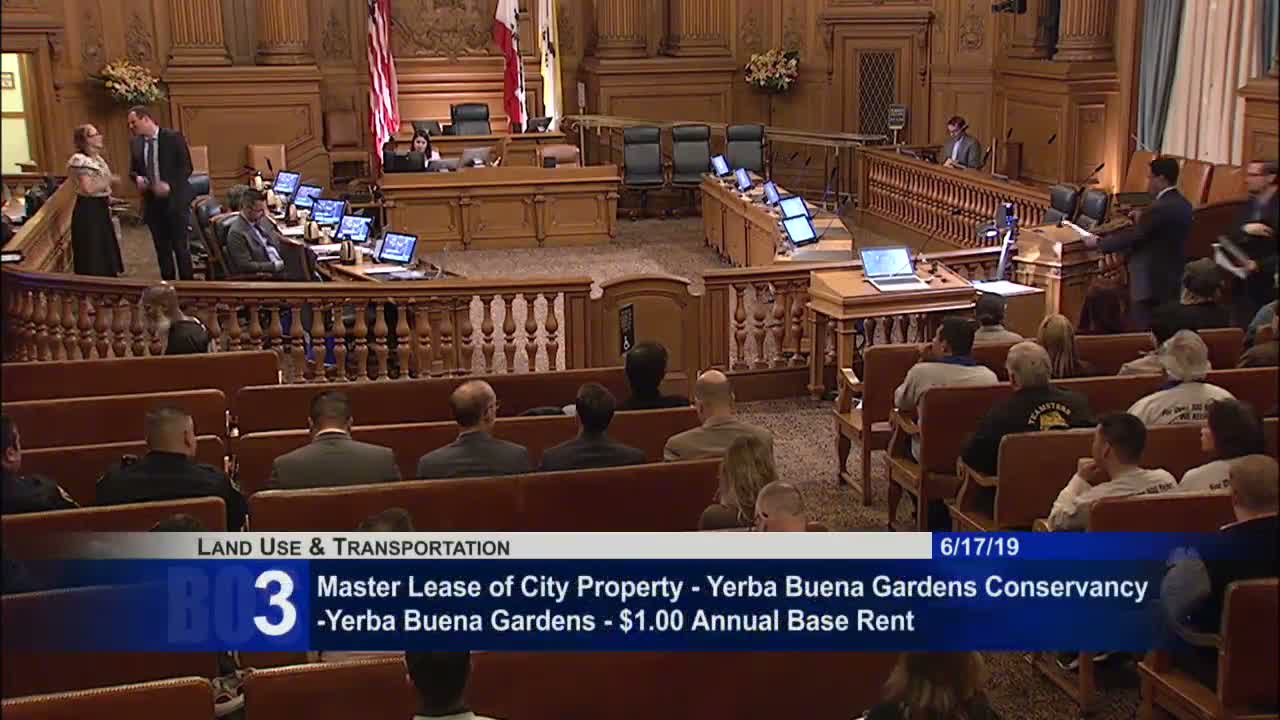
Committee forwards 42-year Yerba Buena Gardens master lease after technical edits
Summary
The Land Use and Transportation Committee advanced a proposed master lease designating the Yerba Buena Gardens Conservancy as master tenant, inserted clarifying language on a district supervisor appointment, and agreed to tighten delegated amendment authority before the Board hears the lease.
Chair Aaron Peskin and committee members advanced a master lease that would place management of Yerba Buena Gardens with a new nonprofit conservancy and send the measure to the full Board of Supervisors after technical amendments.
The committee heard from Andrei Penick, Director of Real Estate, who described the lease as a long-term arrangement created to preserve the unified management of the gardens after redevelopment-era transfers. Penick said the lease term runs from the date of Board approval until Sept. 1, 2061 — roughly 42 years — and that the rent is set at $1 per day. He said the conservancy would be governed by a permanent board composed of eight community members and five city representatives and that the lease is intended to be durable but flexible to address operational needs.
Supporters representing neighborhood stakeholders and nonprofit cultural institutions urged approval. Scott Rowitz, interim executive director of the Yerba Buena Gardens Conservancy, described the conservancy as a 501(c)(3) organized to operate and program publicly owned open spaces and cultural facilities and said the organization will audit operations and comply with HUD and open-meeting rules. Several neighborhood organizations and property managers told the committee the conservancy model had strong community buy-in.
Committee members flagged two policy items for clarification. First, members debated how a city representative tied to the supervisorial district should be selected: whether the city administrator should select a representative in consultation with the district supervisor, or whether the district supervisor should nominate and the Board appoint. The committee agreed to insert language that the representative be “nominated by the district 6 supervisor and appointed by the Board” to preserve Board appointment authority and provide clarity for a 42-year term.
Second, supervisors raised concern about broad boilerplate language authorizing the director of property, in consultation with the city attorney, to approve lease amendments that do not materially increase city obligations. Given the lease’s duration, several supervisors asked staff and the city attorney to tighten or qualify that delegation. Deputy City Attorney John Givner agreed to provide workable language and the parties agreed to finalize the modification before the Board meeting.
After the technical edits were agreed, Chair Peskin moved to send the item as thrice amended with a committee recommendation; the committee forwarded the lease to the Board of Supervisors for consideration the next day.
The committee’s action is procedural: the full Board will consider the master lease, the insertion of the supervisorial appointment language, and any refined limits on delegated amendment authority. If approved by the Board and signed by the mayor, the lease is anticipated to take effect on or before July 1 to align with the fiscal year.