Get Full Government Meeting Transcripts, Videos, & Alerts Forever!
Get email alerts on the Small Business Streamlining topic
No spam. Unsubscribe anytime.
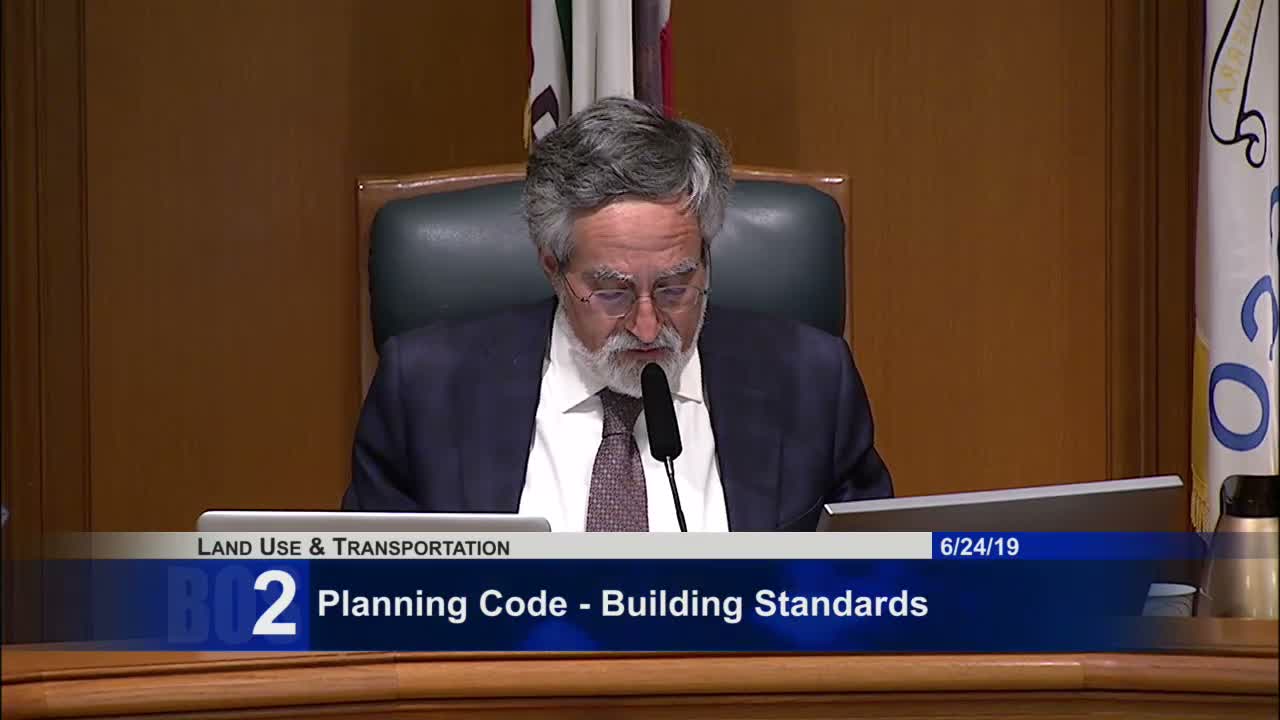
Supervisors advance small-business streamlining ordinance after broad debate over alcohol buffers and inspections
Summary
The Land Use and Transportation Committee on June 24 heard an ordinance to cut duplicative permitting steps, align local health rules with state standards for limited to‑go services, and ease restrictions that block neighborhood retail from offering limited entertainment or alcohol. Committee accepted sponsor amendments and continued the item for further outreach and review.
San Francisco — The Land Use and Transportation Committee on Monday considered an ordinance intended to streamline permitting for small businesses across the city by aligning local health and liquor rules with state standards, reducing duplicative inspections and revising zoning buffer rules that now restrict whether neighborhood retail can add limited food, entertainment or alcohol sales.
The measure, introduced by Supervisor Vallie Brown, would amend the health code, planning code and police code to allow certain retail businesses to offer limited to‑go food and host permitted entertainment more easily, consolidate arcade uses into a single entertainment category, and reduce or change how quarter‑mile buffers around restricted‑use districts apply to neighborhood commercial clusters (NC1) and limited commercial uses.
Supporters said the changes are aimed at reducing the time and cost of permits and helping fill storefront vacancies. “We need to free up small businesses to direct more of their energy and resources to meeting the larger challenges facing them today,” Supervisor Vallie Brown said, describing the bill as the product of work with small merchants and city departments.
Ben Van Houten of the Office of Economic and Workforce Development told the committee the city’s 2018 retail study and a Budget and Legislative Analyst (BLA) review show permitting timelines average about nine months and can double when a conditional‑use authorization is required. “We’re talking nine months on average, 18 months on average,” Van Houten said, noting the legislation is organized into several reform buckets: reconcile local and state health‑code requirements for limited to‑go food, enable limited live entertainment for retail, revise buffer rules that bind NC1 clusters, and clarify planning‑code ambiguities that create inconsistent guidance at counter service.
Several supervisors and members of the public urged neighborhood‑specific outreach before broad buffer changes. Chair Aaron Peskin and Supervisor Matt Haney emphasized that some restricted‑use districts were established after local neighborhood processes, and that their boundaries reflected local concerns. “It’s not a one‑size‑fits‑all solution and it really depends,” Peskin said, asking staff to produce parcel counts and maps for decision makers.
Public testimony was divided. Industry and neighborhood business groups — including the San Francisco Small Business Commission and the Planning Commission’s staff recommendation — generally supported streamlining and the proposed amendments. “When a business like this shuts down, we should all take notice,” Ben Bridal, an entertainment‑industry advocate, said, urging passage to help struggling merchants.
Other neighborhood advocates and public‑safety groups pressed for caution on alcohol provisions. Bruce Livingston of Alcohol Justice said the package “moves them around” and urged further hearings, citing a BLA estimate he described as roughly $54,000,000 in city costs associated with alcohol‑related harms. Tess Welborn of the Haight‑Ashbury Neighborhood Council said her group’s analysis found about 35 NC1 properties and 15 limited commercial uses in the Haight buffer and opposed shrinking the buffer there, arguing rent — not permitting — is the principal barrier to filling vacancies.
Small business owners described concrete impacts. Steve Wickwire, owner of Wooden Coffee House in Cole Valley, said he planned evening comedy and beer/wine sales but later learned he is roughly 50 feet inside a buffer that prevents those changes. “This is a huge shame for my business,” Wickwire said.
Committee members debated process and scope: whether to apply a 300‑foot buffer instead of a quarter‑mile for NC1 clusters, remove buffers around restricted‑use districts in some cases, or keep the quarter‑mile for limited commercial uses while using the nearest — not the most restrictive — neighboring district when overlaps occur. Planning staff said the Planning Commission supported narrowing some buffers, deleting the standalone arcade definition and clarifying hours for certain outdoor activity areas with no alcohol.
Procedurally, the committee accepted sponsor amendments for further review, asked city staff to produce parcel and map data for affected NC1 clusters and restricted‑use districts, and continued the ordinance — with the amendments — to the committee’s next meeting on July 8 for additional legal review and outreach. Item 2 on the agenda was also continued to that date.
Next steps: staff will provide more detailed parcel counts and maps, city attorney review will determine whether any changes require an additional hearing, and supervisors said they will consult district leaders and neighborhood organizations before final action.