Get Full Government Meeting Transcripts, Videos, & Alerts Forever!
Get email alerts on the Small Business Permitting topic
No spam. Unsubscribe anytime.
Committee pauses small‑business permitting changes amid confusion over quarter‑mile buffers and 'bona‑fide eating place' rules
Summary
Legislation to streamline small‑business permitting, recalibrate buffers around restricted‑use districts and create a narrow bona‑fide‑eating‑place exemption for certain entertainment venues drew extensive debate; committee continued the item so supervisors can consult constituents and staff can nail down which corridors keep quarter‑mile buffers.
Supervisor Jane (Brown) introduced legislation July 8 to simplify permitting for small businesses by clarifying buffer rules around restricted‑use districts, right‑sizing how permissibility for NC1 and LCU parcels is measured (proposing 300‑foot or nearest‑NCD rules in some cases), and by exempting narrowly defined entertainment venues from two local bona‑fide eating‑place requirements (51% food‑sales rule and minimum days/hours) when they meet specific criteria.
The central policy questions at committee were twofold: whether quarter‑mile buffers around restricted‑use districts currently apply in the way some merchants and planners believe, and whether the proposed bona‑fide eating‑place carve‑out would unintentionally allow many restaurants to become late‑night alcohol venues without sufficient safeguards. Ben Van Houten of OEWD presented maps and district‑by‑district impacts and described three targeted changes: reduce certain measurements to 300 feet, look to the nearest named commercial district rather than the most restrictive within a quarter mile for LCUs, and eliminate some buffers that, OEWD said, in practice do not exist.
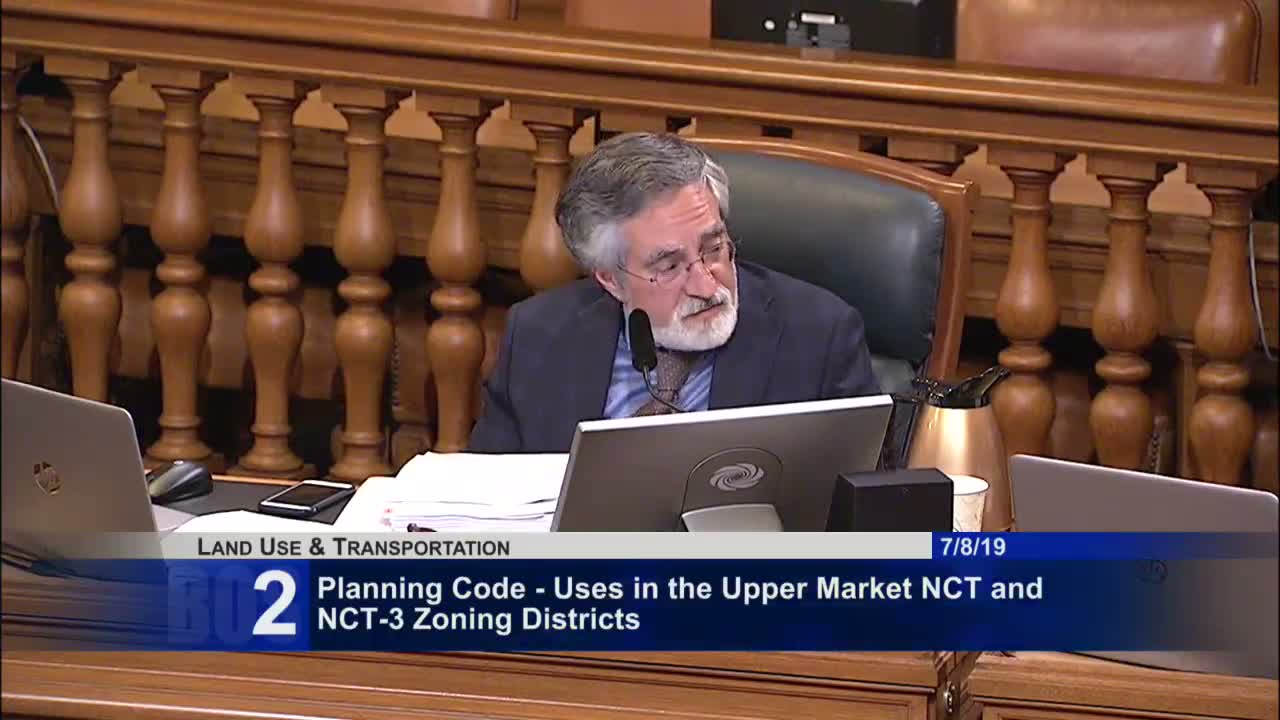
Chair Peskin and other supervisors pressed for written confirmation from Planning's zoning administrator about a 2009 interpretation (and received an email concurrence from Planning during the meeting). Planning staff and OEWD both acknowledged confusion at staff levels and supported clarifying the rules and either confirming interpretations or spelling buffer language explicitly into the code where supervisors wanted protections preserved (e.g., Lower Polk or Haight Street). Public testimony reflected the split: small‑business owners and the Chamber of Commerce urged simplification to fill storefronts; neighborhood groups and Alcohol Justice urged caution and more analysis on alcohol density and public health implications.
Given the district‑sensitive impacts, the committee asked sponsor offices to consult with supervisors and return with a list of named commercial districts or corridor‑level language rather than using supervisorial boundaries. The item was continued for two weeks to July 22 to allow targeted outreach and drafting of district‑specific language.
Next step: sponsor Office and OEWD to coordinate district outreach; Planning to provide formal zoning administrator confirmation for the record; item returns July 22 with clearer, corridor‑by‑corridor amendments.