Get Full Government Meeting Transcripts, Videos, & Alerts Forever!
Get email alerts on the Food Insecurity topic
No spam. Unsubscribe anytime.
Supervisors hear that food insecurity is rising among pregnant people; city staff warn safety net is at capacity
Summary
City health and human services staff told a Sept. 12 board committee that food insecurity in San Francisco has grown and that programs serving pregnant people and families are strained; community members urged more funding, better transit access for caregivers and a coordinated citywide strategy.
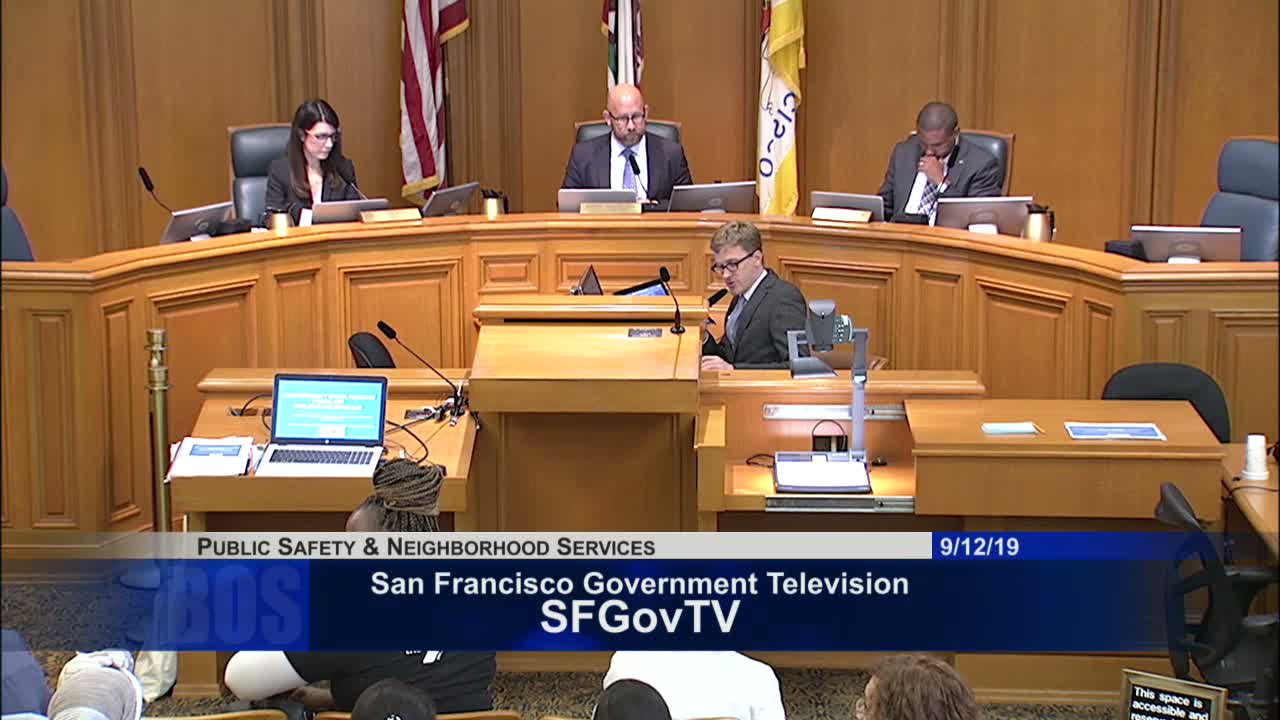
On Sept. 12, 2019 the San Francisco Board of SupervisorsPublic Safety and Neighborhood Services Committee held a special hearing on food insecurity, focusing on low-income pregnant people and families. Vice Chair Stephanie opened the session by saying the city will not meet its 2013 commitment to end hunger by 2020 and asked departments and community partners for concrete next steps.
Paula Jones, a Department of Public Health official, summarized city data and program findings, saying food insecurity is increasing and disproportionately affects pregnant people, children and communities of color. "Food insecurity is people who are hungry or in some cases starving," Jones said, and she warned that program infrastructure for food preparation, storage and distribution is at capacity. Jones also cited program limits, saying CalFresh benefits in San Francisco amount to "about a dollar 40 a meal," and noted that local meal programs require additional city funds because federal reimbursements do not cover higher local costs.
Susie Smith, deputy director for policy and planning at the Human Services Agency, told the committee that immigrant participation in federally funded programs has declined. "Since February we've seen about a 23 decline in households that have a noncitizen on our CalFresh caseload," Smith said, attributing the drop to fear stemming from federal policies such as the public charge rule. Smith and other staff described outreach and communication efforts to counter misinformation and urged stronger enrollment drives.
Supervisors and presenters highlighted several recurring barriers cited by community members: food deserts and lack of nearby grocery stores, insufficient fresh food in some pantry distributions, transportation limits that make carrying groceries difficult for caregivers with strollers, and capacity constraints at family resource centers (FRCs) and community-based organizations that run pantries.
Community commenters offered firsthand accounts. A Homeless Prenatal Program client described being turned away from buses with a large stroller while carrying food; other speakers said food distributions sometimes include nearly expired produce or lack adequate protein for children. Najee Truffant and several FRC representatives praised local pantries and delivery pilots but urged more stable funding and better coordination.
Teresa Zagera, interim executive director of First 5 San Francisco, told the committee that the city's family resource centers collectively distribute roughly 1,400 food bags per week (about 64,000 per year) but are operating at capacity and rely on volunteers and in-kind support. She and other presenters urged targeted investments to expand pantry capacity, bolstered storage and staffing, and pilot programs that bundle services at key life junctures.
The hearing also surfaced local solutions to test or scale: expanding home-delivered meals programs to pregnant people, increasing voucher and market-match programs at farmers markets, piloting grocery delivery for SNAP/CalFresh recipients, and co-locating services so clients can access multiple supports at familiar community sites.
Vice Chair Stephanie asked the city's Budget and Legislative Analyst to assess San Francisco's food security system and recommend data the city should collect to better measure need and program performance. She also said she would follow up with the Municipal Transportation Agency about reported incidents of bus drivers refusing riders with strollers carrying food. At the close of the hearing, Stephanie moved to file the matter; the chair called the motion and the item was filed "without objection."
Next steps identified at the hearing include a BLA system-level assessment, follow-up with MTA on transportation barriers for caregivers, continued outreach to increase enrollment in federal programs, and consideration of targeted funding to expand family resource center capacity and pilot delivery or voucher programs. The committee adjourned after filing the hearing.