Get Full Government Meeting Transcripts, Videos, & Alerts Forever!
Get email alerts on the Utility Poles Undergrounding topic
No spam. Unsubscribe anytime.
Supervisors hold wide-ranging hearing on San Francisco utility poles, inspections and undergrounding
Summary
City committee heard CPUC, PG&E, AT&T, Comcast, SFPUC and Public Works on pole mapping, inspection cycles, abandoned wiring, and undergrounding funding and constraints; residents urged expedited cleanup and a citywide master plan. Committee moved to continue the item for follow-up after a master-plan study.
The Public Safety and Neighborhood Services Committee on July 25 held a multi-agency hearing into utility pole attachments, inspection practices, abandoned wiring, and options and financing for undergrounding overhead utilities in San Francisco.
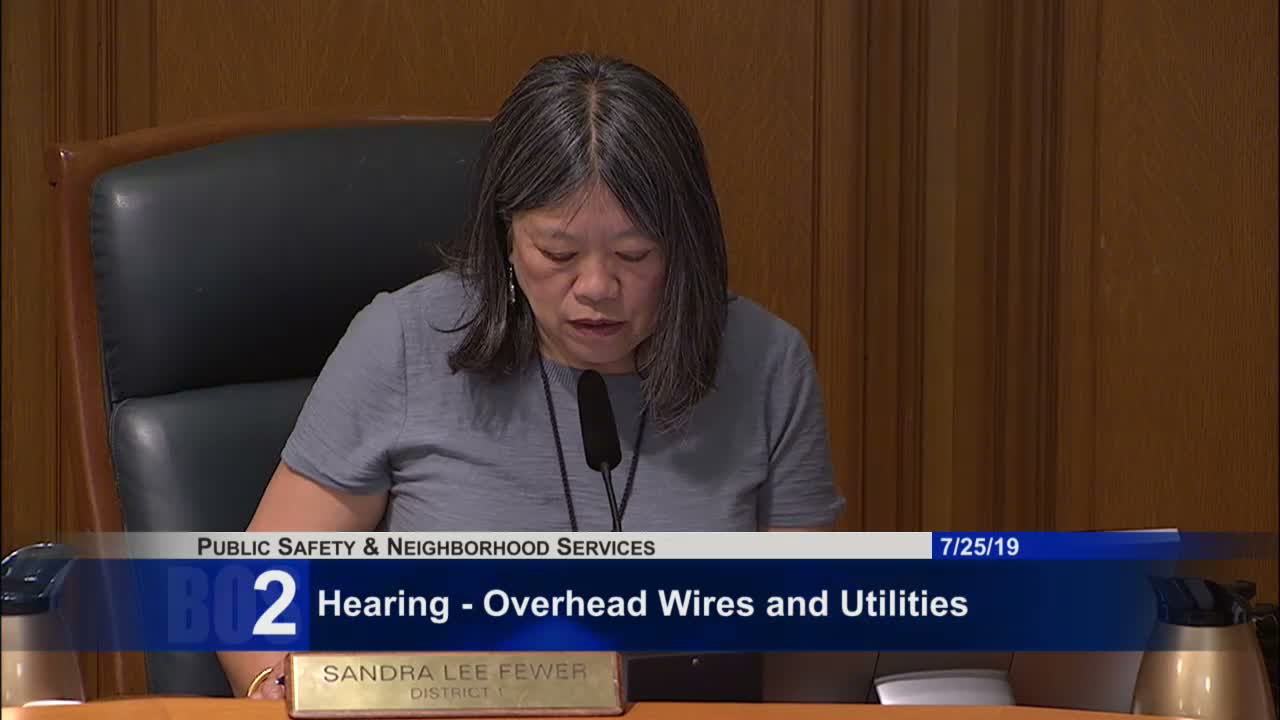
Supervisor (Feuer), who sponsored the hearing, told the committee she had received numerous constituent complaints about “spaghetti webs” of wires on poles across the city and asked agencies to explain practices for inspection, attachment and removal. "As we talk about overhead wires, it is also helpful that we consider this in the context of this vision for underground utilities," she said.
Lee Palmer, Director of the California Public Utilities Commission Safety and Enforcement Division, described the CPUC role: SED audits utilities for compliance with CPUC General Orders — including GO 95 (overhead construction and maintenance) and GO 165 (inspection requirements) — and investigates reportable incidents (fatality/hospitalization, $50,000+ property damage, or significant public attention). Palmer said CPUC does not maintain a centralized statewide map of about 5,000,000 poles; utilities keep individual inventories. He added the CPUC has an open proceeding about pole mapping and access and noted the CPUC does not currently require utilities to underground existing lines, leaving such decisions to utilities and local governments and to funding availability.
PG&E representatives described company inventory and inspection protocols. "Here in San Francisco, we have 32,000 poles," said a PG&E speaker, and the company said it inspects poles annually in urban environments, performs intrusive pole testing on a multi‑decadal cycle (PG&E said it conducts intrusive tests every 10 years), and replaced roughly 700 poles in San Francisco last year. PG&E discussed the Joint Use Map Portal used to coordinate pole ownership data with partners such as SFPUC and explained the Rule 20/Rule 20A program for converting overhead to underground, including the concept of work credits that cities accrue. Telon/PG&E staff said San Francisco’s prior Rule 20A projects have used credits that leave the city with a multi‑year balance that will delay ratepayer‑funded conversions for roughly 14–15 years unless other funding sources are identified.
AT&T and Comcast speakers described provider practices for attachments and field safety. Cammie Blackstone of AT&T told the committee AT&T is attached to approximately 26,000 poles in San Francisco and that every attacher must submit applications and pole loading calculations; AT&T said it notifies co‑users when safety issues arise. Comcast described a formal field protocol that requires technicians to look one span left and right for nonconformance and to create immediate work orders for repairs.
San Francisco Public Utilities Commission and Department of Public Works staff outlined local inventories and the city’s undergrounding master-plan study. SFPUC said it owns about 200 power poles and roughly 25,000 streetlight poles (the bulk of utility poles are owned or base‑owned by PG&E). Public Works said the Telamon master-plan study, due in late August or early September, will assess costs, phasing, and coordination opportunities; staff noted past city work (roughly 46 miles undergrounded between 1996 and 2006 at about $173 million) and gave a range of current cost estimates that vary widely by site (Telamon cited sample ranges from about $3 million to $13 million per mile, depending on underground complexity).
During public comment, residents and neighborhood coalitions urged a citywide master plan, immediate removal of nonfunctioning and abandoned wires, mandatory dig‑once coordination with road and water projects, and new funding mechanisms (developer fees, franchise changes, or a dedicated undergrounding fund). Residents reported visible examples of long‑standing hanging cable, tall replacement poles near windows, and public‑safety concerns including prior pole failures and fire risk.
Committee members also pressed agencies for local data: supervisors asked the CPUC and utilities to provide counts of complaints and confirmed violations in San Francisco, clarification on who tracks private poles, and more detail on Rule 20 work‑credit accounting. Several supervisors urged the CPUC to produce analysis on undergrounding safety and cost‑benefit for urban locales; CPUC staff said such a detailed safety comparison has not been done statewide.
With study results pending, the committee moved to continue the item to the call of the chair to allow further follow-up after the Telamon report. The committee voiced support for additional hearings and coordination work between the city and the CPUC and utilities.
What happens next: Public Works and the Telamon consultant expect to deliver the master-plan study in late August–early September; the committee continued the item for further hearings and directed agencies to provide requested data to the committee in advance of follow-up sessions.