Get Full Government Meeting Transcripts, Videos, & Alerts Forever!
Get email alerts on the Adu Ordinance topic
No spam. Unsubscribe anytime.
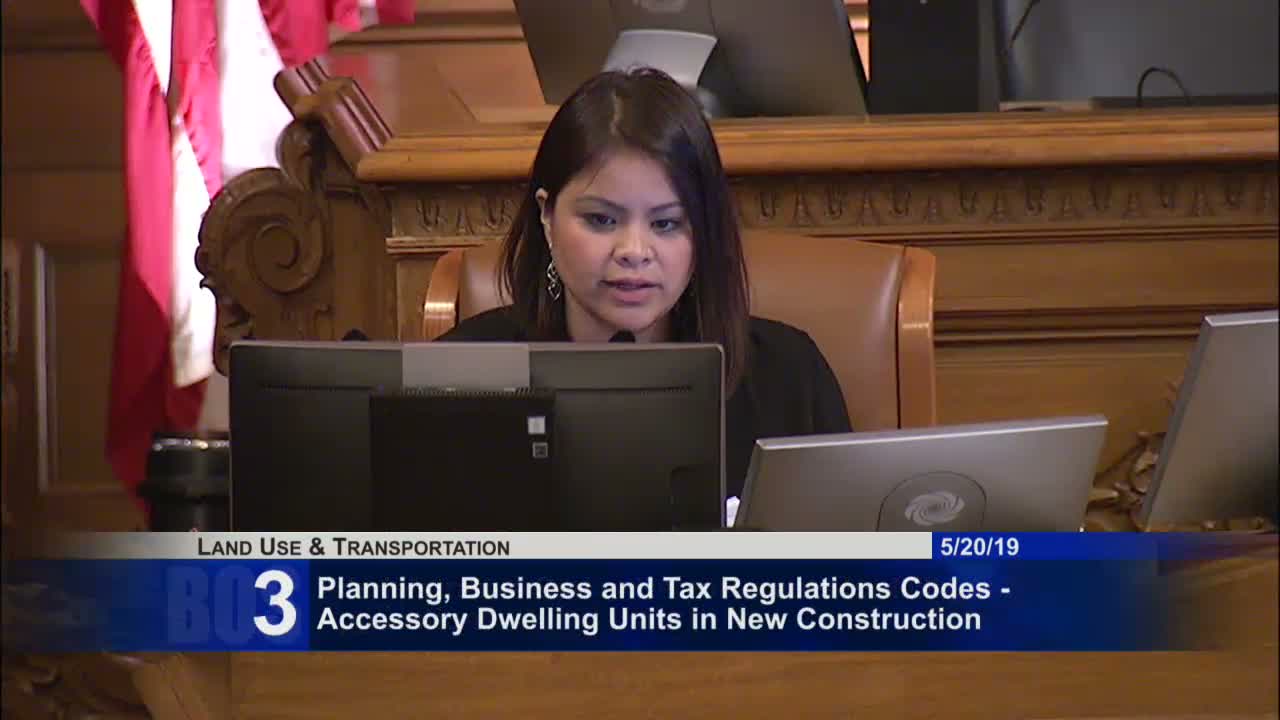
Board committee advances ADU ordinance with amendments on rent control, tenant notice and size limits
Summary
The Land Use & Transportation Committee duplicated and amended an ADU ordinance to focus on new construction, propose a 50% minimum ADU size, allow local rent‑control authority in some new builds, and require tenant notice before permits; the file was re‑referred to Planning and continued to June 3 for further review.
The Land Use & Transportation Committee advanced an ordinance on accessory dwelling units (ADUs) on Monday, moving to duplicate the file and send revised language back to the Planning Commission for further review. Chair Aaron Peskin and other supervisors framed the draft as a narrow, compliance‑oriented update that will apply primarily to ADUs in new construction.
Peskin said the ordinance is intended to bring San Francisco into alignment with recent state law while preserving local policy tools where possible. He cited data showing “more than 1,200 in the pipeline” and said expanding ADUs in new construction could meaningfully increase housing stock over time. To address concerns raised in public comment, Peskin proposed several amendments now to be considered by Planning, including deleting language that ties ADU rent‑control treatment to the existence of an earlier rental unit on a lot, adding a drafting request for a 50% minimum ADU size relative to the primary dwelling, and requiring tenant notice prior to permit issuance.
Public commenters offered a mix of support and caution. Georgia Schutisch said ADUs historically provided affordable housing but warned that liberalizing rules should not “encourage speculators to demolish sound, functioning, livable single family housing” for ADU opportunities. Michael Murphy, a retired research attorney, urged more study to ensure the ordinance complies with state ADU law. Tenant advocates and neighborhood speakers—including Bruce Bowen, Jennifer Feber (San Francisco Tenancy), and Ozzie Round—urged stronger tenant protections, including rent control for some new ADUs and tighter safeguards against the severance of services or displacement when garages or storage are converted.
Planning staff and the Deputy City Attorney explained legal constraints. Deputy City Attorney Peter Milyanich told the committee the Historic Preservation Commission had developed objective architectural review standards and that state law requires ministerial consideration for some ADUs, which limits the City’s ability to require discretionary review in those cases.
The committee voted to duplicate the file, incorporate the discussed amendments as drafting requests, and re‑refer the duplicated file to Planning for 90 days; the Chair’s motion was accepted without objection. Deputy City Attorney John Givner recommended scheduling both the original and the duplicated file for further consideration at the June 3 Land Use meeting, a suggestion the committee accepted. The committee’s action was procedural: the ordinance remains subject to Planning review and subsequent public hearings.
What happens next: the duplicated file goes back to the Planning Commission for further consideration of the drafting requests (including the 50% size proposal and tenant‑notice language). The committee continued the matter to the June 3 Land Use meeting for follow‑up and potential refinement.