Get Full Government Meeting Transcripts, Videos, & Alerts Forever!
Get email alerts on the Public Health topic
No spam. Unsubscribe anytime.
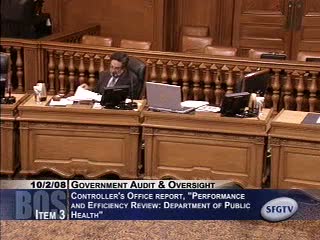
Controller: San Francisco Public Health services efficient but need IT and capacity investments
Summary
A controller—s office performance review found San Francisco—s Department of Public Health provides high‑quality safety‑net care but recommended investments in hospital capacity planning, community long‑term care models, clinic redesign to reduce patient wait times, and greater IT improvements to improve efficiency.
The controller—s office presented a performance and efficiency review of the San Francisco Department of Public Health and recommended four priorities: maintain acute and safety‑net hospital capacity, develop alternative long‑term and skilled nursing care models, improve access to primary and community care through clinic redesign, and increase investment in health information technology.
Catherine Moller of the controller—s office said the review, which drew on several reports dating to 2005, found that San Francisco General Hospital is a highly efficient safety‑net provider: it accounts for about 17 percent of acute care beds citywide but provides a disproportionate share of psychiatric, HIV and substance‑use services. The report estimated the general saves about $6 million annually compared with benchmark hospitals by using about 26 percent fewer long‑term days and 61 fewer full‑time equivalents to achieve comparable outcomes.
The report also documented long patient waits in some primary care clinics (Moller cited an average of 35 days for new‑patient appointments in DPH clinics) and noted increases in preventable hospitalizations in several categories. It recommended clinic redesign and renovation — $20 million in renovations were reported as about 50 percent complete across 10 clinics — and said improved IT systems (improved revenue accounting, integrated electronic medical records and computerized physician order entry) could reduce costs and improve patient flow.
Laguna Honda Hospital leadership described its shift from a largely residential facility to a rehabilitation and transitional care model to return patients to the community. Public commenters and a physician speaker raised concerns: Dr. Himsa Simchai argued the report did not substitute for a financial audit and questioned whether maintaining area hospital capacity was sufficient given overcrowding; other commenters, including a long‑time hospital worker, urged more attention to specific departmental problems.
The committee filed the controller's report for the record and thanked the controller—s staff and health department for their cooperation. The meeting adjourned shortly afterward.