Get Full Government Meeting Transcripts, Videos, & Alerts Forever!
Get email alerts on the Tourism Improvement District topic
No spam. Unsubscribe anytime.
Supervisors advance tourism improvement district plan to fund Moscone improvements and CVB marketing
Summary
Committee adopted amendments and sent a Tourism Improvement District (TID) plan to the full Board; Zone 1 hotels would pay 1.5% of gross room revenue (years 1–5) and Zone 2 hotels 1.0% (years 1–5), with roughly two‑thirds of early revenues for CVB marketing and one‑third for Moscone improvements.
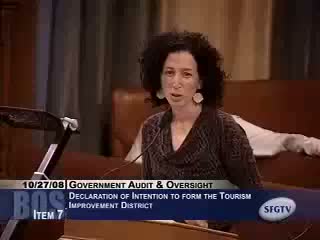
The Government Audit and Oversight Committee advanced a proposal on Oct. 27 to form a Tourism Improvement District that would assess hotels in two zones to raise funds for marketing and capital improvements to the Moscone Convention Center.
Jennifer Entine Matz of the Office of Economic and Workforce Development summarized the management plan and related documents; CVB counsel described a two‑zone structure. Zone 1 hotels (closer to the convention center) would pay 1.5% of gross room revenue for years one through five, falling to 1.0% for years six through 15. Zone 2 hotels would pay 1.0% for years one through five and 0.75% thereafter. Projected first‑year collections, using 2007 numbers, were roughly $27 million split approximately $18 million for Convention and Visitors Bureau marketing and $9 million toward Moscone improvements and planning.
Comptroller staff described a parallel financing track: issuing certificates of participation to front‑fund several years of general fund support for Moscone capital improvements, to be coordinated with the TID proceeds. CVB counsel said petitions from hotels were overwhelmingly supportive on a weighted basis and that collections would be managed by the city treasurer and tax collector using a process similar to the transient occupancy tax collection.
Public comment featured extensive industry and community support: hotel operators, restaurant associations, labor unions and neighborhood groups testified in favor of the district, emphasizing jobs, competition with other cities and Moscone’s need for upgrades. Labor and community speakers also asked supervisors to maintain service equity and to ensure the needs of lower‑income neighborhoods would be considered in how improvements and marketing benefits are distributed.
The committee adopted technical amendments to the documents and forwarded the package as a committee report and cosponsored item to the full Board, with a target timeline for final approvals to meet statutory deadlines and for services to begin July 1, 2009, if approved.