Get Full Government Meeting Transcripts, Videos, & Alerts Forever!
Get email alerts on the Bonding And Financial Assistance topic
No spam. Unsubscribe anytime.
City staff recommend $2 million seed for citywide surety bond guarantee to restore LBE access
Summary
HRC and the risk manager recommended a self-insurance fund with an immediate up-to-$2,000,000 contribution to revive the city's surety bond guarantee pool and restore bidding access for small and LBE contractors, with an actuarial study to follow.
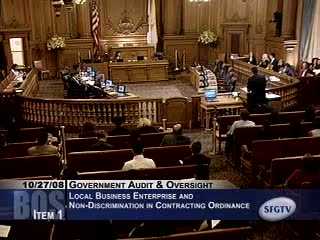
San Francisco officials told the Board’s Government Audit and Oversight Committee on Oct. 27 that an underfunded bonding guarantee program is blocking small contractors from bidding on city construction work and that a self‑insurance fund is the preferred near‑term fix.
Chris Iglesias of the Human Rights Commission reviewed the program’s history — originating with a $4 million airport pool in the 1990s and later expanded citywide — and said the program currently relies on a remnant pool of roughly $395,000. Iglesias said 30 guarantee requests were denied between May 2003 and October 2007 because no backing funds could be identified, preventing contractors from bidding on nearly $50 million in work.
Matt Hanson, city risk manager, described the committee’s recommended Option 1: a self‑insurance fund administered by the risk manager with HRC oversight. Hanson requested an immediate funding commitment of up to $2,000,000, subject to departments’ budget availability, and said an actuarial study would determine how that initial commitment could be leveraged to increase program capacity. Hanson said the program’s historical default rate was extremely low and that underwriting conversations supported the program’s model.
Supporters from enterprise departments, including Todd Reedstrom of the Public Utilities Commission, said a pooled approach would capture favorable experience ratings and reduce the administrative and capital costs of department‑level set‑asides. Program administrator Merriweather and HRC staff urged the committee to support the recommended option while the city works on long‑term funding mechanics.
The committee filed Item 2 while awaiting implementing legislation and staff work; supervisors indicated the matter would come back to the Board with proposed funding instructions and potential ordinance language. The committee discussion emphasized preserving access for historically excluded contractors while balancing departmental budget constraints and the need for an actuarial study to set ongoing contributions.