Get Full Government Meeting Transcripts, Videos, & Alerts Forever!
Get email alerts on the Accountability And Elections topic
No spam. Unsubscribe anytime.
Board hears civil jury concerns on ballot fiscal impact, capital planning and elections operations
Summary
The grand jury asked for post‑enactment follow‑up on comptroller fiscal‑impact statements and a systematic way to track required reports; supervisors and officials debated capital planning oversight and whether to require more prescriptive ballot or bond information. The Elections Division was praised for operations but urged to secure permanent space and strengthen voter education for ranked‑choice voting and absentee ballots.
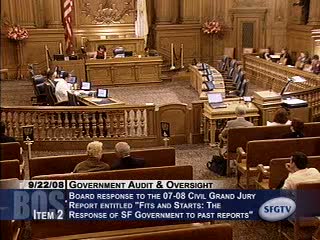
The Audit & Oversight Committee on Sept. 22 took testimony on the civil grand jury’s accountability report and a separate report on the year of five elections.
Patricia Knight, foreperson of the February 2008 grand jury, said the jury was concerned that the comptroller’s fiscal‑impact comments lack systematic follow‑up, which prevents verification of whether prior predictions were accurate. "How do you know you're getting it right if you don't follow‑up and see whether your prediction was correct?" Knight asked.
Peg Stevenson of the Controller’s Office told the committee the controller does conduct follow‑up analysis through standard budget monitoring (six‑ and nine‑month reports, monthly meetings with large departments) and that the office would provide materials for independent third‑party reviews. Stevenson said the controller also performs audit follow‑ups at 6, 12 and 24 months and will add targeted testing for critical recommendations as part of its work plan.
Supervisors and public commenters debated whether the grand jury failed to account for existing structures: Supervisor Ellsburn pointed out the Capital Planning Committee and a 10‑year capital plan and urged the grand jury to recognize those institutional improvements; former grand juror Bob Planthold and other commenters said oversight gaps remain and recommended stronger tracking of required reports and clearer documentation in the voter information pamphlet.
On elections, the grand jury praised the Department of Elections’ work but recommended a permanent consolidated operations site, improved public education on ranked‑choice voting, contingency plans should Sequoia certification be delayed, and clearer absentee‑ballot guidance.
John Arndt of the Department of Elections said City Hall and Pier 48 currently serve operational needs and that Pier 48 consolidation helped most operations, though the Pier 48 lease will expire in a few years and long‑term space needs must be addressed. Amy Brown, the city's director of real estate, said the Real Estate Office would conduct property searches if directed by the board but characterized the choice of a permanent consolidated site as a policy call requiring mayoral/board direction and appropriation.
The committee adopted an amended set of recommended responses (classifying items as 'agree', 'partially disagree' or 'agree with future implementation') and forwarded the package to the full board. The committee also inserted a 'further resolve' directing additional consideration of a post‑enactment review of the comptroller’s voter pamphlet statements, noting resource implications for the controller’s office.
The hearing record shows divided views on whether existing committees and audit processes already provide adequate oversight, and it leaves open whether the board will pursue charter or legislative changes to expand citizen oversight of bond measures.