Get Full Government Meeting Transcripts, Videos, & Alerts Forever!
Get email alerts on the Liquor License topic
No spam. Unsubscribe anytime.
SF committee continues Daldas Market liquor‑license transfer after conditions remain unsigned
Summary
The Public Safety & Neighborhood Services Committee continued a request to transfer a Type 21 off‑sale liquor license for Daldas Market to 168–186 Eddy St. after police‑recommended conditions (hours, litter/loitering controls, noise limits) remained unsigned; the applicant and police pledged to finalize conditions before the next meeting on May 23, 2019.
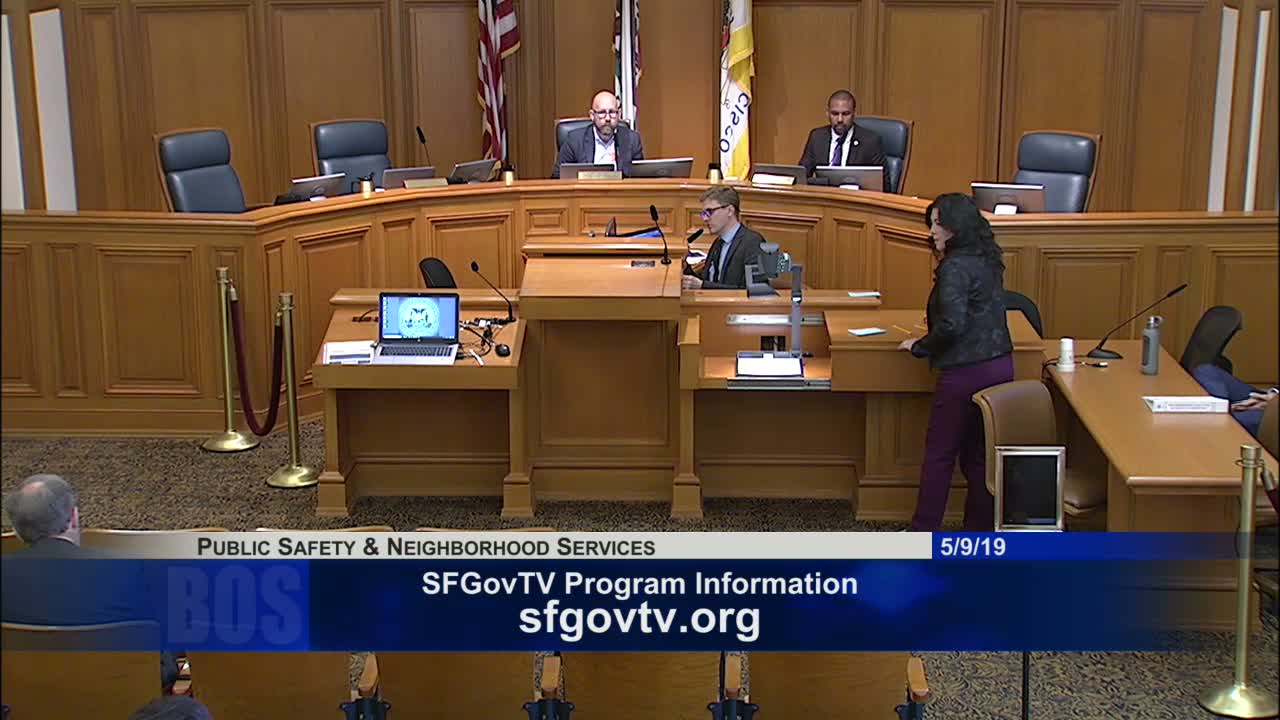
Supervisor Rafael Mandelman, chair of the Public Safety & Neighborhood Services Committee, moved on May 9 to continue consideration of a transfer of a Type 21 off‑sale general (beer, wine and distilled spirits) liquor license for Daldas Market to 168–186 Eddy Street after police recommended conditions had not yet been signed.
Officer Mackey of the San Francisco Police Department told the committee the Alcoholic Beverage Control unit’s investigator had issued recommended conditions including restricted hours for alcohol sales, a requirement that the petitioner keep adjacent areas free of litter, monitoring to prevent loitering on adjacent properties, and limits on audible noise at nearby residences. Mackey said the site is in Plot 176 (described in the report as a high‑crime area) and in Census Tract 125.01 (described as a high‑saturation area); he also reported four letters of protest and no letters of support in the file.
Applicant counsel and the market’s owner told the committee they were willing to accept the recommended conditions but that the Alcoholic Beverage Control (ABC) had not yet executed or returned signed conditions. The counsel said the ABC normally sets the final conditions and that, once provided, the applicant would sign them. Mackey said the department had faxed its recommendations to ABC on March 13 and had not received correspondence back, and that the parties typically negotiate hours (for example, 7 a.m. vs. 8 a.m. start times) with ABC.
Several community partners and neighborhood stakeholders urged approval. Shelly Dyer of the Tenderloin Healthy Corner Store Coalition and John McCormick, a coalition representative, described Daldas Market as a long‑standing participant in the Healthy Corner Store program, saying the store has reduced the area devoted to alcohol sales by about 20 percent, does not sell alcohol on credit and distributes roughly 1,600 units of produce per month. Alexandra Goldman, planning and policy manager at the Tenderloin Neighborhood Development Corporation (TNDC), said TNDC reviewed the store’s financials and concluded the business would not be financially viable without alcohol sales; TNDC supports the transfer and noted the new space would dedicate 10 percent or less to alcohol sales while expanding room for healthy, affordable food.
Not all public commenters supported immediate approval. An unidentified resident warned that easier retail access to alcohol can perpetuate excess drinking among vulnerable people in the neighborhood; other commenters raised concerns about the broader need for housing and services for people experiencing homelessness.
After public comment, Supervisor Walton asked whether the police department and the store owner could guarantee that the recommended conditions would be resolved before alcohol sales begin. Applicant counsel and Officer Mackey both said they would work to finalize and sign the conditions promptly; the applicant’s counsel committed to accepting the conditions once provided and the police said it expected to reach agreement with ABC.
Chair Mandelman said it was unusual to consider an application without agreed conditions and outlined options including a two‑week continuance. Mandelman moved to continue the item to the committee’s May 23, 2019 meeting; the motion was taken without objection and the item was continued. The committee did not record a roll‑call vote on the matter.
The committee’s file includes a reference to the California Business and Professions Code cited in the applicant’s packet; the transcript cites that authority while discussing the public convenience or necessity standard. The committee’s action postponed a final finding on public convenience and necessity pending signed conditions and the ABC’s finalization of the transfer.
The committee adjourned after the continuance was entered.