Get Full Government Meeting Transcripts, Videos, & Alerts Forever!
Get email alerts on the Behavioral Health And Jail Treatment topic
No spam. Unsubscribe anytime.
Supervisors hear limits and successes of behavioral health court, diversion and jail treatment as city plans data-driven needs assessment
Summary
Supervisors and city officials described strong individual outcomes from San Francisco's collaborative treatment courts but long waits and limited bed capacity that constrain scale. A MacArthur grant and a proposed independent needs assessment (estimated at about $500,000) are expected to guide investments to shorten time to treatment and reduce jail population.
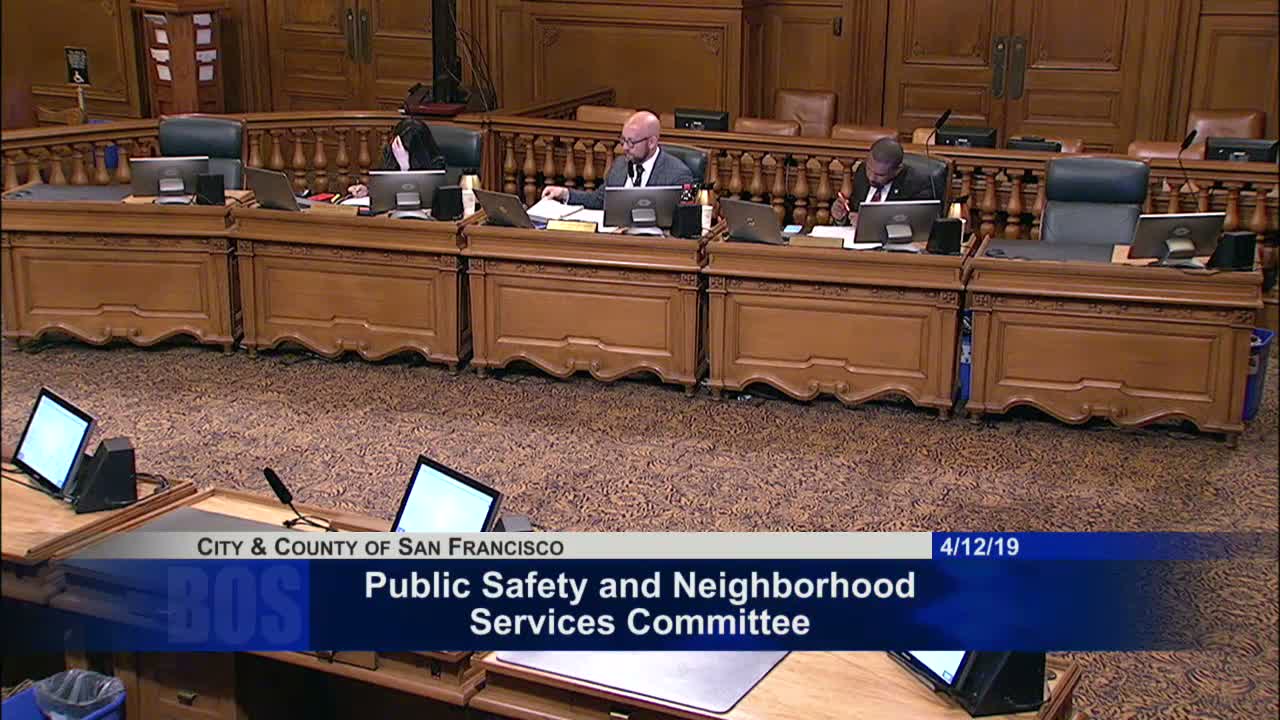
San Francisco 'April 12, 2019 ' The Board of Supervisors' Public Safety and Neighborhood Services Committee heard evidence Friday that collaborative courts and new state diversion law are helping many justice-involved people get treatment but that limited treatment beds, long placement waits and fragmented services still block broader impact.
Judge Harry Dorfman, who presides over Behavioral Health Court at the Hall of Justice, described an intensive, team-based court process that frequently requires weeks of clinical assessment and often more than two years of treatment for participants. "It's not a short period of treatment," Dorfman said, noting the median time in the program for graduates was "over 2 years" and giving program counts: roughly 130 clients currently receiving BHC services, about 912 clinical assessments from 2016 to 2018 (roughly 300/year), 378 clinically eligible and 204 accepted into BHC in that three-year span. He said 78 percent of BHC graduates avoided arrest within a year of graduation.
The judge also described the new state mental health diversion law and the judicial role it creates. "If the individual, once in mental health diversion, successfully finishes treatment, then the law says the judge must dismiss the case," Dorfman said, and gave preliminary local statistics: about 166 referrals since August, 35 accepted, 50 denied and 50 pending.
Tanya Mara, director of Jail Health and Reentry Services at the Department of Public Health, described the jail'based screening and housing tiers and said reentry planning begins in custody. Mara said the county completed 22 successful conservatorship referrals in the last year and that some waits to residential placements remain long: "that's a pretty long wait, 84 days," she said for certain locked facilities, while adding that the Behavioral Health Center's 40 new beds have "made a huge dent" in waits for some populations.
Kathleen Connolly Lacy of UCSF Citywide Case Management emphasized the role of intensive, forensic-oriented case management that follows clients in and out of custody and described the program'level capacity: DPH contracts for 175 intensive case management slots, the CASC supports 220 intensive slots and additional services for roughly 300 clients through classes and groups. Lacy said the justice-involved population often presents severe psychotic disorders combined with substance use and years of homelessness, and she urged a coordinated strategy that includes more residential and diversified supportive housing.
Katie Miller of the District Attorney's Office outlined work funded through the MacArthur Foundation's Safety and Justice Challenge, including cross-agency data sharing with California Policy Lab to identify high users of multiple systems and to reduce jail population by a local target (presented as 17 percent). Miller said an independent, comprehensive needs assessment and gap analysis is the logical next step; slide materials presented to the committee estimated the study could cost about $500,000.
Speakers from the Public Defender's Office and multiple non-profit and clinical organizations urged community-based treatment and housing investments and pressed for quicker placement timelines. In public comment, clinicians and advocates repeatedly called for more low-barrier, on-demand treatment, housing and peer support and warned against assuming jail-based care alone will solve the problem.
The committee did not vote on policy or budget items at the hearing. Supervisors Rafael Mandelmann and Vice Chair Stephanie said they planned to continue work through the budget process and the MacArthur grant implementation; Mandelmann moved to continue the item "to the call of the chair" so the board can revisit preliminary findings and next steps in six to eight months.
What happened next: staff said the city is close to finalizing accept-and-expend authorization for MacArthur grant resources, expected hires and SAMHSA technical assistance that will support an initial analysis. Officials proposed a two-track approach: make short-term, targeted investments where evidence points to clear need and commission a longer, independent needs assessment to guide larger budget allocations.
Ending: The committee adjourned after public comment and a short wrap-up; supervisors encouraged stakeholders to submit concrete short-term investment proposals for the budget cycle while the larger assessment and MacArthur-funded work progress.