Get Full Government Meeting Transcripts, Videos, & Alerts Forever!
Get email alerts on the Film Rebate topic
No spam. Unsubscribe anytime.
Committee backs lowering small-production film fees and expanding city rebate to documentaries and unscripted TV
Summary
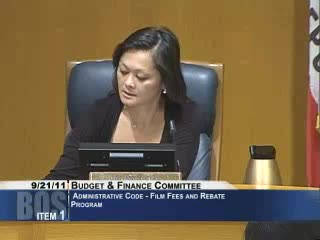
The Budget and Finance Committee voted without objection to send forward an ordinance that would cut daily permit fees for very small productions and expand San Francisco—s film rebate to include documentaries and unscripted television, and it added a requirement that the Film Commission report back with program metrics by Dec. 31.
The Budget and Finance Committee on Sept. 13 advanced an ordinance that would reduce permit fees for very small film productions and expand eligibility for San Francisco—s film rebate to include documentaries and unscripted television, and it added a requirement that the Film Commission report back to the Board with program metrics by Dec. 31.
Sponsor Supervisor Ed Farrell told the committee the change is aimed at keeping productions in San Francisco and encouraging small filmmakers to pull permits rather than shoot without them. "Lowering the fee for small budget films will encourage these productions to actually pull permits," Farrell said, arguing that the city will gain jobs and local spending when productions hire local crews and use services here.
The ordinance amends San Francisco Administrative Code sections 57.5 and 57.8 to: codify existing film-permit fees, reduce the daily permit fee for productions with budgets under $500,000 from $300 to $100, and expand the city rebate to include documentary films, docudramas and reality/unscripted programming; it also proposes exemptions for nonprofit productions, public-service announcements and qualifying student projects.
Susanna Robbins, executive director of the Film Commission, told the committee the commission supports the three changes and outlined steps it has taken to support local, independent filmmakers, including a Film Collective that provides low-cost office space. Robbins read historical statistics for unscripted television production, noting growth in estimated budgets and permit receipts between fiscal 2008-09 and 2010-11. She also described non-tax incentives the commission is pursuing to attract shoots, such as a promotional reel and a vendor-discount program with participating hotels and merchants to lower local production costs.
The city—s budget analyst said reducing the daily fee by $200 for qualifying small productions would produce a small estimated reduction in city revenues (the analyst—s estimate, based on the last three fiscal years, was about $4,400); the analyst also said the maximum authorized cost of the city—s rebate program under current law is $1,800,000, with $286,073 uncommitted under that cap. Because the Film Commission has not consistently tracked documentaries and unscripted programs, the analyst said the fiscal impact of expanding rebate eligibility could not be precisely estimated. The analyst recommended the Board require a report from the Film Commission before extending the program so supervisors can evaluate the program—s objectives and outcomes (including numbers of jobs and wages paid to economically disadvantaged San Francisco residents).
Farrell proposed and the committee accepted an amendment to require that the Film Commission deliver that report to the Board by Dec. 31 of this year so the Board can evaluate whether to extend the rebate, which is set to expire June 30 of the following year. The chair asked if the committee could take the motion "without objection," and members agreed; the ordinance was forwarded out of committee with a recommendation as amended.
Public commenters included long-time resident Douglas Yap, who said he supported measures that bring income to the city; Robin Kinkade, a location scout and producer who said shrinking production budgets make San Francisco—s permit and parking costs prohibitive and urged the committee to make it easier for local productions to film in the city; and Catherine Bloom of Catbird Scouts, who cited large audiences for productions shot in San Francisco and urged support for the measure as beneficial to local employment and tourism.
The committee—s action was procedural: the ordinance as amended was sent to the Board of Supervisors with a positive recommendation and a requirement that the Film Commission report on the program—s outcomes by Dec. 31. The committee adjourned after completing the agenda.