Get Full Government Meeting Transcripts, Videos, & Alerts Forever!
Get email alerts on the Labor Mou Pensions topic
No spam. Unsubscribe anytime.
Supervisors advance police and fire MOU concessions amid debate over pension impacts
Summary
The Budget & Finance Committee forwarded multi-unit memoranda of understanding that lock in wage deferrals and a 3% employee retirement contribution, citing $22–30 million in near-term savings; critics including the public defender urged an independent cost analysis and warned of large long-term pension costs tied to competing ballot measures.
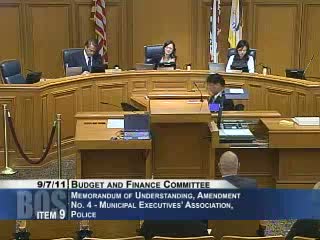
The Budget and Finance Committee on Sept. 13 voted to send a package of amended memoranda of understanding for police and fire bargaining units to the full Board without a committee recommendation after a lengthy public and supervisory debate.
Department of Human Resources Employee Relations Director Martin Grama told the committee the negotiated package includes short-term wage deferrals and an additional 3 percentage-point employee pickup of retirement contributions, applied contractually in addition to the existing 7.5% contribution. Grama said the combination of concessions and the retirement pickup would produce roughly $20 million to $30 million in savings over the first two years and that the agreements were crafted with contingency language tied to competing pension ballot measures.
Public Defender Jeff Adachi, speaking during public comment, urged the Board to commission an independent cost analysis before approving the MOUs. Adachi said the contracts could increase pension costs over time and cited figures he said showed long-term exposure he characterized as “$45 million now” and as much as “$127 million over 20 years.” He also warned that language in the agreements could exempt police and fire from contributions proposed in a rival ballot measure (referred to in the hearing as Prop D) and asked the committee to examine those costs.
Tom O—9Connor, president of Firefighters Local 798, defended the concessions as real sacrifices by members, saying the union members are “reaching into their own pockets” to address pension issues and that the $22 million savings figure reflects concessions already factored into retirement actuarial estimates.
Controller—9s Office staff (Monique Smoota) told the panel their cost letters used the most up-to-date actuarial information and that the $22 million estimate reflects the delta between the original contracts and the proposed amendments. DHR and the Controller—9s Office both said the concessions lock in near-term savings and that contingencies modify out-year effects depending on whether ballot measures are implemented and survive legal challenges.
Several supervisors—including Supervisor Kim—expressed support for the concessions but said they were uncomfortable with clauses that could bar the effect of a ballot measure on certain bargaining units and asked for more time to consult labor partners; the committee ultimately moved items 4, 6, 7, 8 and 9 to the full Board without a recommendation, citing the budgetary risk of delaying adoption of assumed savings.
What happens next: the full Board will take up the MOUs. Committee members asked the Controller—9s Office to make available its analysis and for staff to be prepared to answer follow-up questions about the projected $61 million impact cited by some speakers for particular contingencies in later years.