Get Full Government Meeting Transcripts, Videos, & Alerts Forever!
Get email alerts on the Sunday Streets topic
No spam. Unsubscribe anytime.
Supervisors send Embarcadero economic‑impact resolution to full board; ordinance on new street closures held
Summary
After hours of public comment from Fisherman’s Wharf merchants and neighborhood groups, the committee voted to forward a resolution ordering an economic study of two proposed Sunday‑street closures (Aug. 31 and Sept. 14) to the full board without recommendation and held an ordinance that would tighten board approval for new event routes.
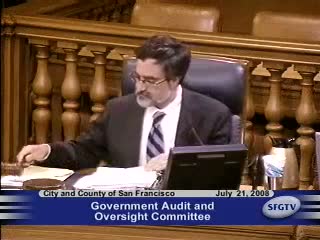
The Government Audit & Oversight Committee on July 21 voted to send a resolution to the full San Francisco Board of Supervisors asking the Office of Economic Analysis and the Office of Small Business to study the economic effects of proposed temporary Sunday closures of portions of the Embarcadero on Aug. 31 and Sept. 14. The committee did not recommend the resolution; it will proceed to the full board for further consideration.
Supervisor Aaron Peskin, who represents part of the affected waterfront, introduced the two items and said many merchants and residents had contacted his office with concerns about the selected dates and the process used by the mayor’s office. Peskin said the measure is about ensuring meaningful outreach and information, not about partisanship: “This is about communication,” he said, urging traffic and economic analysis before closures occur.
The mayor’s office, represented by Mike Farah and project manager Susan King, described the pilot as modelled on successful programs elsewhere and said corporate sponsors would cover direct event costs. King outlined the route as running from Third and Mendell through Terry Francois Boulevard, around China Basin and up the northbound Embarcadero to Washington and Portsmouth Square in Chinatown, and described the operation as a “soft closure” with ingress and egress maintained at staffed intersections. The mayor’s office estimated each event’s staffing and logistics at roughly $30,000–$50,000 and said Muni T and F lines would run free for the period.
Merchants and workers from Fisherman’s Wharf, Pier 39 and nearby hotels, restaurants and parking operations urged delay or a date change, saying the selected days fall on peak holiday weekend traffic and could cut off primary access from 280 and U.S.‑101. Jeffrey Pollock of the Fisherman’s Wharf Restaurant Association told the committee that Fisherman’s Wharf depends on Bay Area patrons who use those arterial routes and that merchants needed a study before a closure is tried on a busy weekend. “We just don’t want a beta test of our unknown program started on one of our busiest days of the year,” he said.
Labor and civic organizations (including the San Francisco Labor Council, Unite Here Local 2, the San Francisco Bicycle Coalition and Livable City) expressed broad support for the concept and urged either conducting the economic study on a quieter Sunday or working with merchants on mitigations. Cheryl Brinkman, president of Livable City, said other cities’ pilots have produced increased pedestrian traffic and, anecdotally, higher sales for nearby businesses.
After the testimony, Chair Peskin told the committee the controller’s office and Municipal Transportation Agency could perform the requested analyses; the committee agreed to forward Item 1 (the economic‑analysis resolution) to the full board without recommendation and to keep Item 2 (the transportation‑code amendment requiring Board approval of new routes) in committee at the call of the chair so stakeholders could continue negotiations.
Next steps: The resolution requesting an economic impact analysis will be added to the board’s calendar for further consideration. The ordinance amending the transportation code was held for further work and possible rescheduling by the chair.