Get Full Government Meeting Transcripts, Videos, & Alerts Forever!
Get email alerts on the Transportation topic
No spam. Unsubscribe anytime.
San Francisco committee advances ordinance to raise taxi gate fees and require greener cabs
Summary
The Government Audit and Oversight Committee sent an amended ordinance to the full Board that would raise the taxicab gate-fee cap to $96.50, authorize surcharges for low-emission vehicles, and require taxi companies to cut fleet greenhouse-gas emissions 20% from 1990 levels by 2012. The move followed extended public comment and debate over retroactive fee ratification and driver impacts.
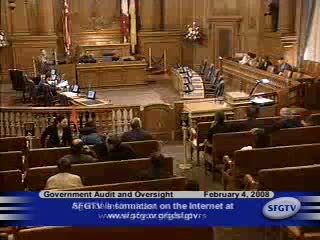
The Government Audit and Oversight Committee on (meeting date not specified) forwarded to the full Board an amended ordinance that would raise the taxicab gate-fee cap to $96.50, authorize surcharges for low-emission vehicles and require taxi companies to reduce fleet greenhouse-gas emissions 20% from 1990 levels by 2012.
Supervisor Gerardo Sandoval, who introduced the amendment of the whole, said the package was intended to "green the taxicab industry without bankrupting the companies and without doing so on the backs of cab drivers" and that the measure would allow companies to replace their fleets with low-emission vehicles within about three years. He said drivers would see conservative fuel savings of "$12 to $15" per shift from switching to hybrid vehicles and emphasized that the ordinance requires cars to be on the California Air Resources Board's Super Ultra Low Emission Vehicle list.
The Budget Analyst's Office presented fuel-cost comparisons showing a Crown Victoria shift fuel cost estimate of about $24.58–$25.38 and much lower per-shift fuel costs for hybrids. Severin Campbell of the Budget Analyst's Office said the office's tables indicate fuel-cost savings that would exceed either a $7.50 or $10 surcharge in most scenarios. Ted Egan of the Office of Economic Analysis said fleetwide mileage improvements could yield about "$20 per shift" in driver savings while imposing roughly a $3-per-shift company cost in his modeled example.
Paul Gillespie, president of the Taxi Commission, urged the committee to approve the ordinance to achieve a 20% greenhouse-gas reduction, calling it "the point of this" initiative and saying the city stood to cut roughly 30,000 tons of greenhouse gases annually if the fleet converted as projected. Gillespie, who also described personal experience driving a hybrid, said drivers commonly save $20 or more per shift in real-world operation.
Union representatives and other drivers cautioned that the measure risks transferring income from drivers to medallion or company owners. David Barlow of the United Taxicab Workers and other UTW speakers questioned whether drivers would actually realize the savings and said the ordinance's retroactive ratification of prior gate fees and the removal of earlier health-care commitments amounted to a reversal of promises to drivers. "These savings that drivers are supposed to be getting from alternative fuel are illusory," one UTW speaker said, arguing that higher gate fees without a meter increase shift money upward.
Company representatives and some drivers supplied waybills and operational figures intended to back the hybrid-savings case: Jim Gillespie of Yellow Cab provided trip records showing Crown Victorias at roughly 10 mpg and about $40 per shift in fuel versus a hybrid sample that used about $15 per shift for comparable distance. Some company speakers warned that a $7.50 surcharge might be insufficient to cover purchase and financing differentials for certain hybrid models and urged a $10 surcharge to accelerate fleet replacement.
A point of contention throughout comment was a retroactivity clause that would ratify gate fees charged between January 1, 2003, and October 27, 2006. Supporters said ratification would clear outstanding legal uncertainty and focus attention on future emissions reductions; opponents called it an attempt to short-circuit litigation and said it raised separation-of-powers and due-process concerns.
After extended public comment, Supervisor Michele Elliott moved to amend the package (reducing a proposed $10 hybrid surcharge to $7.50 and setting a $5 across-the-board gate increase), and to table Item 2. The chair determined the amendments were non‑substantive and, "without objection," the committee tabled Item 2 and forwarded Item 1 as amended to the Board of Supervisors meeting a week later.
The committee record shows the ordinance as amended will next be considered by the full Board; public speakers and union representatives said they intend to continue pressing for health-care provisions and additional oversight of medallion and gate practices.