Get Full Government Meeting Transcripts, Videos, & Alerts Forever!
Get email alerts on the DROP Program topic
No spam. Unsubscribe anytime.
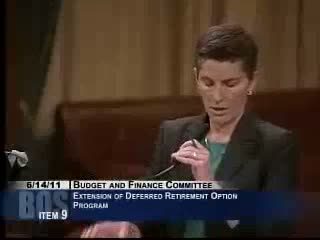
Controller finds DROP fails charter'mandated cost-neutrality test; actuary says results are indeterminate — committee forwards item without recommendation
Summary
The Controller's Office reported that San Francisco's Deferred Retirement Option Program (DROP) has not demonstrated cost neutrality under the charter; the Retirement System actuary said costs or savings cannot be determined with the limited 2.5-year sample but provided a preliminary estimate that making the program permanent could cost about 0.25% of payroll. The committee voted to forward the DROP item to the Board without recommendation.
The Budget and Finance Committee held an extended hearing on the Deferred Retirement Option Program (DROP), receiving a cost report from the Controller's Office, an actuarial analysis from the Retirement System's consultant (Chiron), and testimony from the Police Officers Association and independent actuaries.
Peg Stevenson of the Controller's Office summarized the controller's analysis and said the program is not demonstrating the cost neutrality required by the charter amendment that authorized DROP. Stevenson reported that, based on available data and the consulting actuary's modeling, the retirement-system cost of continuing the program permanently would be approximately $52 million amortized (which translates to an estimated ongoing actuarial cost of about 0.25 percent of payroll, roughly $6 million annually amortized over 20 years). Controller staff also estimated city operating savings from deferred recruitment and training to be much smaller than the retirement-cost increase under the modeled scenarios.
Chiron actuary Bill Hallmark said the question of net cost or savings cannot be answered with certainty from the limited 2.5 years of experience, noting that members who entered DROP may have altered their retirement timing in ways that make counterfactual comparison difficult; using current behavior, Chiron estimated a possible long-term cost of about 0.25 percent of payroll if the program were made permanent but cautioned it is an initial estimate subject to revision with more experience.
Retirement System staff provided demographic detail: of 564 eligible officers, a subset had elected DROP and many remain enrolled; the retirement system and actuaries said more time and data would reduce uncertainty. The Police Officers Association and its actuarial consultant argued the sample is too small, warned of a potential staffing crisis if DROP were eliminated, and urged a time-limited extension to allow more data collection. The committee debated whether an extension would yield more conclusive evidence and noted that the charter does not permit modifying program mechanics without voter action.
After discussion the committee voted to forward the item to the full Board of Supervisors without recommendation to allow broader deliberation and stakeholder engagement.