Get Full Government Meeting Transcripts, Videos, & Alerts Forever!
Get email alerts on the Infrastructure Bond topic
No spam. Unsubscribe anytime.
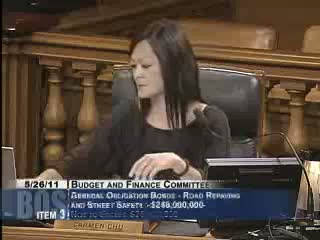
Budget committee advances $248 million streets and safety bond to ballot
Summary
The Budget & Finance Committee voted to forward a proposed $248 million general obligation bond to the full Board with a positive recommendation. The bond would fund street repaving, 1,900 curb ramps, pedestrian and bicycle safety projects, structures repair and transit signal work; the budget analyst noted ~$189 million in projected interest costs over the life of the bonds.
The San Francisco Budget and Finance Committee advanced a $248 million general obligation bond measure to the full Board of Supervisors on a positive recommendation, saying the funds would shore up the city’s deteriorating street network and pay for sidewalks, curb ramps and safety improvements.
Douglas Legg, manager of finance, budget and performance at the Department of Public Works, told the committee the bond is designed to halt a decline in pavement condition. “This bond…will provide, with other sources…funds to keep us on track to actually improve the condition of our streets,” Legg said, citing the city’s pavement condition index and a projection that without the bond average PCI would slip further in three years.
DPW’s plan would direct about $148 million to repaving and reconstruction, $22 million to sidewalk accessibility (about 1,900 new curb ramps and roughly 125,000 square feet of sidewalks), $7.3 million to street structures (bridges, guardrails, tunnels and stairs), $50 million to pedestrian and bicycle safety and streetscape improvements, and $20 million to traffic infrastructure and transit signal upgrades.
The department emphasized coordination with other utilities and agencies to reduce redundant street digs and said preventive treatments such as slurry sealing extend pavement life by five to seven years. “All of those are considered capital assets,” Legg said, noting that resurfacing typically yields a 20‑ to 30‑year useful life.
Budget Analyst Mr. Rose summarized the long‑term cost: estimated total debt service of roughly $437.25 million over the bond period—$248 million in principal and about $189.2 million in interest—yielding an average annual debt service near $18.2 million. He said timing of issuance is expected to offset property tax rate increases because new bonds would be issued as older bonds are retired; on a $500,000 home the analyst estimated an annual tax impact of about $37.33 after homeowner exemptions.
Supervisors debated bonding versus pay‑as‑you‑go finance. Supervisor Wiener, who moved to forward the measure, said bonding is commonly used for street capital in other large U.S. cities and warned that delaying investment will convert resurfacing needs into more expensive reconstruction. The budget analyst and several supervisors noted the interest cost penalty of issuing debt rather than using available revenues, but concluded the present funding environment leaves few alternatives.
Public commenters representing the San Francisco Bicycle Coalition and Walk San Francisco urged approval on safety grounds, citing recent severe pedestrian injuries and the outsized safety impact of pavement quality on bicyclists.
The committee approved forwarding the bond with a positive recommendation and required future transparency measures including project schedules, scopes and budgets, oversight by a Citizens General Obligation Bond Oversight Committee, and project appropriations to come before the Board prior to spending.
The ordinance calling the bond election is expected in early July; the department said the Board must approve second reading by July 26 to meet the Department of Elections’ July 29 submittal deadline.