Get Full Government Meeting Transcripts, Videos, & Alerts Forever!
Get email alerts on the Zero Waste topic
No spam. Unsubscribe anytime.
Supervisors press agencies, Recology and unions as San Francisco seeks to reverse rising landfill tons
Summary
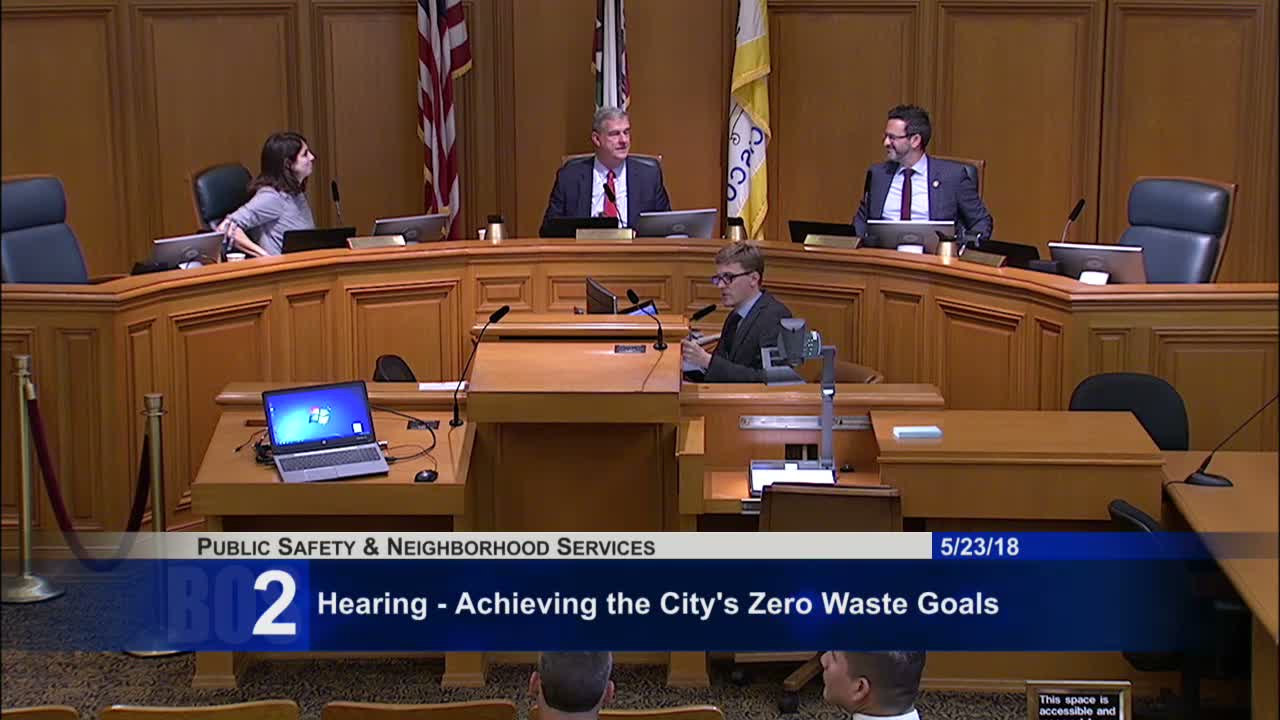
A May 23 committee hearing on the city's diversion rate reviewed causes for rising landfill tonnage — construction and demolition debris, large generators and consumption patterns — and discussed enforcement, producer responsibility and facility upgrades; unions and janitors urged more local processing and worker support.
City officials, Recology and labor representatives told a Board of Supervisors committee on May 23 that San Francisco must combine stronger enforcement, producer responsibility and infrastructure investment to reverse a recent increase in tons sent to landfill and move closer to the city's 0 Waste goal.
Supervisor Aaron Peskin Safaie (listed in transcript as Supervisor Safaie) opened the diversion hearing by reviewing the city's long‑standing 0 Waste goal, noting that while the city achieved a 75 percent diversion rate by 2008, current tonnage to landfill has leveled off and in some years increased. “We are not going to achieve 0 waste” without changes in behavior, enforcement and infrastructure, he said.
Debbie Rafael, director of the San Francisco Department of the Environment, told the committee that roughly 60 percent of material now going to landfill has a place in the blue (recycling) or green (compost) bins; another 25 percent is construction and demolition (C&D) debris that should be sorted or recovered; and the remaining 15 percent are items difficult for municipal systems to handle (diapers, soiled materials, some composite furniture). Rafael described three core challenges: bad actors bypassing registered C&D sorting facilities, large generators (hospitals, hotels, large apartments) that produce high volumes, and consumption patterns that create hard‑to‑process materials. She said the department will pursue stronger C&D regulation, enhanced outreach, and upgrades to Recycle Central (Pier 96) to accept film plastics and cartons.
John Porter of Recology described a major single‑family rollout that shrank standard trash carts to 16 gallons, increased recycling capacity and expanded accepted commodities; he said 78 percent of customers have accepted the new configuration and Recology invested about $14.7 million in Pier 96 upgrades. Porter and department staff said improved source separation, targeted technical assistance for multi‑family buildings and stepped‑up compliance enforcement (notices, fines, rate adjustments) are central to capturing the estimated 60 percent of diverted tonnage.
Supervisors pressed staff on practical options. Several members asked whether Recology could process the “black‑bin” trash stream to recover organics and recyclables; Recology said it has tested processing technologies (an OREX extrusion press and other equipment) and studied dirty MRFs but found that source separation yields higher quality recyclable commodities and that post‑collection processing currently recovers much less (about 20 percent) and risks contaminating recyclable streams.
Labor testimony emphasized workers’ role. John Bouchard of Teachers Local 350, representing Recology and Pier 96 employees, urged regulation requiring SF‑generated C&D to be processed locally and recommended more transparency on incoming loads. Janitor and teamster speakers said in‑building sorters and enforcement on building owners are important because janitors are often tasked with correcting contamination after tenants create it.
The committee indicated interest in follow‑up actions: targeted enforcement for large generators, pilot investments in additional worker‑led sorting or post‑collection processing where practical, and school‑based and multifamily outreach programs to change behavior. After public testimony, the committee filed the hearing for the record.
For now, staff emphasized a multipronged approach: continue outreach and technical assistance, expand producer responsibility initiatives and facility upgrades, increase enforcement against noncompliant C&D actors, and pursue long‑term options for post‑collection processing if technology and markets permit.