Get Full Government Meeting Transcripts, Videos, & Alerts Forever!
Get email alerts on the Corrections Jail Policy topic
No spam. Unsubscribe anytime.
Supervisors probe jail alternatives after DA wins MacArthur grant; sheriff warns CJ4 safety and requests planning funds
Summary
A long committee hearing on re‑envisioning the jail project produced divergent views: the DA urged a pause while the MacArthur‑funded review proceeds; the sheriff warned that County Jail 4 is seismically unsafe and requested planning funds to renovate County Jail 6 if alternatives do not reduce the population.
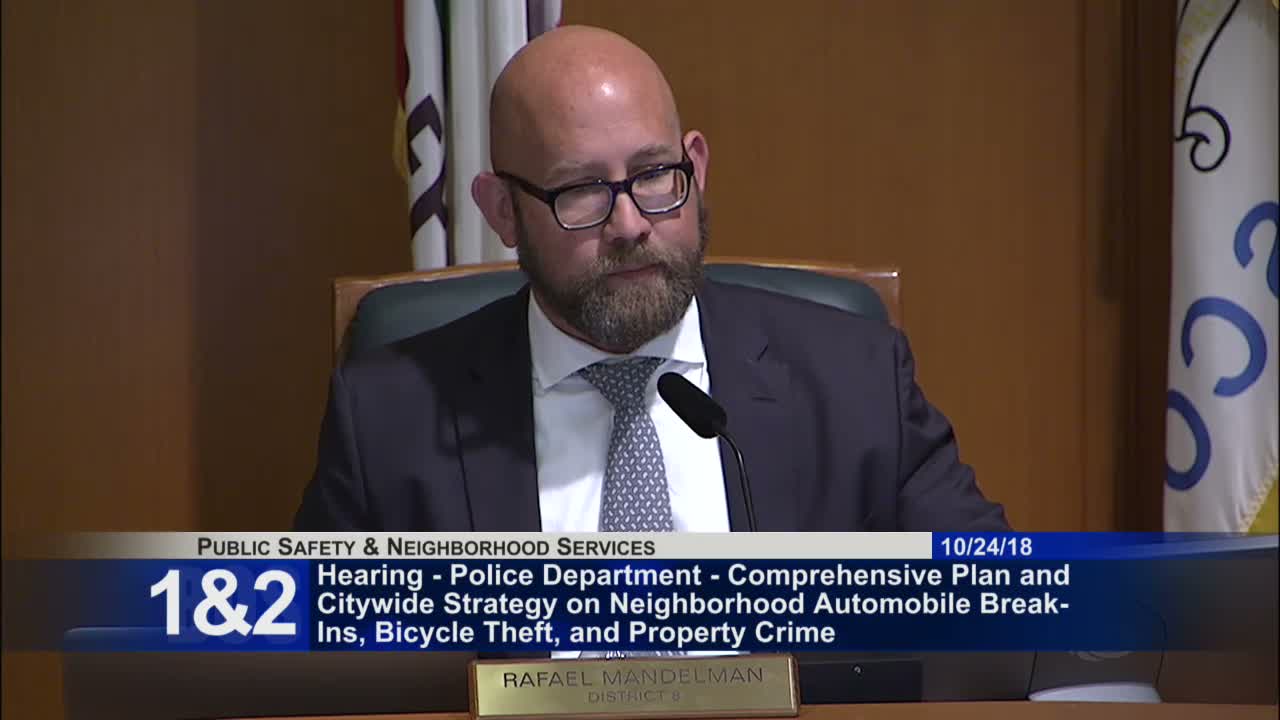
The Public Safety and Neighborhood Services Committee on Oct. 24 devoted several hours to updates from the Jail Replacement Project working group and competing proposals for addressing an aging, seismically vulnerable County Jail 4 (850 Bryant St.).
District Attorney George Gascon said his office obtained a $2 million MacArthur Foundation grant to fund an independent, two‑year systems review and recommended the Board “take a pause” on new construction while the outside analysis identifies capacity needs and policy levers to reduce the jail population.
“We need to figure out how to deal with that,” Gascon said, describing a grant‑funded process that will bring national experts to assess the system and recommend what kind of facility — if any — the city should build in the future.
Sheriff Vicki Hennessy described operational constraints and public‑safety risks at County Jail 4 and urged the Board to fund planning for possible replacement space. “County Jail 4 keeps me awake,” she said, arguing that a renovation plan for County Jail 6 in San Bruno would take 18 months to plan and require $9 million to $12 million in planning funds before construction could begin.
Panelists from the Department of Public Health, the Mayor’s Budget Office and the controller’s office summarized progress on alternatives the JRP recommended in 2016: behavioral‑health beds, expanded pretrial and diversion services and housing initiatives. Greg Wagner (DPH) reported some reductions in jail bed‑days for people awaiting transfers to county‑funded mental‑health beds; the controller said the county would need to reduce average daily population to about 1,064 to close County Jails 3 and 4 and estimated roughly 80,000 annual bed‑day reductions remain to meet that threshold.
Chesa Boudin, the public defender, described new units in his office that have increased releases and estimated the pretrial release unit could save about 11,200 jail bed days per year with current staffing; he also discussed pending litigation (Inray Humphrey) altering pretrial detention law and likely to increase release rates statewide.
Public comment was extensive and largely opposed to building or renovating more jail capacity. Community groups and formerly incarcerated people urged the Board to close 850 Bryant and redirect capital and operating dollars to housing, supportive services and neighborhood‑based alternatives to incarceration. Several speakers flagged racial disparities in the jail population and requested a sustained oversight body to track JRP implementation.
The committee did not adopt a final capital decision at the hearing. Members agreed to continue the item to the call of the chair so the MacArthur‑funded review and additional data can inform next steps; the sheriff reiterated she needs planning funds if the Board decides to move ahead with replacement capacity planning.
Next steps: supervisors requested follow‑up data on bed‑day drivers, the overlap between jail health users and community treatment caseloads, and a timeline for the MacArthur grant review and its deliverables.