Get Full Government Meeting Transcripts, Videos, & Alerts Forever!
Get email alerts on the Public Safety Property Crime topic
No spam. Unsubscribe anytime.
Supervisors Hear SFPD, DA on Neighborhood property‑crime unit progress; citywide auto burglaries down about 15%
Summary
SFPD and the District Attorney’s Crime Strategies Unit told the Board committee that a district‑level property‑crime liaison model plus centralized investigations and public outreach have produced declines in many districts but uneven results (notably Mission). Supervisors requested more station‑level workload and time‑on‑task data.
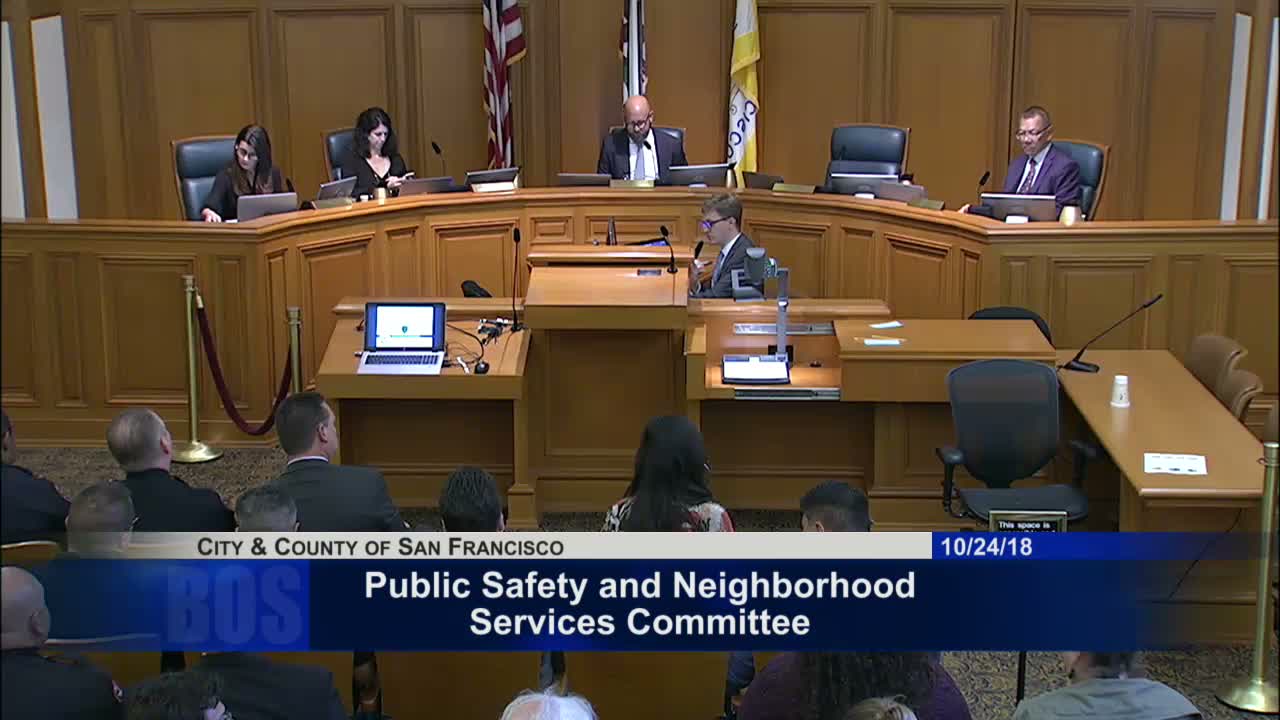
Chief Bill Scott and SFPD Deputy Chief Mike Redmond told the Public Safety and Neighborhood Services Committee on Oct. 24 that the department’s station‑based property‑crime liaisons, supported by a centralized investigations unit and public awareness campaigns such as Park Smart, have helped reduce citywide auto burglaries.
“Citywide, now we are at about a 15% decrease,” Chief Scott said, citing January‑through‑September data updating a July report to the Board.
The hearing combined two agenda items: a six‑month report on the department’s comprehensive plan and an update on the neighborhood property‑crime unit. Deputy Chief Redmond described a mix of tactics used at the station level — foot beats, targeted surveillance operations, bay‑car deployments and partnerships with parking‑lot managers — and said centralized investigative teams have produced arrests in serial burglary cases that contributed to local declines.
Maria McKee, principal analyst in the District Attorney’s Crime Strategies Unit, described spatial analysis of “hot spots” and in‑park garages and said her office’s work with parking managers identified a concentration of burglaries in particular lots. “Within a given auto burglary hot spot you are four times more likely to be the victim of an auto burglary inside of an in‑park parking lot,” McKee said, describing pilot collaborations to improve lighting, security and enforcement with MPARK and the SFMTA.
Supervisors pressed for more precise, comparable measures. Supervisor Ronan said the pilot was intended to test whether station‑by‑station, focused investigative attention would produce different results; Taraval has seen substantial declines, Ronan noted, while Mission has not seen the same level of improvement. Deputy Chief Redmond and Chief Scott said Mission faces different dynamics — higher event density, more calls for service and violent‑crime pressures — and proposed sharing station workload and staffing‑deployment metrics to allow year‑over‑year comparisons.
The District Attorney’s office noted prosecution rates for cases presented to it: Maria McKee said the office prosecutes roughly 80% of cases brought forward and described coordination aimed at stronger serial‑case presentations.
Public commenters offered a range of reactions, from praise for arrests and camera projects to critiques urging investments in housing and treatment rather than additional policing. Several residents urged expansion of camera registries and parking‑lot interventions; others said hiring more officers is not the preferred policy response.
The committee did not take a final policy vote on the report. Sponsors asked to keep the topic open for follow‑up, and the committee continued the item to the call of the chair so SFPD can provide station workload comparisons and additional data requested by supervisors.