Get Full Government Meeting Transcripts, Videos, & Alerts Forever!
Get email alerts on the Mission Street Rezoning topic
No spam. Unsubscribe anytime.
Committee advances plan to rezone 1650–1680 Mission Street, asks staff to clarify change-of-use fees
Summary
The Land Use and Transportation Committee forwarded three linked general-plan and zoning amendments for properties at 1650–1680 Mission Street, asking the city attorney to draft clarifying language to ensure any change-of-use fees are collected when office conversions occur.
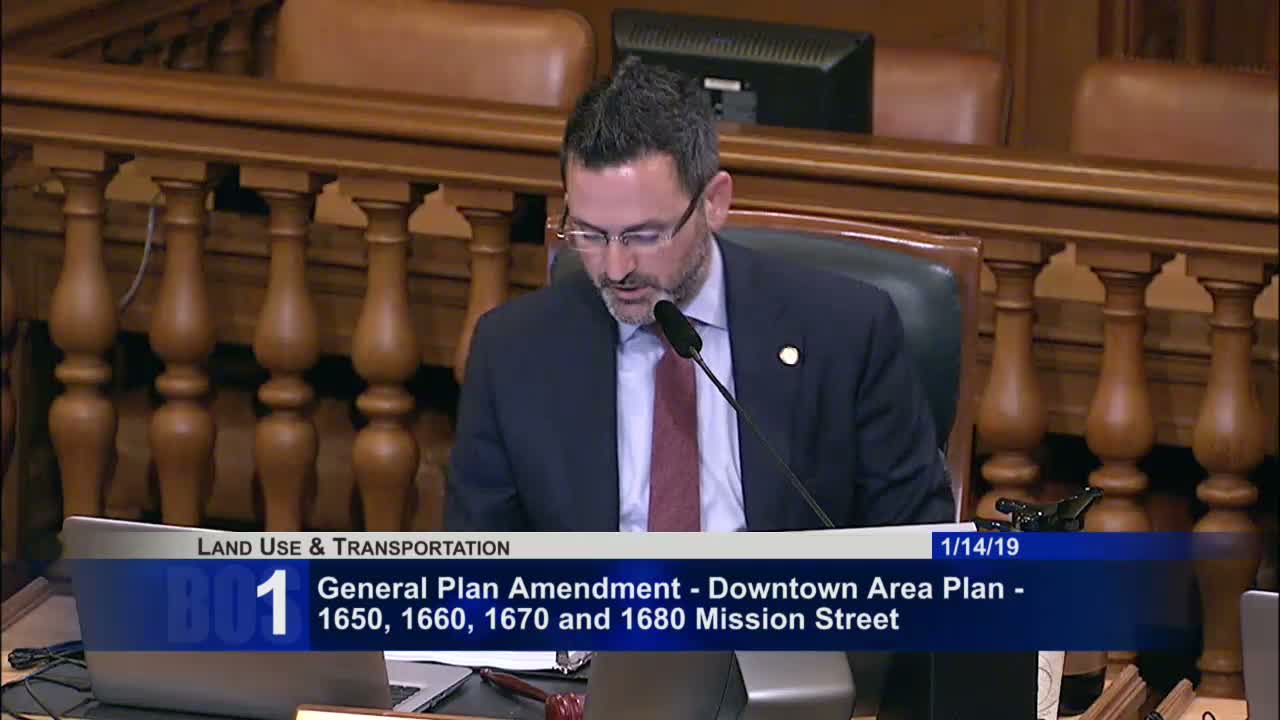
The Land Use and Transportation Committee of the San Francisco Board of Supervisors voted Jan. 14 to forward three related ordinances that would amend the general plan and rezoning map for properties at 1650 through 1680 Mission Street to a C3-G downtown general designation. Chair Supervisor Asha Safai convened the committee and Supervisor Aaron Peskin moved the committee report action, which passed without objection.
Aaron Starr, manager of legislative affairs for the Planning Department, told the committee the package includes two general-plan map amendments and a zoning code amendment to rezone the parcels to C3-G so the zoning map aligns with the general plan. He said the Planning Commission unanimously recommended approval on Oct. 25. Andreico Penick, director of the Real Estate Division, said the rezoning was contemplated in the city’s purchase-and-sale agreement for two of the parcels and that an appraisal (by Carnegie & Partners) used office comparables averaging about $650 per square foot, supporting an office highest-and-best use.
The committee heard a lengthy public comment from tenant advocate Sue Hester, who warned the city could lose substantial impact-fee revenue if buildings that have been used as city offices are treated as preexisting office without triggering conversion fees. Hester cited an appeal and a precedent she said allowed developers to avoid paying housing, childcare and municipal transportation fees in past conversions.
Supervisor Peskin and Planning Department staff clarified that the zoning administrator has determined these sites are considered office for Proposition M purposes and that a separate change-of-use application would be required to convert a public facility to general office use. Planning staff said any applicable impact fees would be triggered by that change-of-use application. To address the public’s concern, Peskin asked Deputy City Attorney John Gibner to draft language to add to the ordinance making clear that required fees are due and payable when a change-of-use application is filed; Gibner said drafting the language would likely be doable by the next day.
Peskin moved to forward items 1 and 2 to the Board as committee reports with recommendations and item 3 as a committee report without recommendation, subject to the clarifying amendment to be prepared by the city attorney’s office. The committee approved the motion without objection; the items will appear on the Board of Supervisors agenda on Jan. 29.
Background: Penick said the two parcels were part of a sale whose proceeds helped fund the 49 South Van Ness project. The record cited a sale-comparables approach in the appraisal and a cooperation clause in the purchase-and-sale agreement that anticipated a rezoning application by the buyer, but made clear rezoning would be undertaken by the Planning Department and the Board of Supervisors in their sole discretion.
The committee asked staff to obtain written confirmation from the zoning administrator for the record about the fee and classification determinations. The Board will consider the ordinances and any amendment clarifying fee collection when the items are scheduled for the Jan. 29 agenda.