Get Full Government Meeting Transcripts, Videos, & Alerts Forever!
Get email alerts on the Ct Peakers topic
No spam. Unsubscribe anytime.
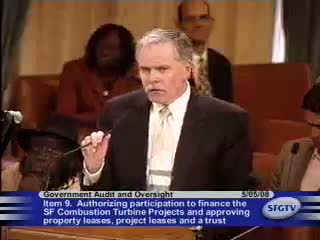
Supervisors hear technical disputes over proposed CT peaker project meant to permit Potrero shutdown
Summary
After hours of testimony, City departments and state agencies disagreed on whether three city‑sited combustion‑turbine peakers (plus one at SFO) are the only reliable way to remove Potrero/Moran from service. Climate and community advocates demanded fresh independent analysis and a fiscal feasibility review; the committee sent CT finance ordinances to the full board and tabled other procedural items for follow‑up.
The Government Audit & Oversight Committee devoted most of an extraordinary session to a technical and political debate over a San Francisco Public Utilities Commission proposal to site three combustion‑turbine (CT) peakers in the city and a fourth at SFO. The SFPUC argues the CT package, together with transmission work, is the only mechanism the California Independent System Operator (Cal ISO) will accept to remove the Potrero/Moran units’ Reliability‑Must‑Run designation and allow their retirement.
SFPUC General Manager Ben Harrington and power staff presented modeling and a financing plan that assumes Department of Water Resources (DWR) capacity payments through 2015 and later market or city uses for residual capacity. The Bay Area Air Quality Management District and independent consultants (Sierra Research) presented separate air‑quality modeling: both agreed the CTs would have substantially lower particulate and NOx emissions per megawatt‑hour than current Potrero operation in worst‑case comparisons; Sierra Research emphasized that the largest net reductions occur when comparing the full Potrero facility annual emissions to the proposed CTs because Potrero’s boiler often runs in inefficient modes.
Opponents — community groups, civic advocates and environmental organizations — pressed for an updated “2008 action plan” that fully evaluates the Transbay transmission cable, renewables, demand response, and other non‑fossil alternatives before approving long‑term capital borrowing to build CTs. Energy Commission staff explained their licensing process and said their alternatives and cumulative health analyses were extensive; Cal ISO and former ISO board members repeatedly said the ISO’s engineering requirement for some in‑city firm generation still stands regardless of Transbay, though several witnesses argued the ISO’s guidance should be reexamined.
On procedure, the committee approved sending the financing‑related certificates of participation (Items 9 and 11) to the full Board with recommendation; the committee split Item 10 into ordinance and resolution pieces and transmitted them with technical amendments. The Committee tabled two staff‑requested follow‑ups (a separate independent study motion and a fiscal‑feasibility motion) for further procedural work after members debated whether CEC, ISO and PUC analyses were already sufficient.
What happens next: The Board will consider the financing and siting ordinances at full session. Supervisors asked the SFPUC and ISO for written clarifications of operating‑hour assumptions, financing backstops after DWR payments end, and whether alternative portfolios (transmission + renewables + demand response) were formally submitted to ISO. Community groups signaled they will continue rapid advocacy and called for a short, independent review before any final capital commitment.