Get Full Government Meeting Transcripts, Videos, & Alerts Forever!
Get email alerts on the Hospital Security topic
No spam. Unsubscribe anytime.
Health department defends plan to contract hospital security as supervisors press for safety guarantees
Summary
San Francisco Department of Public Health proposed contracting some hospital security work to private firms to avoid service cuts; supervisors and the controller pressed for clearer safety comparisons, hybrid models and staffing numbers. The committee deferred a final decision for further talks.
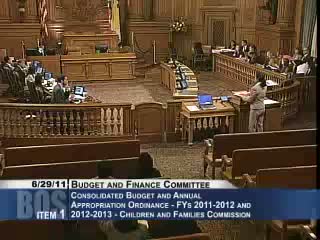
The San Francisco Department of Public Health told the Budget and Finance Committee on July 11 that contracting some hospital security services could avert deeper cuts to health and human services while meeting joint‑commission safety requirements.
"We put this up not to increase our safety ability, but to not have to cut as many health and human services," Director of Health Barbara Garcia said, describing a proposal that would replace many current sheriff posts with a contractor model intended to yield budget savings.
The proposal prompted sustained questioning from supervisors and fiscal staff about safety trade‑offs and the size of likely savings. Comptroller Ben Rosenfield told the committee an "IP‑only" contractor model would reduce costs by an estimated $600,000 to $900,000 per full year and about $300,000 to $450,000 for a half‑year, while the Department of Public Health and the mayor's office cited larger savings estimates bundled into the department's budget proposal.
Hospital managers and DPH representatives told supervisors the core operational argument is that private, medically trained security staff could assist with medically driven detentions and crisis management in ways sheriff deputies, constrained by law‑enforcement duties, do not. "The sheriffs feel legally bound that they cannot intervene in those medical crisis situations with patients," Todd (hospital representative) said, and DPH said JCAHO (Joint Commission) expectations require the hospital to provide safe care in those situations.
Supervisors pressed for alternatives and clarifications. Supervisor Weiner and others urged exploration of a hybrid model—contracting routine coverage while retaining deputies in the highest‑risk areas, such as the emergency room or psychiatric wards. DPH acknowledged the hybrid option could be compatible with their concerns about both safety and savings.
Committee members also asked for precise staffing baselines. DPH said there are roughly 49 deputy sheriffs on hospital posts at any given time and noted a work‑order listing of 84 positions; Mr. Rosenfield and mayoral budget staff warned that comparisons of contractor and civil‑service models must be apples‑to‑apples because differences in supervisory versus working supervisory classifications affect cost math.
No formal vote was taken on the contracting proposal at the July 11 meeting. Chair Carmen Chu and several supervisors said they wanted more time to compare cost estimates, safety protocols and union proposals; Chu said additional conversations would occur and she supported moving the item for further discussion the following day.
Next steps: supervisors directed staff and the mayor's office to continue negotiations and to provide clearer written comparisons of the contractor model, the IP‑only alternate and hybrid variants before the committee resumes deliberations.