Get Full Government Meeting Transcripts, Videos, & Alerts Forever!
Get email alerts on the Shelter Crisis topic
No spam. Unsubscribe anytime.
Committee advances two-part shelter crisis package to speed shelters, contracting and approvals
Summary
The committee forwarded two mayoral ordinances to streamline contracting and adopt alternative building procedures for shelters during a declared shelter crisis; the measures include a five-year sunset (or a 30% reduction trigger), adoption of California Appendix N for emergency shelter standards, and a board veto process for specific sites.
The Land Use & Transportation Committee on March 19 recommended that the Board of Supervisors consider two ordinances intended to accelerate the creation of homeless shelters and related services during a declared shelter crisis.
Emily Cohen of the Mayor's Office framed the package as building on a 2018 shelter emergency. She said San Francisco faces roughly 7,500 people experiencing homelessness on any given night, about 4,300 of whom are unsheltered, and that the city's shelter waiting list runs at more than 1,100 per night. Cohen said the 2018 emergency authority helped open temporary beds and navigation centers and that the current ordinances would expand contracting tools and adopt alternative building procedures tied to AB 932 and California state building code Appendix N.
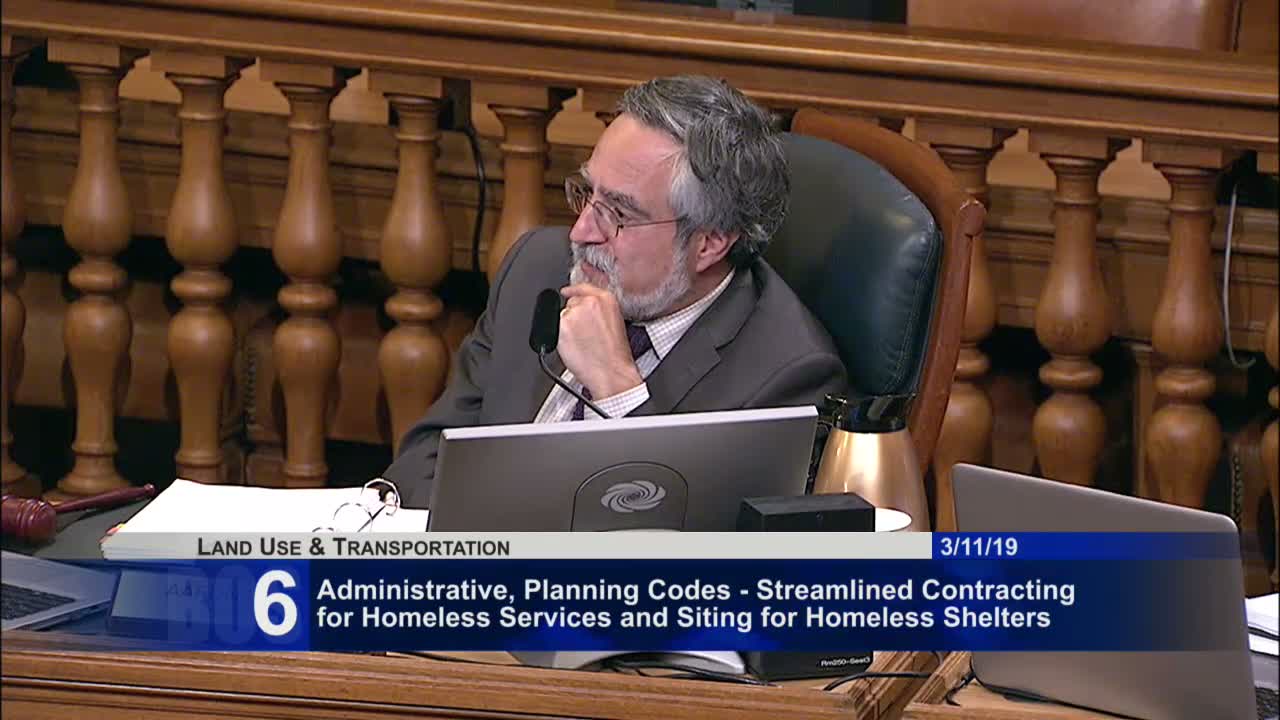
Item 6 (administrative and planning code changes) would streamline contracting and remove certain planning-code barriers for siting shelters, allow longer-term use of navigation centers beyond a two-year limit, require robust community engagement before opening sites, and include a sunset of five years or until homelessness is reduced by 30 percent. Item 5 (building code amendments) would adopt Appendix N and an MOU-based alternative approval process among DBI, Fire, Public Works and Planning to confirm compliance with zoning and health standards for shelters; both items would require state sign-off where applicable.
Fire Marshal Dan Decociosio and Acting City Architect Ron Alameda said the streamlined approval process would not waive fire life-safety requirements and that their departments support the ordinances. Gigi Whitley, Deputy Director for Admin and Finance at the Department of Homelessness and Supportive Housing (HSH), described "safe centers" as larger navigation-center-like facilities that aim to reduce the per-bed cost while preserving enriched services, and said the department plans to rely more on mobile and regionalized service models rather than fixed on-site staffing ratios.
Service providers and nonprofits — including Larkin Street Youth Services, HealthRight 360, Mission Housing Development Corporation and others — urged the committee to advance both ordinances, citing the urgency of shelter needs and the ability of the measures to bring beds and services online more quickly.
Supervisors pressed for clarity on contracting scope (what waivers apply to rapid rehousing and other services), limits on where expedited procedures apply, and how changes would affect specific projects such as the Seawall site. Supervisor Matt Haney offered recital language committing the city to expand the successful shelter-and-service model across supervisorial districts; the chair accepted that language as an amendment.
The committee sent both items to the full Board with a positive recommendation. Committee members noted the package still requires state sign-off for certain building-code provisions and that the Board retains oversight authority over contracts via threshold rules in the charter. The package includes a mechanism by which any Board member could disallow expedited building procedures for a particular site by passing an ordinance with a majority vote.