Get Full Government Meeting Transcripts, Videos, & Alerts Forever!
Get email alerts on the Museum Of Ice Cream Type42 topic
No spam. Unsubscribe anytime.
Supervisors to recommend denial for Museum of Ice Cream’s on‑site beer‑and‑wine permit after district concerns
Summary
The committee voted to forward a resolution recommending denial of the Museum of Ice Cream’s application for a type 42 on‑sale beer and wine license, citing district supervisor concerns about public convenience and necessity despite ALU’s recommended conditions and applicant agreement.
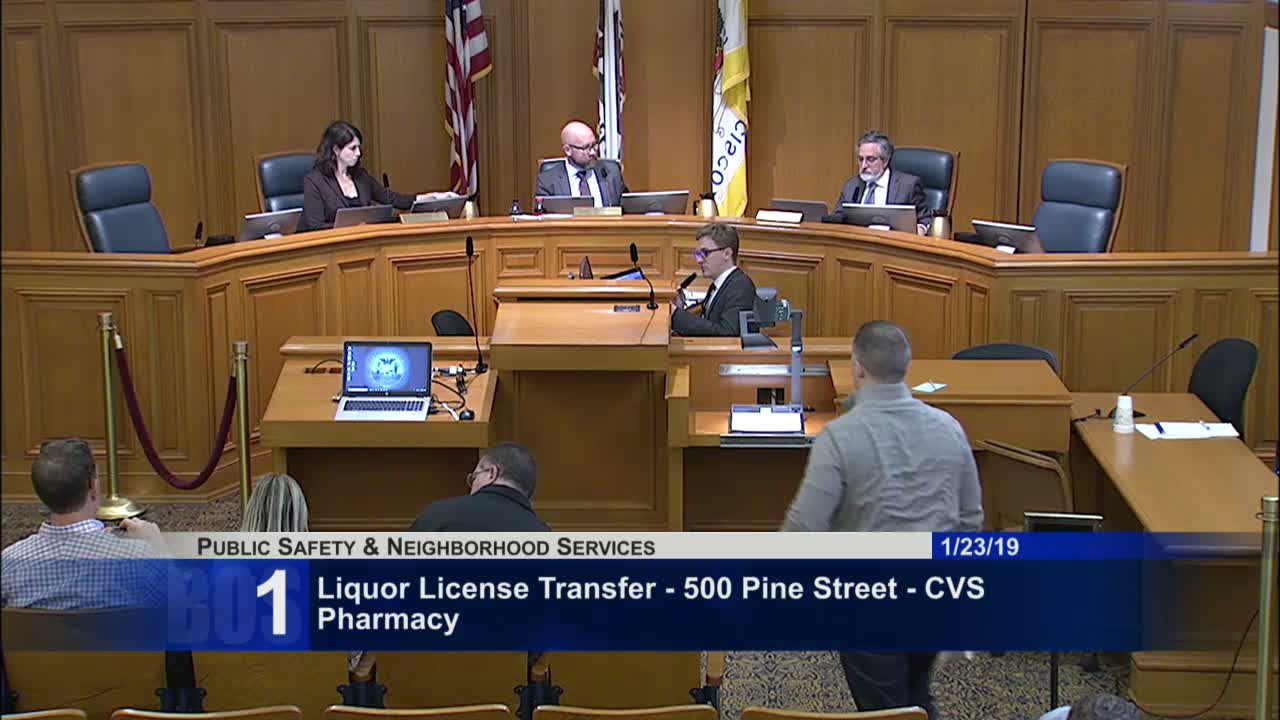
The Public Safety and Neighborhood Services Committee on Jan. 23 moved to forward a resolution recommending denial of the Museum of Ice Cream’s application for a type 42 on‑sale beer and wine license at 1 Grant Avenue.
Officer Patrick Mackey of the San Francisco Police Department’s Alcohol Liaison Unit told the committee there were zero letters of protest or support in the file and that the applicant had agreed to ALU’s recommended conditions, including restricted hours and monitoring requirements. ALU’s packet initially included a typographical error listing a type 21 license on one page; ALU staff corrected the record during the hearing and confirmed the correct application is for a type 42.
Gemma Lester, a consultant for the applicant, described the Museum as an innovative attraction that brings significant visitor traffic and said the young, female owners had agreed to conditions and expected to close earlier than maximum allowed hours. Danica, the museum’s general manager, said the museum had served hundreds of thousands of visitors and that the bar would be a separated mezzanine area intended to complement the exhibit experience.
Supervisor Peskin, whose district includes the site, said he could not find a public convenience or necessity for the type 42 permit and noted prior city interactions with the museum (including a city grant and earlier operational issues). Vice Chair Ronan recommended giving Peskin’s office time to meet with the applicant, but the committee discussed statutory timelines: the clerk said the board has 90 days to act and Jan. 24 would be the ninetieth day, after which the state agency may act on its own.
Deputy City Attorney John Gifford reminded the committee that the Board of Supervisors cannot impose binding conditions on state permits; the board can urge the state to adopt conditions but cannot itself set the state’s permit conditions.
Supervisor Peskin moved to prepare a resolution finding that the public convenience or necessity would not be served and to forward that recommendation to the full Board. The motion was taken without objection.
Next steps: The resolution will be prepared and placed on the full Board agenda. The committee record and the state’s 90‑day review deadline were discussed as part of scheduling and outreach considerations.