Get Full Government Meeting Transcripts, Videos, & Alerts Forever!
Get email alerts on the Liquor License Cvs topic
No spam. Unsubscribe anytime.
Committee urges denial of CVS liquor license at 500 Pine after neighborhood objections
Summary
The Supervisors’ Public Safety and Neighborhood Services Committee voted to forward a resolution recommending denial of CVS Pharmacy’s request for a type 21 off‑sale liquor license at 500 Pine, following department conditions, applicant testimony and multiple public protests citing proximity to recovery housing and public‑safety concerns.
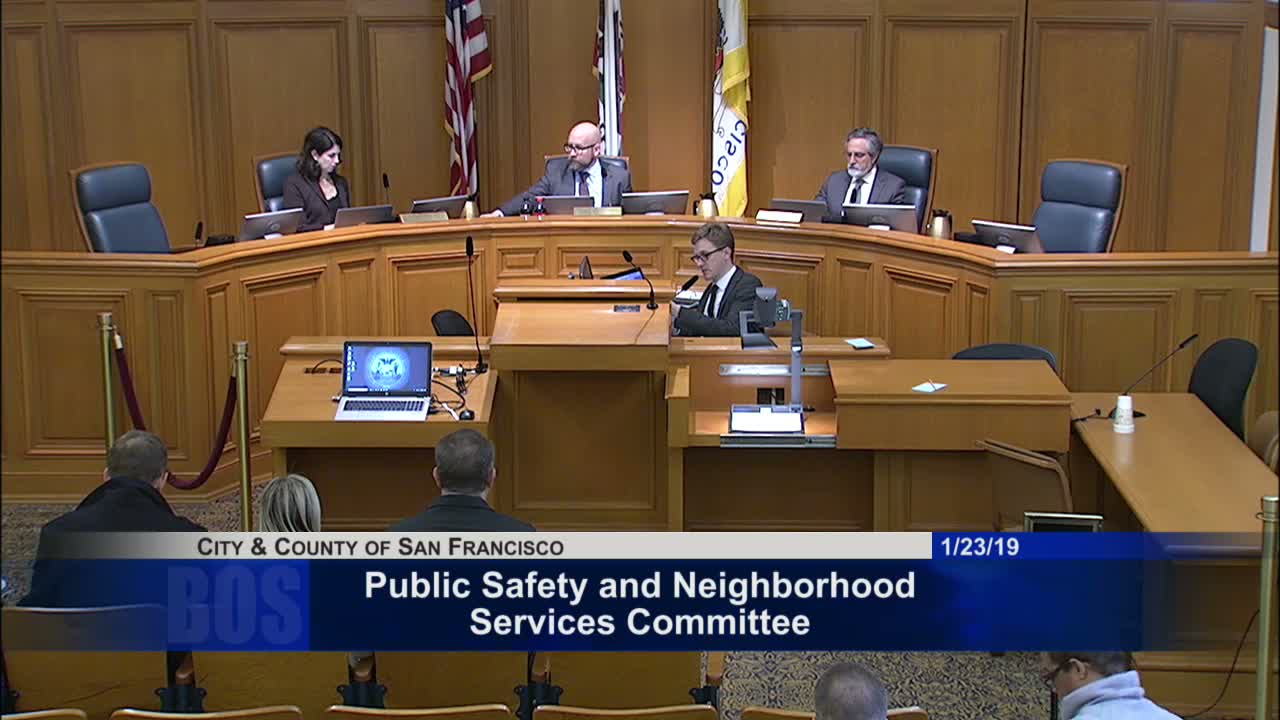
The Public Safety and Neighborhood Services Committee on Jan. 23 recommended that the full Board of Supervisors deny CVS Pharmacy’s request to transfer a type 21 off‑sale general liquor license for the store at 500 Pine.
Sergeant Gigi George Washington of the San Francisco Police Department’s Alcohol Liaison Unit presented the department’s report, saying the application had seven letters of protest and zero letters of support, and noting the site is in Plot 160 and Census Tract 117, which the packet characterized as high‑crime and high‑saturation areas. ALU recommended the license be approved only if the board adopted a set of conditions the applicant had accepted, including limiting sales to 7 a.m.–10 p.m. daily; prohibiting sales of certain single‑container low‑price products and premixed wine cocktails; limiting wine above 15 percent alcohol by volume; prohibiting distilled spirits in containers smaller than 600 milliliters; and requiring petitioners to monitor the area to prevent loitering.
Jody Knight, counsel for the project sponsor, and Steven Labonge, CVS real‑estate director for the West Coast, described the store as an operating neighborhood pharmacy with about 85 square feet of shelf space devoted to alcohol and said CVS had agreed to the ALU conditions. Labonge said CVS has roughly 18 stores in the city and was “always open to better ideas” to prevent nuisance sales.
Several neighborhood residents and business owners urged denial. Dan Galvin, a resident near Portsmouth Square, said the store’s proximity to Swords to Plowshares recovery housing made early‑morning alcohol sales particularly harmful. “If they’ve got access to liquor that early in the morning, I don’t think that really is a boon to the whole community at all,” Galvin said. Nearby residents described worsening street conditions and the risks early access would pose to people in recovery. Mo Mana, who owns a liquor store at 300 Kearny, warned that corporate retailers undercutting small businesses would replicate across blocks.
Michael Nolte, one of the protestants, told the committee he saw no evidence of community outreach or letters of support and submitted materials comparing the case to prior controversies over corporate liquor retailers. Nolte also raised concerns about empty containers and neighborhood impacts.
Supervisor Peskin, citing the BevMo precedent and testimony from neighbors at 250 Kearney, moved that the committee direct the clerk to prepare a resolution finding that the public convenience or necessity would not be served by the application and forward that recommendation to the full board. The motion was taken without objection.
Next steps: The committee’s recommendation will be placed on the full Board of Supervisors agenda for consideration on Jan. 29; the city’s action will go to the state agency after the board acts or when the state’s 90‑day review period expires.