Get Full Government Meeting Transcripts, Videos, & Alerts Forever!
Get email alerts on the Airport Noise topic
No spam. Unsubscribe anytime.
San Francisco supervisors, airport officials press FAA after NextGen concentrates flight tracks over southern neighborhoods
Summary
Supervisors and airport leaders held a Dec. 3, 2018 hearing where residents described persistent sleep disruption from concentrated departure corridors after FAA NextGen changes; SFO urged FAA study of a "night-hush" offshore departure and congressional offices pledged to press the agency.
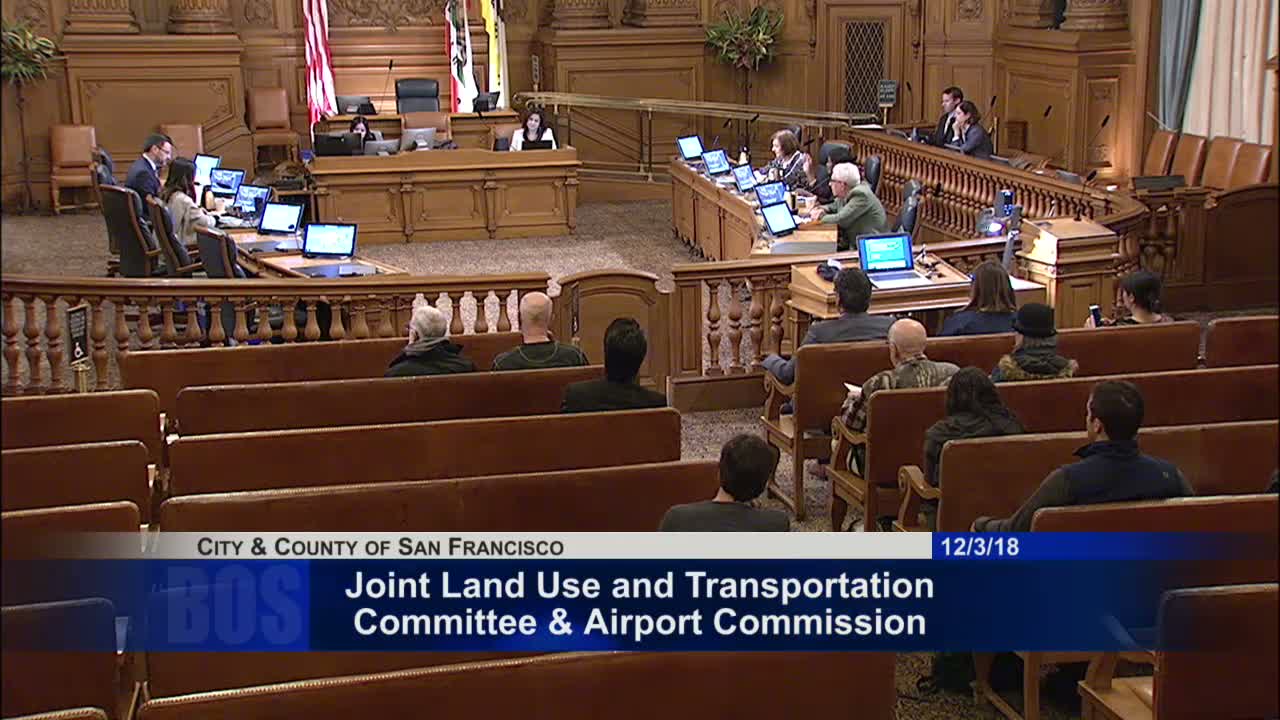
On Dec. 3, 2018, the joint San Francisco Land Use & Transportation Committee and the Airport Commission held a hearing on aircraft noise concentrated over southern parts of the city after the Federal Aviation Administration's NextGen navigation changes. Supervisor Asha Safai, who called the hearing, said residents have complained that GPS-based procedures implemented mid-decade turned once-dispersed tracks into a narrow "river" of departures that now pass over Bayview-Hunters Point, Visitation Valley, the Excelsior and other neighborhoods.
"It is too low, too loud, and too often," resident Luis Betanzas told the committee, summarizing what many speakers described as an around-the-clock problem. Multiple residents urged federal action and local advocacy, with some calling for a 10,000-foot minimum for flights over the city.
Director Ivar Sattero of San Francisco International Airport told the panel that NextGen, introduced in Northern California around 20142015, tightened departure corridors by shifting ground-based navigation to GPS. He displayed SFO noise contours and historical flight-track maps and said focus of traffic now places an outsized burden on southern districts. Sattero said SFO does not control flight paths or schedules but can advocate to the FAA, run a voluntary nighttime "flight quiet" program and measure airline compliance.
Sattero highlighted August 2018 data showing about 3,400 departures in the night period (10 p.m. to 6 a.m.), with roughly 432 of those flights over San Francisco at an average altitude of about 5,200 feet. He described SFO's network of permanent and portable noise monitors and said the airport has urged the FAA to study a "night-hush" offshore departure and a 050-degree heading, which would shift more departures over water and, in SFO's estimation, could handle operational capacity when combined.
Several residents said the federal noise metric (65 dB CNEL) understates disruption. "Jet noise above recommended levels is associated with adverse health effects," one commenter said, urging use of supplemental metrics and more public airing of studies such as Part 150 analyses. Others argued the FAA's NextGen rollout did not include adequate environmental review or public hearings in the region and urged congressional intervention.
Staff from Senator Dianne Feinstein's and Congresswoman Pelosi's offices and John Murray from Feinstein's office said the senators and representatives have written letters to the FAA and will continue to press for studies and engagement. Murray noted Senator Feinstein had raised Northern California concerns in 2016 and 2017 and would continue to press the agency.
Committee members asked technical and policy questions: whether the FAA could revert to pre-NextGen procedures (Sattero said it could and cited Phoenix as an example where operations were adjusted), whether an altitude floor such as 10,000 feet would be feasible (Sattero said any change would require regional airspace coordination and FAA analysis), and when a delayed FAA "noise annoyance" study mandated in reauthorization might be released (Sattero and supervisors said it is expected under reauthorization timelines, with a statutory deadline cited as October 2020).
Supervisor Safai and commissioners emphasized the city's limited direct authority over flight paths but stressed they would use elected representatives and public pressure to seek FAA action. The hearing concluded with a motion to file the item; the chair filed the hearing without objection. The hearing record shows continuing follow-up: SFO and the community roundtable will press the FAA on the night-hush study and notify congressional offices to seek earlier release of internal noise analyses.
The committee did not adopt new local regulation at the meeting; instead officials recorded community testimony, outlined technical options under FAA control and asked congressional allies to press for study release and procedural review. The Airport Commission said it will continue monitoring airline compliance with voluntary procedures and that SFO would pursue regional coordination with Oakland and San Jose as part of any solution.