Get Full Government Meeting Transcripts, Videos, & Alerts Forever!
Get email alerts on the Water Policy topic
No spam. Unsubscribe anytime.
Supervisors send resolution urging State Water Board to act on Bay‑Delta plan after tense debate with PUC
Summary
The committee adopted language urging the State Water Resources Control Board to adopt its proposed Bay‑Delta flow update and to consider voluntary agreements; SFPUC warned mandatory unimpaired‑flow rules could force large supply projects, rationing and rate rises if implemented without negotiated settlement.
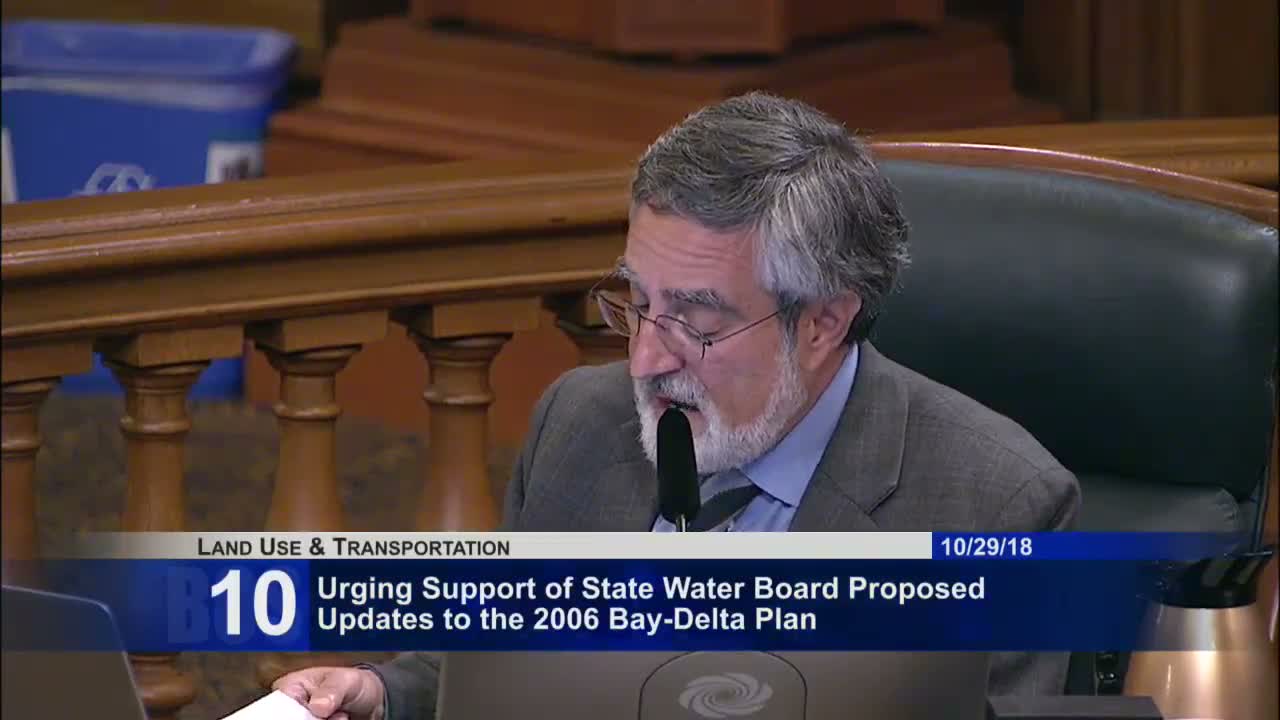
After a lengthy public hearing with more than two dozen speakers, the Land Use & Transportation Committee on Oct. 29 adopted and sent to the full Board a resolution urging the State Water Resources Control Board to act on its proposed update to the 2006 Bay‑Delta plan and to allow timely consideration of voluntary agreements.
Supervisor Aaron Peskin, the resolution’s lead sponsor, framed the vote as a push for science‑based action to protect the Bay and regional fisheries. General Manager Harlan Kelly of the San Francisco Public Utilities Commission told the committee the state draft would require the SFPUC to release roughly 100,000,000 gallons of water per day during dry years — roughly half the system’s average daily deliveries — and said that without negotiated settlements the utility would be forced to pursue large, costly alternative supply projects or face extreme rationing scenarios.
Michael Carlin, SFPUC technical lead on Tuolumne River planning, presented the SFPUC’s alternative approach that pairs targeted or “functional” flows with habitat restoration, predator suppression and an adaptive monitoring program. He argued targeted flows timed to biological needs plus nonflow measures could produce larger increases in juvenile fish survival per unit of water than an across‑the‑board unimpaired‑flow percentage.
Public commenters were sharply divided: fishing groups and environmental organizations urged immediate state action to increase flows, citing scientific studies and the Tuolumne’s collapsing salmon runs; many water districts and municipal water officials urged delay while ongoing voluntary settlement negotiations continue. The committee accepted language that acknowledged ongoing negotiations and explicitly encouraged timely voluntary agreements; the resolution was forwarded as a committee report to the Board of Supervisors.