Get Full Government Meeting Transcripts, Videos, & Alerts Forever!
Get email alerts on the Transit Safety topic
No spam. Unsubscribe anytime.
Committee hears Muni and SFPD data on transit crime; requests gender-disaggregated safety metrics
Summary
Supervisors held a hearing on public-transportation security focusing on rider and operator safety. Muni and SFPD reported multi-year reductions in assaults and robberies and described mitigation steps including expanded police surge deployments, video surveillance and near-universal driver enclosures; supervisors requested more gendered and sexual-assault data.
The committee convened a focused hearing Oct. 22 to examine security policies and procedures on San Francisco's public-transportation system. Sponsors flagged concerns that riders, particularly women, report feeling unsafe and that operator assaults have become a staffing and safety issue.
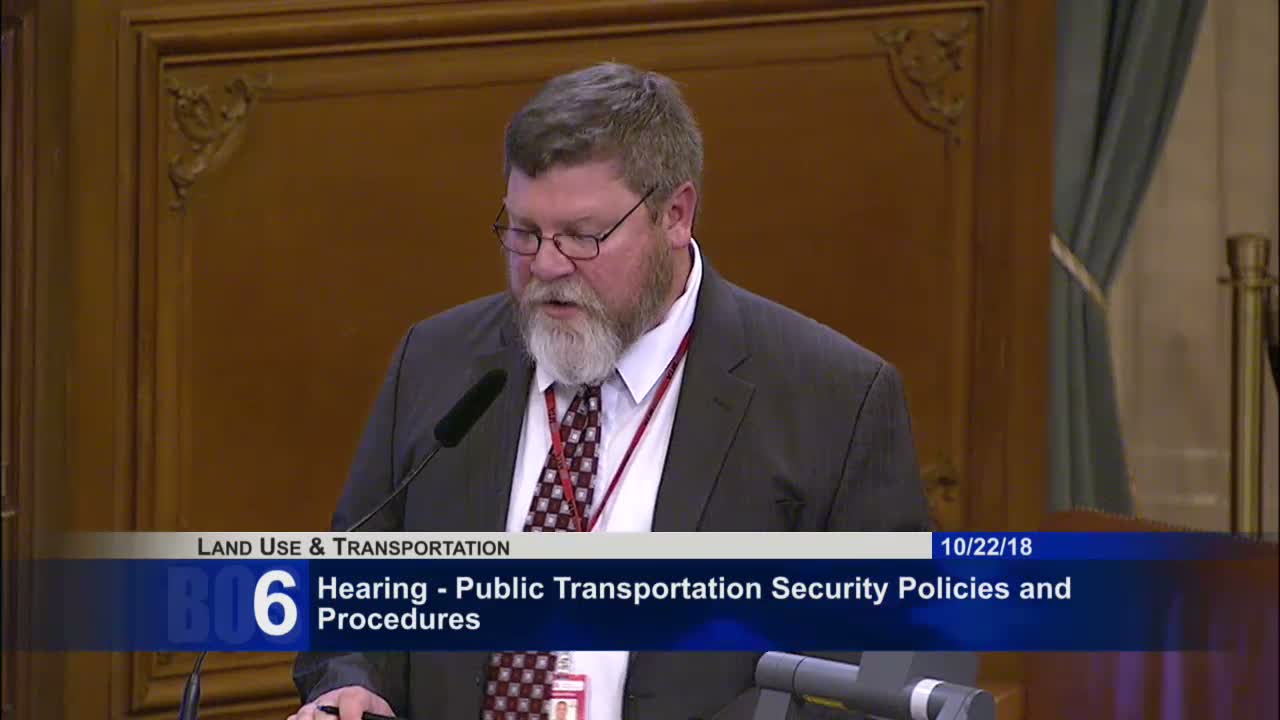
Muni security chief Chris Karparkovich presented five-year trends showing periods of decline in assaults and robberies (noting a 52% reduction in assaults since FY2015 and a cumulative 60% decline in robbery since FY2014) but also ongoing challenges with theft. He described the agency's "surge" deployment of SFPD officers on overtime, the use of plainclothes investigators, a proof-of-payment enforcement unit, contract security, improved video surveillance (45,000 videos provided to prosecutors in 2017) and near-complete installation of driver enclosures and silent alarms.
Commander Teresa Ewens (SFPD) described dedicated Muni policing resources (uniformed and plainclothes officers and an explosives K-9 unit) and close collaboration with BART PD for downtown station safety. Both agencies said data-driven deployments drove most improvements and that a fully resourced deployment in specific periods produced sharp crime reductions.
Supervisors pressed for gender-disaggregated data and specific counts for sexual assaults; staff said they do not currently analyze or publish most incident data by gender and will follow up with the specific breakdown and sexual-assault categories. Committee members also asked about safety conditions at public parking garages and about the responsiveness of on-call police after operator reports; staff said police response after-hours typically averages about five minutes.
Outcome: the committee filed the hearing (no ordinance action) and requested follow-up information including gender-disaggregated victimization data, sexual-assault categorization, line/time-of-day breakdowns and a briefing on parking-garage security improvements.