Get Full Government Meeting Transcripts, Videos, & Alerts Forever!
Get email alerts on the Housing Inclusionary topic
No spam. Unsubscribe anytime.
Land Use panel delays vote on changing Prop C grandfathering amid heated public outcry
Summary
The committee continued an ordinance that would adjust deadlines and fees for projects grandfathered under 2016's Proposition C after hours of testimony from housing advocates, developers and community groups. Supporters said the change would save thousands of units at risk; opponents said extending grandfathering would undermine voters' intent.
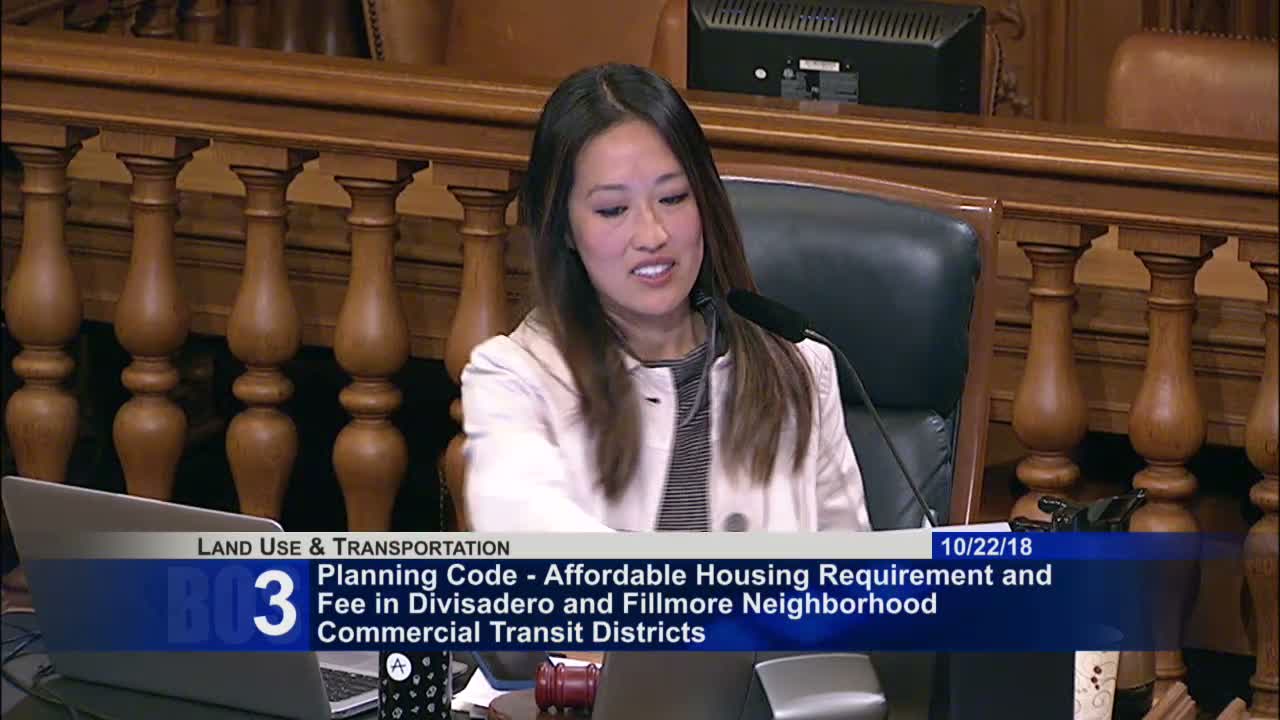
The Land Use and Transportation Committee on Oct. 22 continued consideration of an ordinance that would amend the city's inclusionary housing rules to modify the date by which projects grandfathered under Proposition C must obtain site permits, a move the mayor's office and OEWD warned could be needed to keep projects viable.
OEWD project manager Chrissy Otano told the committee the current 12/07/2018 deadline threatens roughly 4,000 housing units citywide, including about 600 permanently affordable units, given the long, multi-agency site-permit process. "Without this legislation, we risk losing over 4,000 units, including more than 600 permanently affordable units," Otano said.
Planning staff said the proposed change would align grandfathering with the ordinary 30-month post-entitlement site-permit standard used elsewhere in the code and clarified technical issues such as switching from on-site units to in-lieu fees and how density-bonus changes can trigger current inclusionary rates.
Public testimony was sharply divided. Labor and housing advocates warned that an extension would weaken a voter mandate: "By extending the deadline past December 7, you would effectively undermine the democratic process," said Diana Martinez of Dolores Street Community Services. Labor representatives and affordable-housing advocates also argued that thousands of units and hundreds of deeply affordable homes could be lost if projects cannot secure permits in time.
Developers and pro-housing groups countered that rising construction costs, longer plan-check timelines and interagency delays make the grandfathering deadline infeasible for many sponsors. "The pipeline is drying up," said Corey Smith of the Housing Action Coalition. Developers and counsel described permitting and regulatory 'paper cuts' that have delayed projects despite sponsor efforts to move in parallel with entitlement and site-permit work.
Supervisors debated targeted fixes. Some urged strict "use it or lose it" enforcement for projects that have not yet been entitled and suggested recapturing density-bonus fee exemptions for bonus units; others favored narrowly tailored extensions for projects demonstrably stalled by city processes. Deputy City Attorney John Givner said some proposed amendments (for example, recapturing fees on density-bonus units) may require additional referral or noticing.
After discussion, the committee agreed to continue the item to a Nov. 5 Land Use Committee hearing to allow the City Attorney to draft specific amendments and to give staff and community groups more time to refine proposed changes. The committee left open options including aggressive time limits, case-by-case demonstrations of cause for extension, and changes to fee treatment for bonus units.
Next steps: the sponsor and city attorney will draft amendments for the Nov. 5 Land Use Committee; the Board will consider the revised ordinance thereafter. The committee did not adopt the ordinance on Oct. 22.