Get Full Government Meeting Transcripts, Videos, & Alerts Forever!
Get email alerts on the Ethics Behested Payments topic
No spam. Unsubscribe anytime.
San Francisco committee adopts amendments expanding "interested parties" and bans solicited payments; item continued for one week
Summary
The Rules Committee voted to adopt amendments broadening the definition of "interested parties," extending a post-contract blackout to one year, and prohibiting solicited "behested" payments from interested parties (including elected officials); the ordinance was continued one week for finalization and further public input.
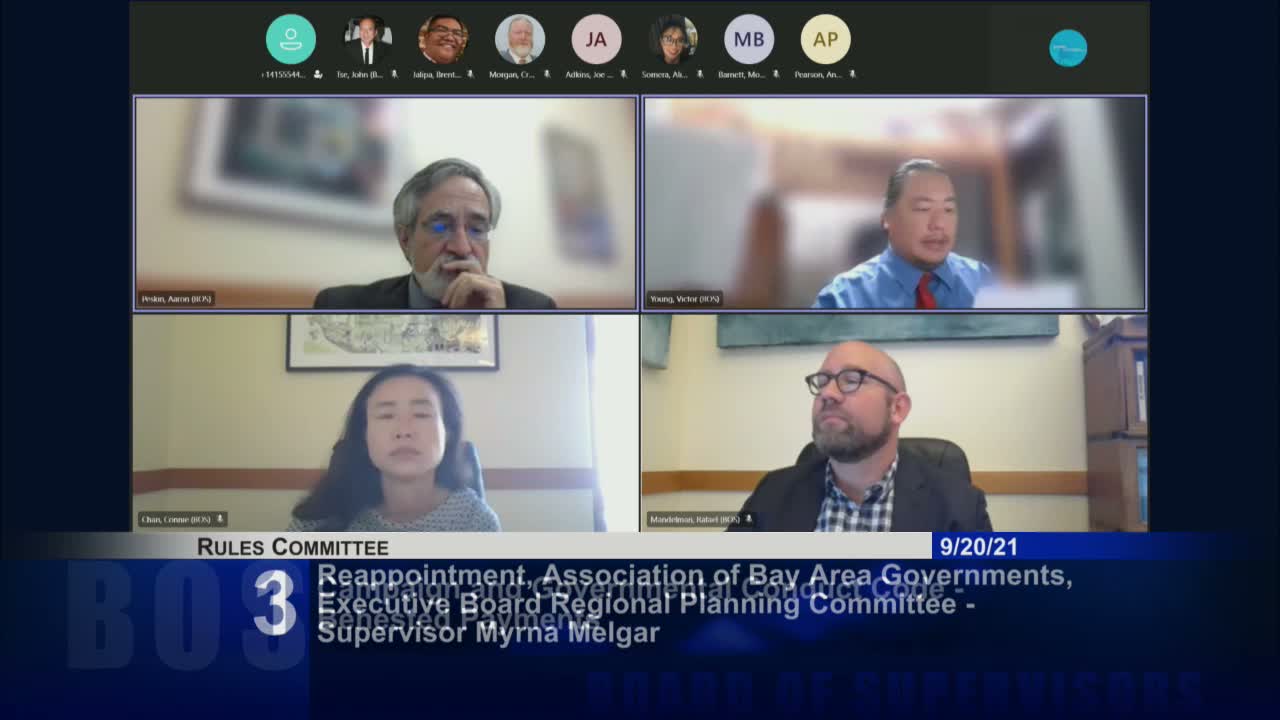
The Rules Committee of the San Francisco Board of Supervisors on Sept. 20 adopted a set of substantive amendments to an ordinance that would expand the city's definition of "interested parties" and prohibit appointed department heads, commissioners, designated employees and (by amendment) elected officials from soliciting behested payments from interested parties.
Chair Aaron Peskin framed the changes as anti-corruption measures intended to prevent "pay-to-play" practices. He said the amendments would enlarge the scope of interested parties to include city contractors and registered contact lobbyists, extend the blackout period for soliciting contractors from six months to one year after contract termination, and remove the local filing requirement for elected officials by instead prohibiting the conduct. Peskin cited prior corruption cases as context for the changes.
Deputy city attorney and ethics staff clarified that public-appeal solicitations (as defined in code) and routine communications are exceptions. Patrick Ford (ethics staff) said state law will continue to require elected officials to file behest payment reports for payments over $5,000; local reporting tied to interested-party solicitations would fall away if the prohibited conduct is in place. Supervisors Chan and Mandelmann asked for additional drafting clarification and expressed support for the policy aim while acknowledging nonprofit and First Amendment concerns.
Six members of the public spoke on the ordinance. Supporters from neighborhood and nonprofit groups (including Charles Head of the Coalition for San Francisco Neighborhoods and Debbie Lerman of the San Francisco Human Services Network) urged strong ethics rules but asked for careful drafting to avoid chilling legitimate charitable fundraising and to protect nonprofit staff who serve on city boards. Other callers accused widespread corruption and demanded enforcement and clarity.
The committee adopted the introduced amendments by roll-call vote (Mandelmann, Chan, Peskin aye) and then voted to continue the matter one week to Sept. 27 to allow members, staff and the public time to review the amendment language. Chair Peskin said he would work with stakeholders during the interim.
Next steps: the ordinance, as amended, will be before the committee again next week for further consideration and then returned to the full board as appropriate.