Get Full Government Meeting Transcripts, Videos, & Alerts Forever!
Get email alerts on the Sheriff Budget topic
No spam. Unsubscribe anytime.
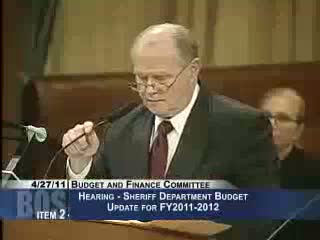
Sheriff warns AB 109 realignment could add millions to San Francisco jail costs
Summary
Sheriff Mike Hennessy told the Budget & Finance Committee that AB 109 realignment could increase county jail costs by several million dollars because state subvention ($25,000 per inmate) is well below local per-inmate costs (about $45,000'$48,000). The department proposed $144.9 million for FY2011-12 compared with current-year expenditures around $154.4 million.
At a San Francisco County Budget & Finance Committee meeting, Sheriff Mike Hennessy said his department's current-year expenditures are about $154,400,000 and his proposed budget for fiscal year 2011'12 is roughly $144,900,000, about $10 million less than estimated spending this year. "There is a graph that looks like this ... our expenditures have been or will be by the end of this fiscal year, dollars 154,400,000.0," Hennessy said.
The sheriff emphasized that the county's jail population recently declined, leaving one small San Bruno facility closed and vacancies in other jails, but cautioned that state criminal-justice realignment under AB 109 will likely raise the local jail population. Hennessy said AB 109 would send many people sentenced for nonviolent, nonserious offenses to county jails rather than state prison and noted uncertainty about sentence caps and how long such individuals might remain in county custody.
"The governor has also committed in writing ... that he signed saying that this realignment will not go into effect until he finds funding to provide to counties to pay for this," Hennessy said, adding the state's proposed payment of about $25,000 per inmate per year "is about half" of what San Francisco's costs appear to be: "Our costs are about twice that." Chair Carmen Chu and Hennessy clarified that local per-inmate costs are "45,000 to 48,000" annually, "close, close to 50,000" in Hennessy's estimate.
Hennessy said the department currently transports roughly 22 people per month to state prison for the types of crimes affected by realignment, and that the minimum state prison sentence is typically 18 months. He warned that county jail populations can "aggregate" as individuals serve longer local terms under the new law, which would raise custody staffing and operating needs.
Asked whether the proposed FY2011-12 budget reflects realignment costs, Hennessy described a budget "wish list" that would add about $2.6 million to custody costs and about $3.6 million for increased residential treatment if the population rises; he framed those items as priorities should the department need to expand alternatives to custody. He also cautioned judges could limit use of alternatives such as electronic monitoring, which would push costs higher.
Maureen Gannon, the department's chief financial officer, told the committee that a roughly $5'$6 million "city grants" line in the budget funds alternative and rehabilitative programs in and outside the jail (anger management, substance-abuse treatment and similar contracted services) and is drawn from the general fund, not federal grants.
Greg Wagner, the mayor's budget director, told the committee the supplemental appropriation coming before the Board would correct this year's budget to operate through July and is not intended to cover the full, potential next-year population increases from realignment; he said the primary fiscal impacts of AB 109 would be felt in the next fiscal year and that the mayor's office will have to make an "educated guess" about future jail population levels while the state finalizes its plan.
Public comment on the item was brief and informal. The committee continued the item to the call of the chair for further updates; a supplemental appropriation was expected to appear before the Board of Supervisors the following week.