Get Full Government Meeting Transcripts, Videos, & Alerts Forever!
Get email alerts on the Entertainment Commission topic
No spam. Unsubscribe anytime.
Supervisors forward grand jury recommendations on Entertainment Commission but stop short on term limits
Summary
A committee hearing on the February 2007 civil grand jury report on the San Francisco Entertainment Commission produced conditional support for several reforms — staff citation authority in principle, code changes to narrow permit duties, and stronger executive leadership — while rejecting immediate charter-level term limits. The committee will forward a revised resolution to the full Board with budget and staffing caveats.
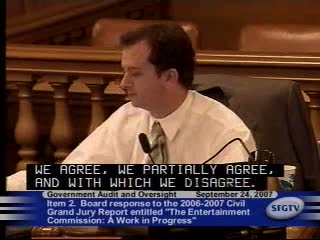
At a special meeting of the Government Audits and Oversight Committee, members heard a February 2007 civil grand jury report criticizing the San Francisco Entertainment Commission’s communications, oversight and operational practices and then instructed staff to forward a revised response to the full Board of Supervisors.
Jenny Parrish, a pro tem grand juror who presented the report, said the jury found both progress and gaps since the commission’s creation in 2003 under Administrative Code 90.1. The jury singled out weak interdepartmental communication, uneven leadership and poor quality or missing required reports and recommended steps including clearer staff roles, improved performance reviews and better coordination for major events.
"We urge the Board of Supervisors to follow the progress of the Entertainment Commission in implementing the recommendations of the civil grand jury," Parrish said during her presentation.
Bob Davis, Executive Director of the Entertainment Commission, told supervisors the commission welcomes the report and plans a retreat at Treasure Island to build cohesion and clarify roles. Davis confirmed the commission currently has four staff — director, deputy/permit administrator, commission secretary and a sound technician — and said his office has asked Supervisor Peskin to carry legislation that would provide nuisance/citation authority for staff to address noise and other neighborhood concerns.
"We have asked Supervisor Peskin to carry some legislation for us which we think will address that," Davis said, describing a measure the commission hopes will move forward in November.
Public comment at the hearing featured multiple neighborhood speakers who said the commission has not protected residents. Robert Garcia, president of the Save Our Streets tenants and merchants association, said the commission had been "ill conceived" and that neighborhoods have been overrun by clubs; he told the committee the commission was $250,000 over budget the previous year and unresponsive to neighborhood outreach requests. Jody Watson of Juniper Street Cares said her neighborhood has more than 150 documented police noise violations and that the commission failed to release an investigation report.
Supervisors debated four clusters of recommendations. They agreed to pursue code changes to reflect realistic permit responsibilities and to press for stronger executive leadership at the commission. On staff citation authority (recommendation A6), supervisors indicated conditional support in principle but raised concerns about sending current 1824-classified positions into enforcement roles without additional staffing or classification changes and said the police department would need to be part of any implementation conversation. The committee explicitly disagreed with trying to impose term limits for commissioners now, noting that a charter amendment would be required and was not appropriate to reopen immediately.
The committee directed staff to forward the resolution responding to the presiding judge as amended — with language that the Board "partially agrees, subject to financial constraints, budget analyst review and budget priorities determined during the annual budget process" — and to carry forward edits reflecting the committee’s direction on citation authority, code amendments and leadership issues. The matter will move to the full Board of Supervisors for final action.
The committee closed the public hearing on the Entertainment Commission without a formal recorded roll-call vote on the underlying grand jury recommendations; the item was forwarded to the full board as amended by the committee.