Get Full Government Meeting Transcripts, Videos, & Alerts Forever!
Get email alerts on the Land Use Development topic
No spam. Unsubscribe anytime.
Committee pauses India Basin development to allow more negotiation on affordability, labor and environmental questions
Summary
The Land Use Committee heard detailed presentations on the India Basin mixed‑use project (1,575 units, ~25% affordable, 11–14 acres of parks, $10 million off‑site transportation contribution) but continued the project items for one week to allow written labor commitments, AMI clarifications and environmental/notice follow‑ups.
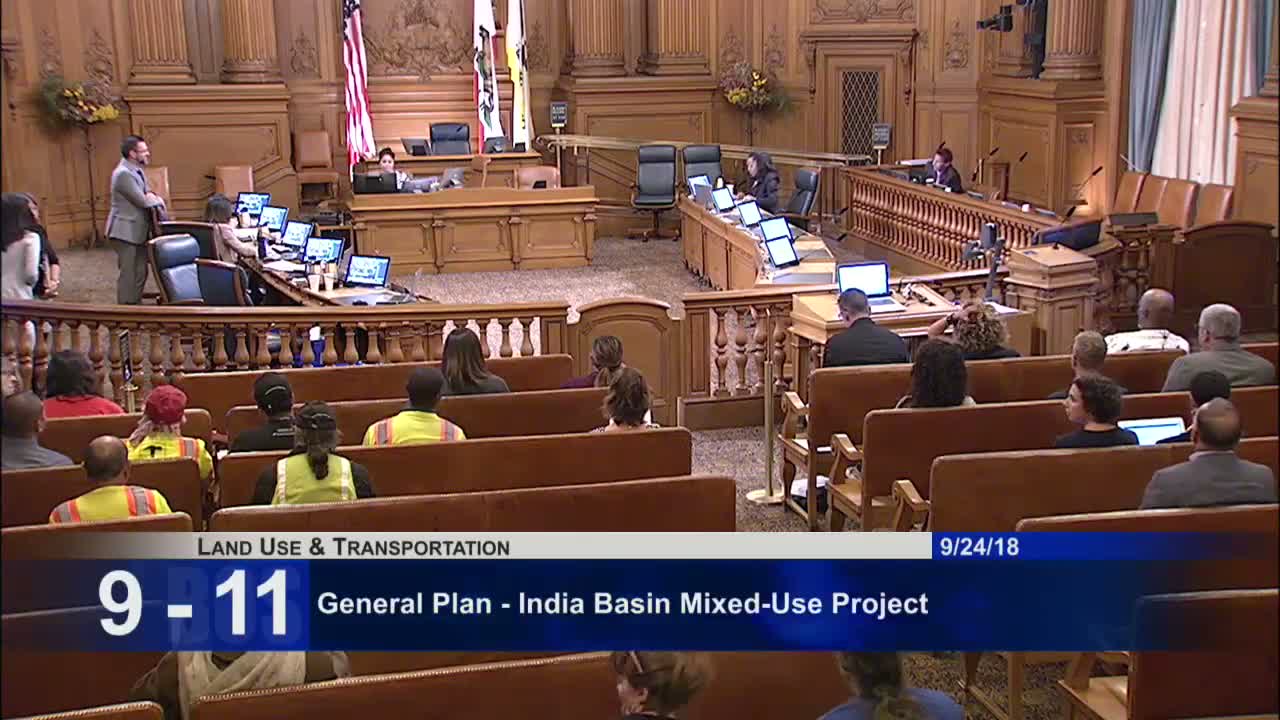
The Land Use Committee took testimony Sept. 24 on the India Basin mixed‑use development, a multi‑phase project spanning roughly 38 acres in Bayview Hunters Point that ties a large private housing proposal to a major new waterfront park and remediation of a brownfield site.
Supervisor Matt Cohen opened the India Basin portion and described the project as part of the city’s Southern Bayfront strategy. Planning staff said the actions before the committee include general plan amendments, planning code map and text changes to create a Special Use District for the 700 Innis portion and a development agreement for the private sponsor (Build Inc). Planning staff described the private component as ~1,575 housing units, 209,000 square feet of nonresidential space, and 14 acres of new and rehabilitated open space; Build Inc and Rec & Parks staff outlined park design, historical preservation goals for the Shipwright’s Cottage, brownfield remediation needs and an estimated remediation start in early 2020.
OEWD staff described the affordable housing program in the development agreement: 25% of market rate units (394 units) would be provided as below‑market units overall. The DA allows the developer to meet that obligation in multiple ways: inclusionary units scattered in market buildings, dedication of up to three parcels to a 100% affordable housing developer (up to 180 units), and an in‑lieu fee option capped so that no more than 75 units can be satisfied by fee‑out. OEWD said the DA sets average affordability targets (approximately 110% AMI for rental and 120% AMI for ownership as an average across on‑site affordable units) and includes a 40% local preference for affordable units. Staff also described community‑benefit commitments including a roughly $10 million contribution for off‑site transportation improvements and a services CFD expected to yield about $1.5 million annually for park maintenance.
Committee members pressed staff and the sponsor on several points. Supervisor Jane Kim sought written commitments on labor (project labor agreement and prevailing wage for vertical work), on permanent job programs for locals, on the Transportation Demand Management plan (staff said the project commits to a 20% reduction in daily driving trips relative to environmental baseline), and most urgently on precise AMI ranges and the mechanics of the in‑lieu option. OEWD and the developer confirmed negotiations with building trades were active; the horizontal infrastructure that will transfer to public ownership will be prevailing wage, and Build said it is in discussions with unions, but a signed project labor agreement was not yet in hand.
Public comment was extensive and sharply divided. Labor and trades speakers (carpenters, building trades council, union apprentices) supported the project for jobs and apprenticeship opportunities. Many neighborhood and environmental justice groups urged more stringent affordability requirements and raised concerns about pollution, incomplete testing, and sea‑level rise impacts. Green Action stated the EIR found unavoidable air‑quality impacts during construction and operations; residents and community groups also criticized insufficient translation and outreach in early CEQA notices.
Given those outstanding questions — written labor commitments, clarified AMI targets, and environmental/notice follow‑up — Supervisor Safaie moved to continue items 9–11 for one week to allow the parties time to produce a letter of intent and additional documentation; the committee continued the items as amended without objection.
The continuance preserves the project record while directing staff and the sponsor to return with more specific, written assurances on the key outstanding issues.