Get Full Government Meeting Transcripts, Videos, & Alerts Forever!
Get email alerts on the India Basin Development topic
No spam. Unsubscribe anytime.
Contested India Basin development advances to full Board after committee debate over income bands and in‑lieu fees
Summary
Supervisor Cohen's India Basin plan and development agreement were amended in committee and sent to the full Board as a committee report without recommendation after extended debate about affordable-home AMI bands, price caps, and whether in-lieu fees should require a higher on-site equivalent.
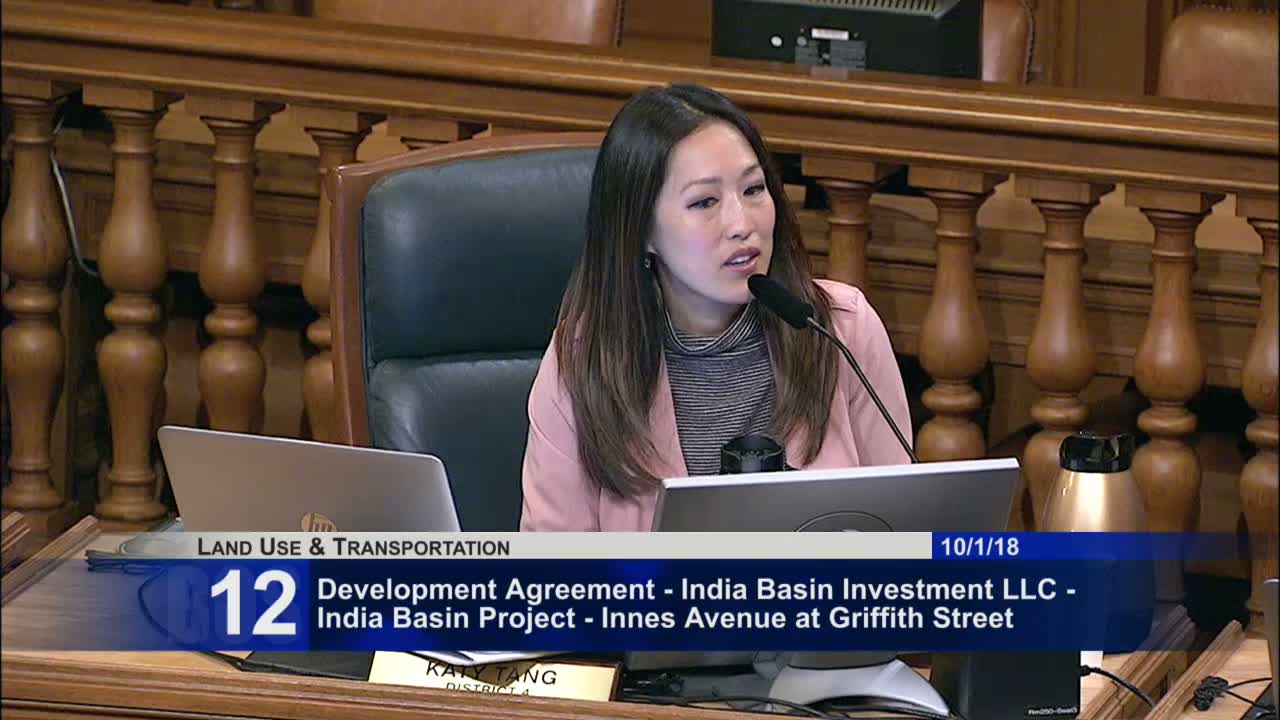
Supervisor London N. Breed (via sponsor remarks from Supervisor Cohen) and project representatives presented Items 10–12 — a package to revise the Bayview Hunters Point area plan, establish an India Basin Special Use District, and approve a development agreement with India Basin Investment LLC. The sponsor said the project would yield roughly 394 below‑market-rate (BMR) units on-site under current terms with a distribution of AMI bands the sponsor presented as 5% at 55% AMI, 15% at 80–120% AMI and 5% at 140% AMI, with an overall 25% BMR contribution (either on-site or via an in-lieu fee).
Supervisors and staff clarified that "55%" and other AMI bands describe eligibility bands while the rent/price pegs determine affordability levels. OEWD clarified that the sponsor proposed no less than 5% at 55% AMI, 15% in the 80–120% band, and up to 5% at 140% AMI; the committee debated whether those rent pegs produce rents that remain affordable (Supervisor Kim repeatedly asked to cap rental price pegs to no higher than 110% AMI for affordability reasons and urged clearer distinctions between rental and ownership price caps).
Public comment was lengthy and divided: construction unions and workforce advocates supported the project for jobs and the prospect of middle-income housing and a grocery store; neighborhood groups, environmental-justice organizations and tenant advocates criticized the project for diluting deep affordability and for potential displacement risks, and asked for stronger anti-displacement protections and clearer, higher-value on-site set‑asides instead of fee-out options. Several speakers urged higher on-site percentages or higher fee multipliers if the developer elects an in-lieu fee, warning that low off-site percentages already proposed could significantly reduce net affordable units.
After discussion the committee accepted Supervisor Cohen's edits to Exhibit H (the maximum-average AMI exhibit) with the understanding that staff and the sponsor would refine the exhibit to distinguish rental vs. ownership pegs and clarify eligibility bands. Because a CEQA appeal remains pending, the committee transmitted Items 10–12 to the full Board as a committee report without recommendation, allowing additional amendment and final action at the Board level.
Key outstanding issues flagged to the full Board included whether rental price pegs for eligibility bands should be capped at 110% AMI (Supervisor Kim's preference), whether the in-lieu fee should require a higher on-site equivalent, and how to ensure project commitments (neighborhood preference, job pipelines, and PDR protections) are enforceable in the final DA.