Get Full Government Meeting Transcripts, Videos, & Alerts Forever!
Get email alerts on the Animal Welfare topic
No spam. Unsubscribe anytime.
Committee adopts amendments and continues proposed ban on fur sales after hours of testimony
Summary
Supervisor Tang introduced an ordinance to ban the sale of animal fur products in San Francisco; after extensive public comment from animal-welfare advocates and small-business owners, the committee adopted amendments (operative date moved to Jan. 1, 2019; nonprofit exemption removed; used fur included) and continued the item to a future committee meeting for further review.
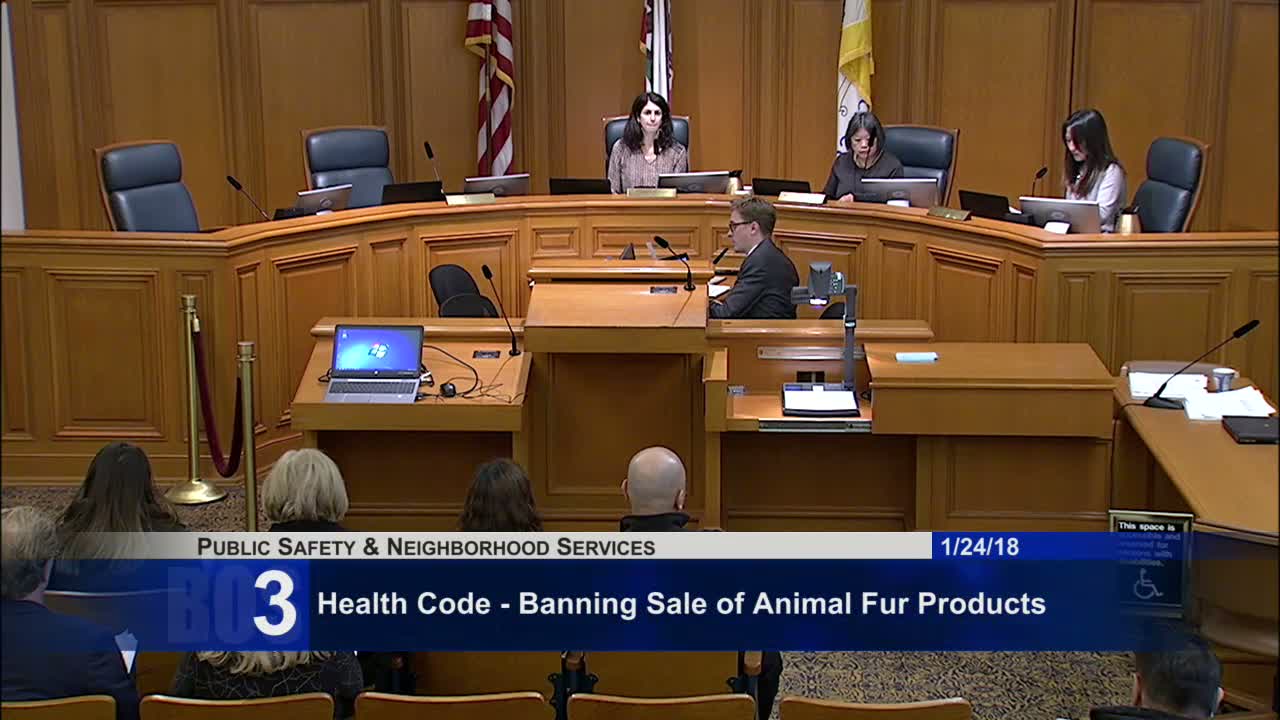
Supervisor Tang introduced an ordinance Jan. 24 to amend the San Francisco Health Code to ban the sale of animal fur products in the city. Tang said the measure would send a strong statement about animal welfare and listed three amendments under consideration: move the operative date to Jan. 1, 2019; remove a nonprofit exemption; and explicitly include manufacturing and sales of used fur products. Tang also clarified that leather products were not included in the proposal.
The committee heard extensive public comment from both sides. Animal-welfare advocates described documented cruelty on fur farms and traps and urged the ban. "I strongly urge everybody to contact their board members ... for this long overdue piece of legislation," Richard Schulke said in support. Representatives from PETA, Direct Action Everywhere and other national and local groups described investigations and graphic welfare allegations; one speaker said industry materials show "roughly 10% of all the foxes raised in fur farms die from cannibalism."
Small-business owners and retailers told the committee a full ban would harm livelihoods. Skip Hawes, owner of West Coast Leather LLC, told the committee that his store had not been adequately notified about the legislation and that a ban could cut roughly 10 percent of his firm's sales, putting jobs at risk. Deborah Paz of West Coast Leather argued that wearing fur is a protected form of expression for consumers and that small retailers and staff would be harmed by a ban.
After public comment, Supervisor Feuer moved to adopt the sponsor’s amendments and continue the ordinance as amended to the next committee meeting; the motion passed without objection. The committee did not take a final vote on the ordinance and continued the item to allow further work on the amendments and related findings.
Next steps: the ordinance was amended and continued; the sponsor and city attorney’s office will process the amendments and the item will return to committee for further consideration.